TLDR;
The United States has outlined its national security strategy, emphasizing American interests and outlining steps to address challenges. The strategy prioritizes economic and military strength, along with geopolitical dominance. It focuses on countering China's influence in the Indo-Pacific region, strengthening alliances, and maintaining stability in the Western Hemisphere and Europe. The document also addresses the Middle East, technology leadership, and global peace initiatives, while highlighting the importance of relationships with countries like India.
- Focus on American interests and challenges.
- Countering China's influence in the Indo-Pacific region.
- Strengthening alliances and maintaining stability.
Introduction [0:00]
The United States has released its National Security Strategy (NSS), emphasizing an "America First" approach. This document outlines the nation's goals, interests, and strategies for addressing various challenges. Washington aims to achieve supremacy in economics, military capabilities, and geopolitics. The report examines the potential impact of this strategy on regions including Asia, Europe, and the Middle East, as well as the evolving dynamics of alliances in the Indo-Pacific region.
Critique of Previous Administration [0:55]
The 33-page national security strategy begins by criticizing the preceding four years under President Joe Biden, characterizing them as a period of failure. It asserts that in the nine months since the current administration took office, efforts have been made to rescue the country from severe damage. The document claims a restoration of American strength both domestically and internationally, following a period of perceived weakness.
Regional Priorities [1:33]
The national security strategy emphasizes the United States' desire to maintain stability and security in the Western Hemisphere, preventing the rise of immigration, drug cartels, and criminal networks. It also aims to support Europe in regaining its identity, confidence, and self-respect. In the Middle East, the U.S. seeks to prevent any rival power from dominating the region while avoiding long-term military engagements. The U.S. intends to maintain its global leadership in technology, particularly in artificial intelligence, biotechnology, and quantum computing.
Indo-Pacific Strategy [2:22]
The Asia-Pacific region is identified as the most critical area in the national security strategy. The U.S. views the current century's primary economic and geopolitical competition as occurring in the Indo-Pacific. With approximately half of the world's GDP generated in this region, its importance is expected to grow. The main goal is to counter China's increasing influence and strengthen the U.S.'s strategic position.
Countering China [2:56]
Washington believes that past policies toward the Asia-Pacific region were flawed, assuming that integrating China into the international market would benefit the U.S. However, China has used its economic power to expand its geopolitical influence. The U.S. now aims for balanced trade and increased cooperation with Japan, South Korea, and Australia in trade, technology, and defense. The primary objective is to reduce China's dominance in the Indo-Pacific region.
Taiwan and Regional Alliances [3:40]
The U.S. will continue to address the conflict between Taiwan and China by bolstering the military strength of its allies in the region. The strategy emphasizes strengthening relationships with India to counter China and establish U.S. dominance in the Asia-Pacific. India is considered a crucial ally, and closer cooperation is planned to address security challenges in the South China Sea. The U.S. aims to strengthen trade and other ties with India to enhance its contribution to Indo-Pacific security, while also maintaining cooperation through the Quad with Australia and Japan.
Pakistan's Omission [4:43]
Despite recent praise from Pakistani Prime Minister Shahbaz Sharif and efforts to arrange a White House visit for the army chief, Pakistan is largely overlooked in the U.S. security strategy. Unlike the 2017 strategy that labeled Pakistan as a haven for terrorism, this document makes no mention of the country.
Bangladesh's Strategic Importance [5:17]
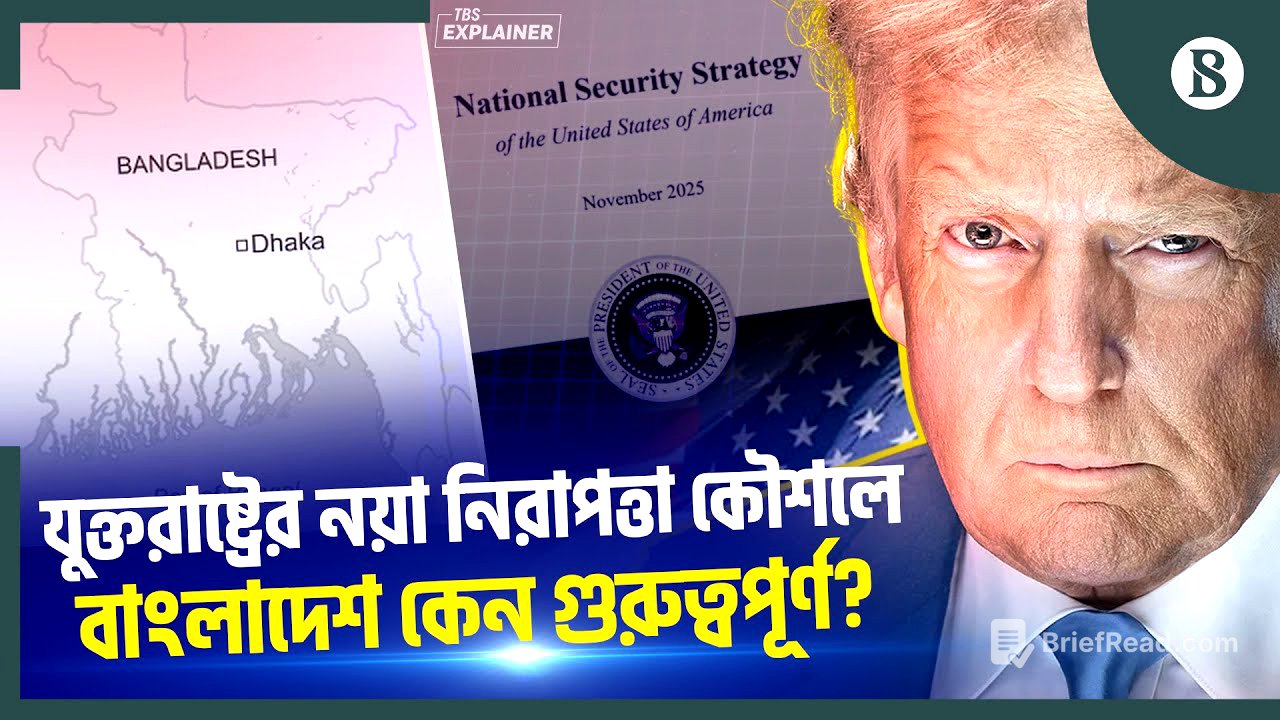
While the document mentions "India" four times and "China" 21 times, "Bangladesh" is not mentioned at all. Despite this omission, Bangladesh is recognized as a significant stakeholder due to its geostrategic location in the Indo-Pacific region. Its position on the Bay of Bengal makes it crucial for both geopolitical and economic reasons. Bangladesh could offer strategic partnership opportunities to the U.S. in countering China's growing influence, suggesting that the U.S. will aim to maintain stable relations with Bangladesh.
International Reactions [6:07]
Russia has welcomed the U.S. national security strategy, with the Kremlin noting fundamental differences between the current and previous U.S. administrations. They find alignment in the adjustments made in the new strategy. However, the European Union has expressed reservations, with officials and analysts criticizing the document's language, particularly its emphasis on sovereignty and perceived similarities to Kremlin rhetoric. Germany's Foreign Minister questioned whether certain aspects, such as opinions on freedom of expression and societal structures, should be included in the U.S. strategic document.
Trump as 'President of Peace' [7:08]
President Donald Trump is portrayed as a "President of Peace" in the U.S. national security strategy. The document claims that following the historic Abraham Accords in his first term, Trump has brokered an unprecedented number of peace agreements in his second term, resolving conflicts in regions such as Cambodia, Thailand, Kosovo, Serbia, Congo, Rwanda, Pakistan, India, Israel, Iran, Egypt, Ethiopia, Armenia, and Azerbaijan, and ending the Gaza conflict.