TLDR;
This lesson teaches how to play Frank Sinatra’s “My Way” on guitar, covering its musical background, chord changes, rhythm, and performance techniques. Key points include the descending bass line, rolling chords, guide fingers for smoother transitions, and following the score’s repeats. The arrangement grows louder in the middle, then slows and softens for a final C major chord.
- “My Way” was released by Frank Sinatra in 1969, adapted from a French song first performed in 1967.
- The tutorial emphasizes the score’s rhythm, chord shapes, and practical fingering choices.
- The performance builds to a fortissimo section before easing into a flexible, quieter ending.
Song Background and Opening Rhythm [3:20]
“My Way” became popular through Frank Sinatra’s 1969 release. It is based on a French song first performed in 1967, with English lyrics later written for the adaptation. The guitar score and tablature are available through Musicnotes.
The opening bass line descends through C, B, B-flat, and A by measure four. The rhythm includes a half note tied to an eighth note, so the player should carefully count the longer sustained notes and the following beats. The tutorial works through the opening measures slowly, then repeats a similar passage a step higher beginning in measure five.
Rolling Chords and Early Chord Changes [4:42]
In measure nine, the instructor often rolls the chord, playing its notes one after another rather than striking them all at once. To do this, place the fingers on the strings first and then play the strings individually. This is a stylistic choice that gives the chord a sound the instructor prefers.
Measure ten uses a bar at the third fret. For a G chord, the instructor chooses a higher position on the neck rather than the more familiar lower-position shape, partly for its sound and because it allows a little vibrato. Some notes may also be held slightly longer than written. In the following measures, keeping the pinky down helps connect the fingering into the C major chord and later passages.
Middle Measures and a Difficult D Minor Shape [5:52]
The tutorial continues through measures 13 to 19, demonstrating the chord shapes and transitions at a slow pace. The instructor keeps certain fingers in place where possible to make the changes smoother. One passage moves into a D minor chord and then to a more difficult shape.
That shape requires a partial bar at the first fret, with the middle finger placed as shown. The fingering can feel challenging, so the passage benefits from slow practice before being played at the song’s full pace.
Fortissimo Section and Guide-Finger Transitions [7:48]
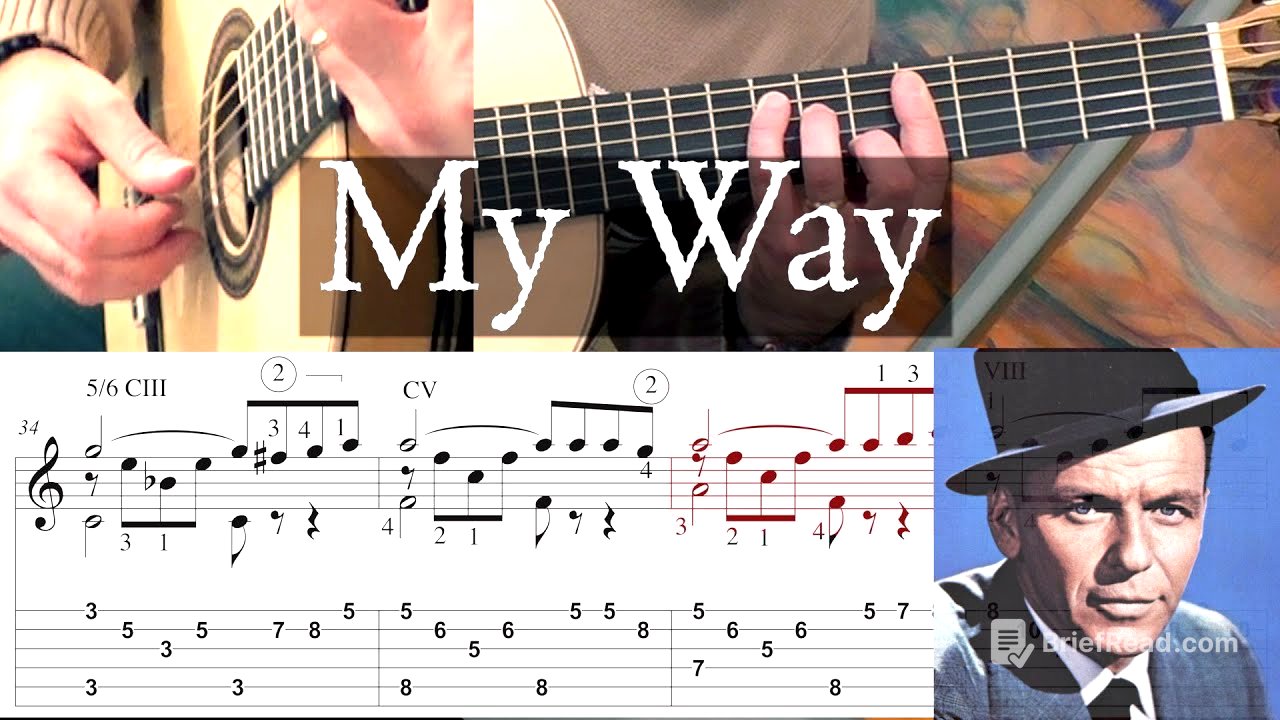
At measure 33, the song gains intensity, marked by two F symbols for fortissimo, meaning very loud. The instructor demonstrates the passage and points out that the third finger is already in place, where it can act as a guide finger—a finger that stays in contact with the strings to help lead the hand to its next position.
The passage moves through F chord shapes and higher positions, then returns to earlier chords. For one C chord, only the notes needed are played rather than forming the full chord; the third and fourth fingers are left off, and the open G string is included.
Repeat, Slowdown, and Final Chord [9:20]
The score’s repeat signs determine how the later passage is played: after the first repeat, return as directed, then skip the first ending on the next pass and play the second ending instead. The second ending includes the C chord before the song moves into its closing section.
To finish, the arrangement slows down and becomes softer. The instructor allows some freedom in the rhythm during this final phrase, then ends on a C major chord.