TLDR;
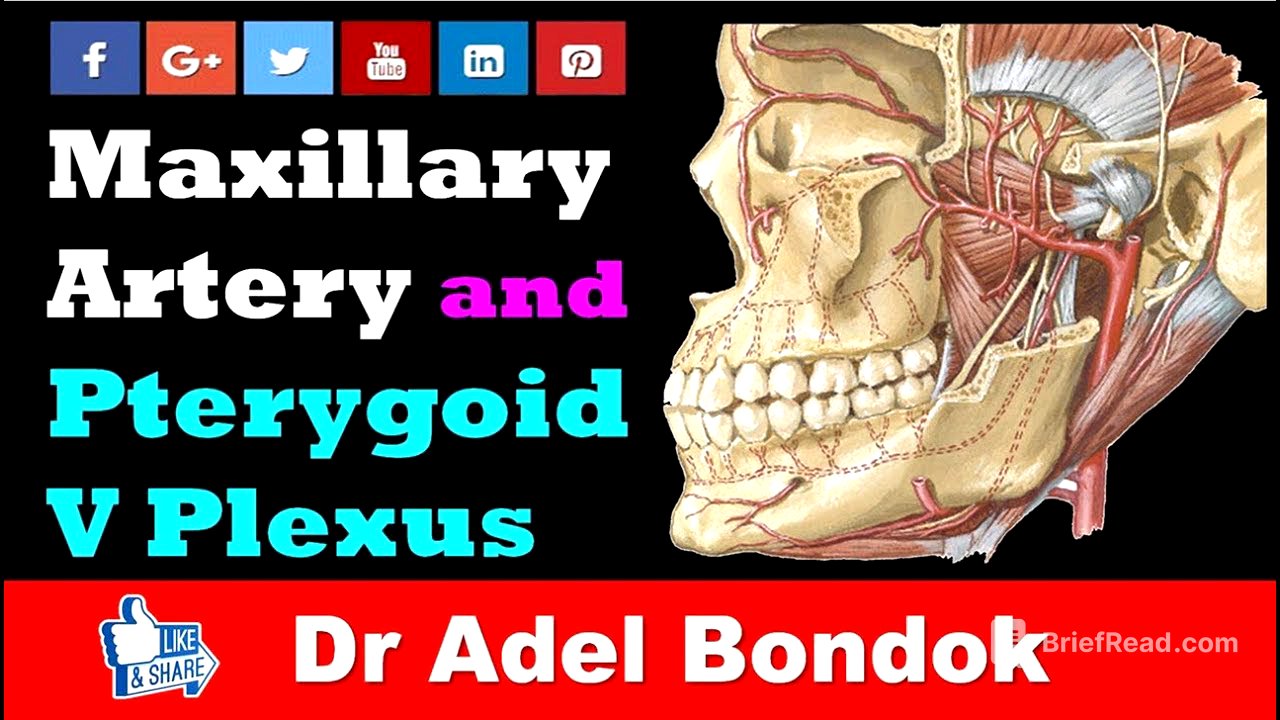
This presentation by Dr. Adel Bondok focuses on the maxillary artery, detailing its origin, course, and branches. Key points include:
- The maxillary artery branches into three parts, each with distinct branches that supply various regions including the teeth, nasal cavity, and palate.
- The video discusses the pterygoid venous plexus, its location, communication pathways, and clinical significance.
Maxillary Artery Overview [0:39]
Dr. Adel Bondok introduces the maxillary artery, originating from the external carotid artery and terminating in the trigopalatine fossa as the sphenopalatine artery. The course of the maxillary artery is divided into three parts by the lateral pterygoid muscle, each with various branches supplying different anatomical structures.
First Part Branches [2:06]
The first part of the maxillary artery gives rise to five branches, which are remembered with the mnemonic "Diana and Demonica are intelligent." These branches include the deep auricular artery (supply to the external auditory meatus), the anterior tympanic artery (supply to the tympanic cavity), the middle meningeal artery (entering the cranial cavity and dividing into anterior and posterior branches), the accessory meningeal artery (supplying dura mater), and the inferior alveolar artery (supplying the lower teeth).
Second Part Branches [4:17]
The second part of the maxillary artery primarily gives muscular branches. Four branches are related to the muscles of mastication: the deep temporal arteries (for temporalis muscle), the masseteric artery (supplying the masseter muscle), pterygoid branches (for lateral and medial pterygoid muscles), and the buccal branch (supplying the buccinator muscle).
Third Part Branches [5:51]
In the third part, six branches are mentioned, including the posterior superior alveolar artery (supplies upper molar and premolar teeth), the inferior orbital artery (entering the orbit and supplying the face), the pharyngeal branch, the artery of the pterygoid canal (also supplying the pharynx), the sphenopalatine artery (main supply to the nasal cavity), and the greater palatine artery (with the lesser palatine artery supplying the soft palate).
Maxillary Artery Distribution [10:18]
The maxillary artery has four main distributions: dental (to upper and lower teeth), nasal (sphenopalatine artery and greater palatine artery), palatine distribution (greater, sphenopalatine, and lesser palatine arteries), and pharyngeal (pharyngeal artery and artery of the pterygoid canal).
Pterygoid Venous Plexus [11:54]
The pterygoid venous plexus is situated around the pterygoid muscles, terminating into the maxillary vein. The maxillary vein joins with the superficial temporal vein to form the retromandibular vein. The plexus has clinical significance as it communicates with the cavernous sinus, anterior facial vein, and the pharyngeal venous plexus, making it a potential pathway for infections to spread from the face.