TLDR;
This lesson explains how to choose French possessive and demonstrative forms by identifying the gender and number of the noun. The key is to check the article or possessive adjective in the sentence, then match the answer to the noun; when punctuation, a question, or a conjunction appears, the possessive form may need to be reversed. The lesson also applies these rules to exam-style questions and highlights irregular plural nouns.
- Identify whether the noun is masculine, feminine, or plural, and whether a plural is masculine or feminine.
- Use the article or possessive adjective as the main clue when selecting a form.
- Watch for questions, commas, and conjunctions, which may require the opposite possessive form.
- For demonstratives, use the noun’s gender and number, including its ending and any irregular forms.
Possessive Forms and the Main Clue [0:04]
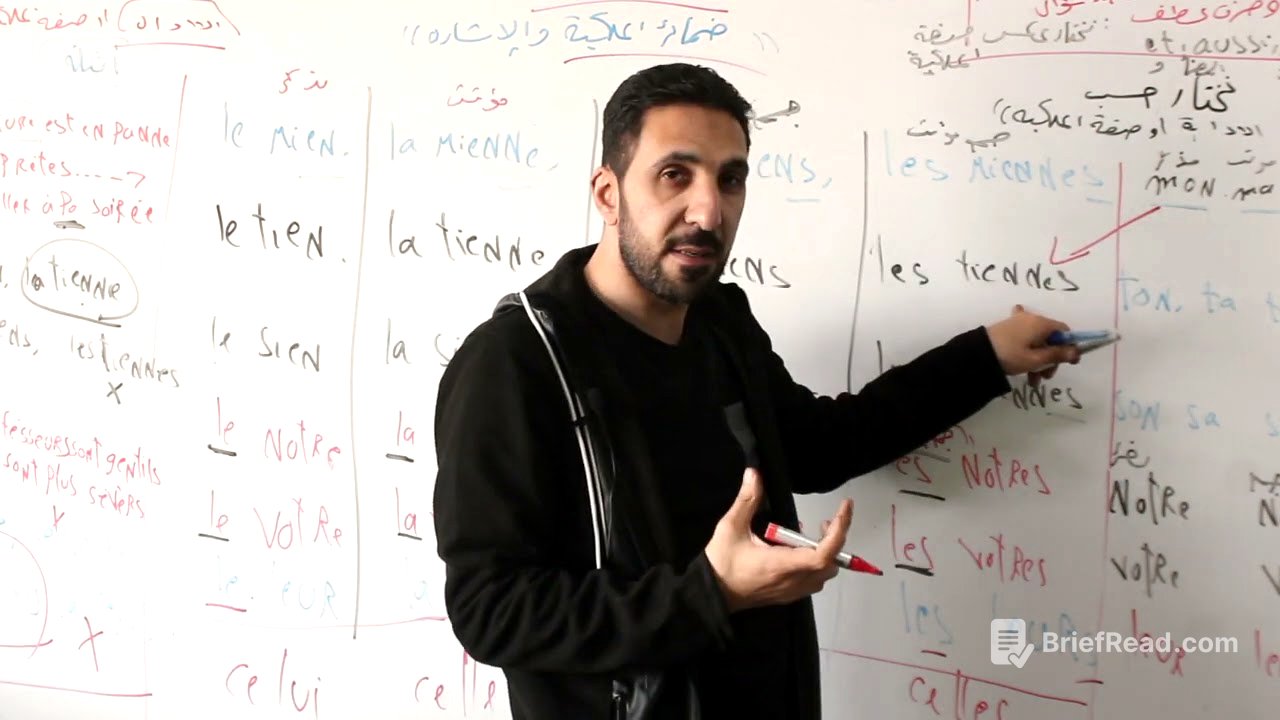
French possessive forms change according to the noun they describe: masculine singular, feminine singular, masculine plural, or feminine plural. The lesson reviews forms such as le mien, la mienne, les miens, and les miennes, and compares them with the possessive adjectives that appear in the sentence, such as mon, ma, mes, ton, ta, tes, son, sa, ses, notre, nos, votre, and vos. These are not chosen according to the owner’s gender; the noun’s gender and number determine the form.
The article or possessive adjective is the key clue for choosing the answer. Locate it wherever it appears in the sentence—before or after the blank—and match the possessive pronoun to the same gender and number. The lesson stresses recognizing noun endings and reviewing the basic rules from the earlier foundational lesson, since the exam options often include several similar forms.
Understanding the Exception After Punctuation or Conjunctions [9:08]
In ordinary sentences, a possessive adjective such as mon or ma points to the corresponding possessive form. However, the teacher gives a special rule for cases involving a question, a comma, or a conjunction: choose the opposite possessive form rather than simply matching the adjective. Conjunctions mentioned include et (“and”), ou (“or”), and mais (“but”).
For example, when mon would normally suggest a masculine form, the special condition may call for its opposite, such as la tienne. The same reversal applies to other pairs, including ma and le tien, and to plural forms such as notre and votre. The sentence’s noun still matters, so students must satisfy both the noun’s gender and number and the reversal rule.
Demonstrative Forms: Matching Gender and Number [12:59]
The lesson then turns to demonstrative forms—forms equivalent to “this,” “that,” “these,” or “those.” The basic method remains the same: identify whether the noun is masculine or feminine and singular or plural, then choose the matching form. Endings help identify noun type, including -e for many feminine nouns and endings such as -s or -x for plural nouns, though students must also remember irregular vocabulary.
Demonstratives include forms such as ce, cet, cette, and ces. The teacher explains that the noun, not a word elsewhere in the sentence, determines the choice. Some exam questions may contain no obvious article, so students must use the noun’s form and meaning; certain irregular nouns, including examples ending in -ier or -eau, are treated as masculine plural in the lesson’s examples.
Applying the Rules to Exam Questions [16:38]
The teacher works through exam-style questions and shows how to eliminate options that do not agree with the noun. Students first identify the relevant article or possessive adjective, then determine the noun’s gender and number, and finally check whether punctuation or a conjunction triggers the possessive reversal rule. A form that matches only the gender but not the number is not correct.
In one example, the noun is feminine plural, so masculine-plural choices are rejected. In another, a possessive adjective provides the clue, but a conjunction means the opposite possessive form must be selected. The same step-by-step method is applied to further questions: identify the clue, classify the noun, apply any exception, and choose the only option that agrees.
Final Review of Exceptions and Combined Clues [19:30]
The final examples combine several clues at once. The teacher reiterates that the article or possessive adjective is the main starting point, but a question or conjunction can require reversing the possessive form. When the sentence contains both a gender or number clue and an exception, students must satisfy both before choosing an answer.
The lesson also emphasizes that plural gender still matters: a feminine plural noun cannot take a masculine plural form merely because both are plural. In the closing example, the noun’s gender, its plural status, and the conjunction rule are considered together to select the correct form. The unit ends with a reminder to review the earlier lesson and use the same method consistently in exercises.