TLDR;
This video explores the life and work of Galileo Galilei, a pivotal figure in the history of science. It covers his early life and education, his groundbreaking astronomical observations and inventions, his advocacy for the heliocentric theory, and his conflicts with the Church. The video also touches on his later life, including his trial, house arrest, and eventual recognition by the Church.
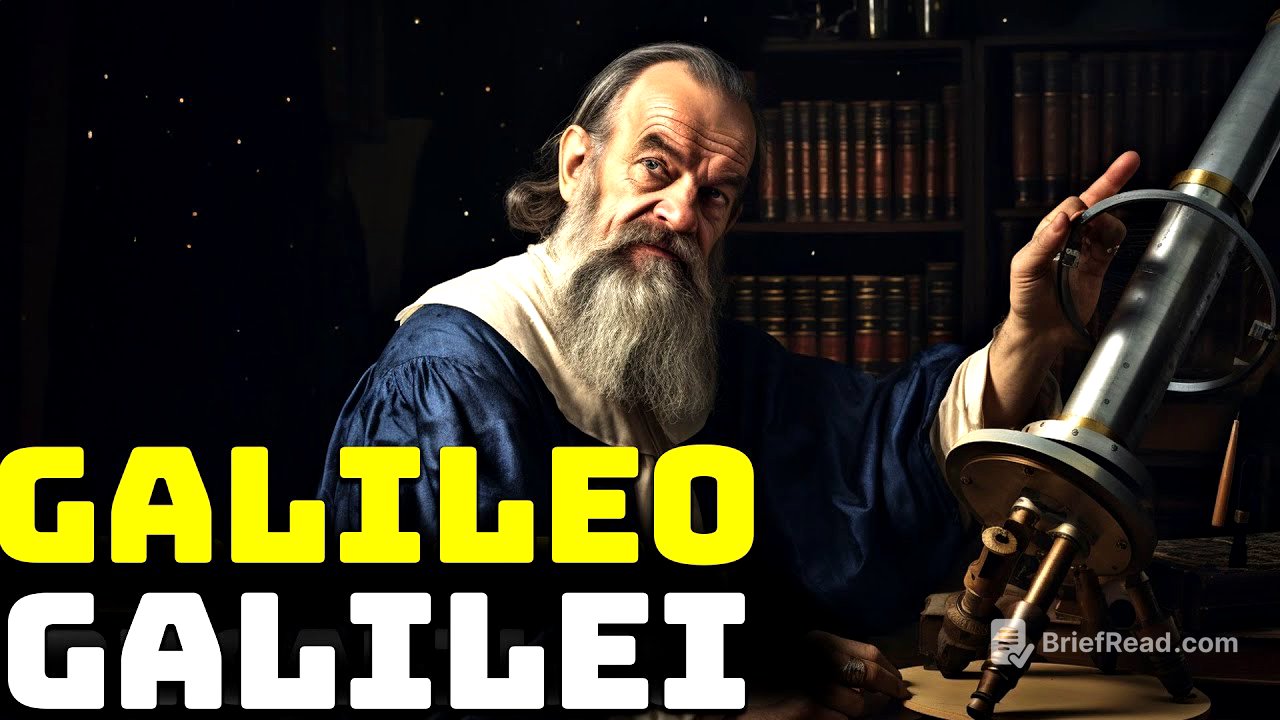
- Galileo Galilei was a physicist, mathematician, and astronomer who made significant contributions to science.
- He invented and improved scientific instruments like the telescope and geometric compass.
- Galileo's support for the heliocentric theory led to conflict with the Church, resulting in a trial and house arrest.
- Despite facing persecution, he continued his work and made lasting contributions to astronomy and physics.
- The Church eventually acknowledged its error in condemning Galileo.
Early Life and Education [0:00]
Galileo Galilei was born in Pisa, Italy, on February 15, 1564, to Vincent bonut galile and Julia. Despite his family's limited financial resources, they ensured he received a good education. Displaying remarkable intelligence from a young age, Galileo explored art and painting, showcasing considerable skill. However, his father, recognizing the challenges of an artistic career, encouraged him to pursue a different path. In 1581, Galileo began studying medicine at the University of Pisa, where he became acquainted with the works of mathematicians like Archimedes and Euclid.
Academic Pursuits and Early Conflicts [1:00]
During his time at the University of Pisa, Galileo started to challenge mainstream views, which angered his professors. He also took private math lessons with otio Richi, further developing his mathematical skills. After four years, Galileo shifted his focus from medicine to mathematics, despite his father's disapproval. To support himself, he began giving private lessons in Florence and gained recognition for his mathematical abilities and broad scientific knowledge. In 1589, Galileo began teaching at the University of Pisa, where he continued to challenge prevailing ideas, questioning traditions and stunning those around him with his insights into science and nature.
Inventions and Discoveries [2:38]
In 1592, Galileo started teaching at the University of Padua, where his ideas were more accepted. He had a relationship with Marina Gamba, with whom he had three children, Virginia and V tinel, though they never married. Hearing about the telescope in 1609, Galileo refined the device, creating a more powerful model. His telescope allowed him to make significant astronomical observations, which he documented in his book "The Celestial Messenger." Galileo discovered previously unseen stars, the satellites of Jupiter, and the irregular surface of the Moon. He also improved the lunet and invented the geometric compass in 1597, which provided him with additional income.
Heliocentric Theory and Conflict with the Church [4:38]
Galileo's research methods differed from the Aristotelian and Theological Legacy of the time. He opposed Aristotle's philosophy in his books, such as "discourses on bodies and water and history and demonstration of sunspots". Galileo supported Nicholas kernus's heliocentric theory, which stated that the sun was the center of the solar system, challenging the geocentric model supported by the church. He developed his tidal Theory, suggesting that tides were proof of the Earth's movement. Galileo's support for the heliocentric theory put him at odds with the Church, which considered it heretical.
Persecution and Trial [6:00]
The Church, holding significant power in Europe, began to be troubled by Galileo's ideas. Throughout his life, he faced constant persecution and had political and religious enemies. In 1616, he was summoned before the Church and Cardinal bellerine, where he was warned to stop defending his ideas, which were deemed heretical. Galileo signed a document pledging to drop some of his ideas as advised by the Church. In 1632, he published "Dialogue Concerning the Two Chief World Systems," again discussing the kernic theory. In 1633, he was summoned to Rome and put on trial for six months.
Condemnation and Later Life [8:05]
On July 23, Galileo's book "Dialogue Concerning the Two Chief World Systems" was banned, and he was sentenced to prison and required to repeat seven Psalms a week for three years. He was then placed under house arrest. The Church opposed Galileo's interpretations of the Bible, which differed from their teachings. In 1634, he was deeply affected by the death of his daughter Virginia. Despite this, he continued his work and completed "The discourses on mathematical demonstrations relating to two new Sciences." Galileo relied on his disciples, venzo viviani and Evangelista toricelli, for assistance in his old age. Due to his frequent use of the telescope, Galileo lost his sight.
Death and Legacy [9:22]
Galileo died on January 8, 1642, in Florence, and his body remains in the Church of Santa croche. Initially, the Church, under Pope Urban VII, opposed building a monument in his honor. However, in 1992, Pope John Paul II recognized the Church's error in condemning Galileo, apologizing for the mistakes and violent acts committed against him. Galileo's visionary thinking and emphasis on observation and experimentation altered the course of science.