TLDR;
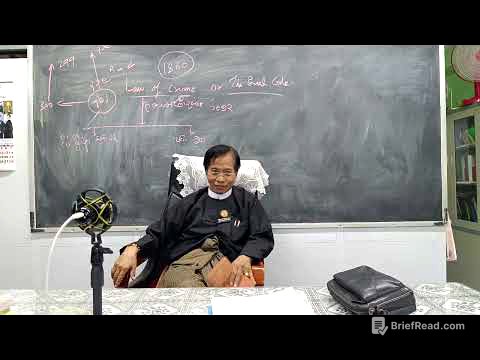
This lecture discusses the constitutional and political history of Pakistan, focusing on the issues that led to the separation of East and West Pakistan. It covers the period from the Objective Resolution to the 1971 war, examining key points of contention such as language, legislative structure, and the distribution of power. The lecture also addresses the rise of military dictatorships, the challenges they faced in legitimizing their rule, and the impact of political movements led by figures like Sheikh Mujibur Rahman and Zulfiqar Ali Bhutto.
- Key issues between East and West Pakistan included language, legislative structure, and power distribution.
- Military dictatorships faced challenges in legitimizing their rule.
- Political movements led by Sheikh Mujibur Rahman and Zulfiqar Ali Bhutto significantly impacted the country.
Introduction [0:05]
The lecture is a continuation of a series on the constitutional and political history of Pakistan, specifically addressing the factors that led to the separation of East and West Pakistan. It builds upon previous discussions about the issues and points of contention that delayed the formation of a constitution and the intentions of figures like Iskander Mirza, who seemed to intentionally delay the process to prevent elected officials from gaining power.
Issues and Constitution Delay [0:37]
The lecture revisits three main points of disagreement that hindered the development of a constitution: the language issue (Urdu vs. Bengali), the structure of the legislature (bicameral vs. unicameral), and the distribution of seats between East and West Pakistan. The debate over seat distribution centered on whether it should be based on population or the principle of parity, which meant equal distribution of seats between East and West Pakistan, regardless of population size. The third issue was the power of the President to dissolve the National Assembly, and under what conditions this could occur.
1956 Constitution [3:51]
The 1956 Constitution declared Urdu as the official language, with Bengali later added. The National Assembly was set to have 300 seats, equally distributed between East and West Pakistan, adhering to the principle of parity. The President had the authority to dissolve the National Assembly, but only with the consent of the Prime Minister.
Political Instability and Martial Law [6:25]
Following the implementation of the 1956 Constitution, elections were delayed. During this period, figures like Ayub Khan and Iskander Mirza sought a leader popular in both East and West Pakistan to maintain harmony. Three individuals served as Prime Minister: Huseyn Shaheed Suhrawardy, who was from East Pakistan, Ibrahim Ismail Chundrigar, and Feroz Khan Noon. However, elections were further delayed, leading Iskander Mirza to impose martial law in October 1958, marking Pakistan's first proper martial law. Ayub Khan was invited to take over the rule.
Legitimacy Challenges for Dictators [8:58]
Ayub Khan faced the challenge of legitimizing his dictatorship. Military dictators often use specific tools and techniques to gain legitimacy. One common approach is to promote grassroots democracy through local government systems. Ayub Khan established a local bodies system, electing 80,000 Basic Democrats (BD) members. These seats were equally distributed between East and West Pakistan, again following the principle of parity.
Referendum and New Constitution [12:06]
To further legitimize his rule, Ayub Khan held a referendum in 1959, asking the public if they wanted him as president. He also introduced a new constitution in 1962, replacing the parliamentary form of government with a presidential one.
1962 Constitution: Key Points [13:51]
The 1962 Constitution addressed the contentious issues between East and West Pakistan. Both Urdu and Bengali were declared official languages. The legislature was unicameral, with 156 total seats, divided equally between East and West Pakistan (78 seats each), maintaining the principle of parity. The constitution also introduced presidential elections.
Presidential Elections [17:39]
The 1962 Constitution established an indirect election system for the President. Instead of direct voting by the public, elected representatives, specifically the 80,000 BD members from the local government system, would cast votes. The elected President would serve a five-year term.
1964 Elections and Fatima Jinnah [19:59]
In 1964, presidential elections were announced. Ayub Khan, seeking to consolidate his position, introduced the Elected Bodies Disqualification Order (EBDO) to disqualify and pressure politicians. The political opposition united to nominate Fatima Jinnah, sister of Muhammad Ali Jinnah, as their candidate against Ayub Khan.
Election Results and Controversy [22:02]
In the 1964 election, Ayub Khan secured 50,000 votes, while Fatima Jinnah received 29,000 votes, leading to Ayub Khan's victory. However, the election was widely disputed due to the presence of 22,000 government officials among the 80,000 BD members, who were likely to vote in favor of Ayub Khan. Many historians did not consider the election free and fair, and protests erupted, particularly in East Pakistan.
1965 War and Tashkent Declaration [24:47]
The 1965 war between India and Pakistan overshadowed the protests against the election results. Ayub Khan used the victory to declare himself Field Marshal. By 1966, the Tashkent Declaration, which established a ceasefire between India and Pakistan, was signed.
Six Points of Mujibur Rahman [26:28]
In 1966, Sheikh Mujibur Rahman presented his Six Points, which became a manifesto for the Awami League. These points included demands for direct elections with adult franchise, provincial autonomy, separate currencies or fiscal policies, and separate forces for East Pakistan. The sixth point, advocating for separate forces, was considered a threat to Pakistan's integrity.
Agitation and Political Movements [32:22]
By 1967, a campaign against Ayub Khan had started. Sheikh Mujibur Rahman promoted his Six Points, while Zulfiqar Ali Bhutto, with the support of students, campaigned against Ayub Khan in West Pakistan, criticizing him for losing the 1965 war at the negotiating table.
Ayub Khan's Resignation and Yahya Khan [34:47]
Facing widespread discontent, Ayub Khan resigned and transferred power to Commander-in-Chief Yahya Khan in 1969. Yahya Khan abrogated the 1962 Constitution and introduced the Legal Framework Order (LFO).
Legal Framework Order (LFO) and 1970 Elections [36:26]
Under the LFO, general elections were to be direct, with a 300-member National Assembly. Seats were distributed based on population, fulfilling a long-standing demand of East Pakistan.
1970 Election Results [37:53]
In the 1970 elections, the Awami League, led by Sheikh Mujibur Rahman, won a decisive victory in East Pakistan, securing 161 seats. In West Pakistan, Zulfiqar Ali Bhutto's Pakistan Peoples Party (PPP) emerged as the largest party with 80 seats.
Post-Election Crisis and 1971 War [40:42]
Sheikh Mujibur Rahman was expected to become Prime Minister, but power was not transferred to him. Some historians claim Zulfiqar Ali Bhutto called for separate governments in East and West Pakistan. India exploited the growing resentment in East Pakistan, supporting the Mukti Bahini and promoting anti-Pakistan sentiments. The Agartala Conspiracy case further fueled tensions.
Separation of East Pakistan [43:56]
A military operation was launched to counter the anti-state movement, but it only intensified the feelings. The 1971 war between India and Pakistan resulted in the separation of East Pakistan, which became Bangladesh. The lecture concludes by highlighting the unresolved issues, including the constitutional structure, language problems, and the failure to satisfy the people of East Pakistan regarding representation based on population.