TLDR;
This video introduces a course on Human Movement Science, outlining its structure, learning outcomes, and the topics covered across eight modules. It emphasizes understanding the human body, the mechanics of movement, and the application of these principles in sports, healthcare, and various professional settings. The course also aims to develop practical skills and provide insights into career opportunities within the field.
- Introduction to Human Movement Science and its integrated fields.
- Understanding the human body systems that govern movement.
- Application of biomechanics and movement principles in sports and healthcare.
- Exploration of career opportunities and research areas in human movement science.
Introduction to Human Movement Science [0:00]
The course is structured into eight modules, beginning with an introduction to Human Movement Science. This module defines the field, its key subjects like biomechanics, kinesiology, and functional anatomy, and also touches on data sciences. It explores the integrated fields within Human Movement Science, its significance, and applications in areas like sports and healthcare. The module also focuses on professional skill set development, discussing the skills acquired from the course and potential career paths, while also addressing the background knowledge required, such as basic mathematics, and providing preparatory resources.
The Human Body: Skeletal, Muscular, and Nervous Systems [3:54]
Module two focuses on the human body, specifically the skeletal, muscular, and nervous systems, and how these systems are designed to enable movement. It examines how these systems function together harmoniously to produce movement. The module also introduces motor control, explaining how movement learning happens, where it originates, and how skills are improved, including the coordination of motor areas in the brain.
Functional Anatomy: Understanding Movement [4:59]
Module three covers functional anatomy, emphasizing the theoretical knowledge essential for understanding movement. It begins with defining the anatomical position and reference systems to ensure a common language among professionals. The module then discusses bones, joints, and muscles, explaining how movement occurs anatomically. Posture analysis is also covered, including the importance of good posture and its implications for human movement science.
Biomechanics for Human Movement Science [6:27]
Module four explores biomechanics, an area of study within human movement science, covering its scope, application, and significance. Biomechanics is divided into kinematics and kinetics, with kinematics studying movement principles and kinetics focusing on force, energy, and work to understand movement. This module builds on the theoretical knowledge from the previous modules, integrating biomechanics, kinesiology, and functional anatomy.
Tools and Techniques for Movement Analysis [7:12]
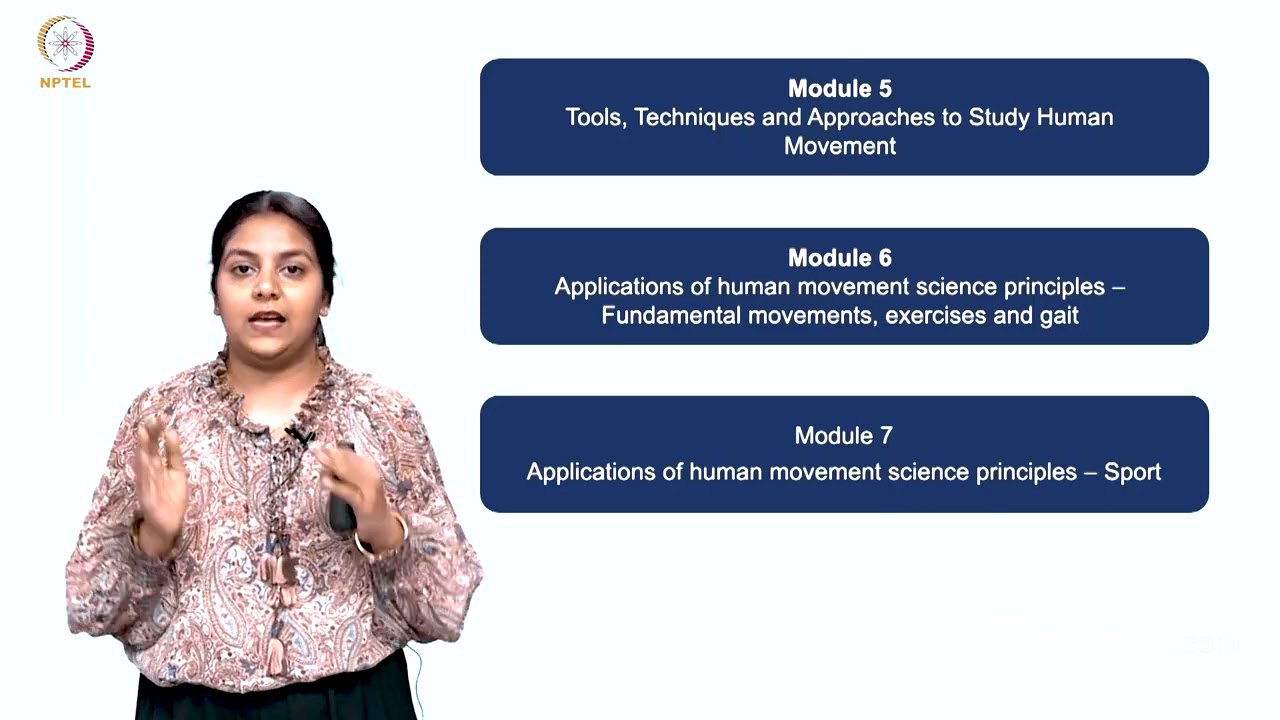
Module five shifts from theoretical knowledge to practical application, focusing on the tools, techniques, and technologies used to analyze movement. It explores different types of analysis, including qualitative and quantitative methods. The module also covers computer simulation, musculoskeletal modeling, and EMG techniques for studying human movement.
Applications of Human Movement Principles [7:26]
Module six focuses on applying the principles learned in previous modules to fundamental movements, exercises, and gait. It emphasizes a coaching perspective, beneficial for coaches, athletes, and sports science professionals. The module covers how coaching science helps understand motor skills, analyze fundamental movements, and identify key performance and injury patterns to enhance performance and prevent injuries.
Human Movement Science in Sports [7:53]
Module seven applies human movement science principles to various sports, categorizing sports based on movement characteristics. It examines upper-body, lower-body, and co-dominant sports to understand the biomechanical patterns related to performance and injury prevention. The module includes case studies on tennis (tennis serve) and cricket (cricket fast bowling), analyzing movement phases, performance, and injury patterns.
Integrated Disciplines and Career Opportunities [11:09]
Module eight discusses integrated disciplines and opportunities in human movement science, emphasizing collaboration to broaden understanding and advance knowledge. It touches on research areas, application, ethics, and the scope of human movement science in specialized populations like polio patients or stroke rehabilitation. The module concludes with career opportunities, providing insights into potential work areas and additional courses for career advancement.