TLDR;
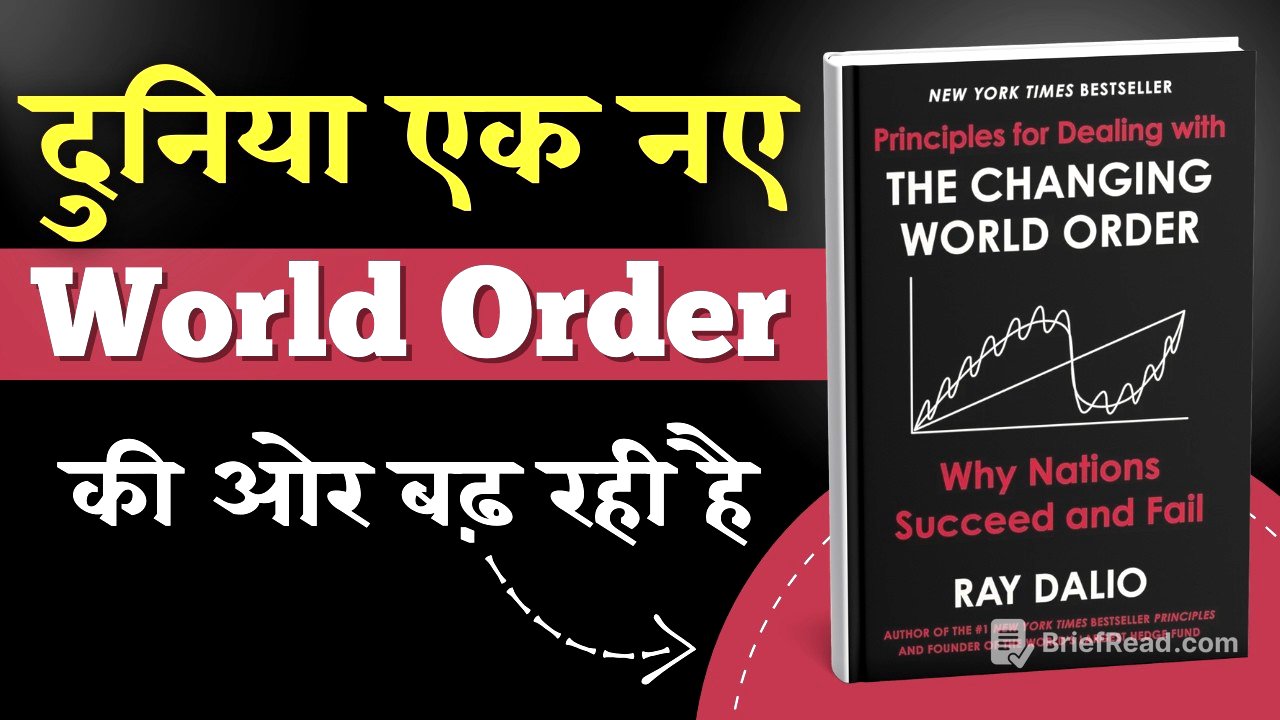
The video summarizes Ray Dalio's "The Changing World Order," explaining the rise and fall of global powers through history, focusing on the Dutch, British, and American empires. It highlights recurring patterns such as debt cycles, internal conflicts, and the challenge of maintaining power amid rising competitors like China. The video concludes by pondering whether we are on the cusp of a new world order, emphasizing the importance of learning from history to navigate the shifting global landscape peacefully.
- World order is always in flux, with power shifting between nations over time.
- The rise and fall of empires follow predictable patterns, including economic strength, debt accumulation, and internal conflicts.
- The competition between the U.S. and China mirrors historical power transitions and will significantly shape the future world order.
Introduction [0:00]
The video introduces the concept that the world order is constantly changing, referencing the dominance of the Dutch in the 1600s, the British in the 1800s, and the United States after 1945. It points out that events like the Bretton Woods Agreement in 1944, the decoupling of the dollar from gold in 1971, and the 2008 financial crisis are not isolated incidents but signs of a shifting global landscape. The video aims to provide historical context to understand how past patterns are shaping current events, particularly the growing competition between the U.S. and China, global debt, and political polarization.
Chapter 1: The Basic Principle of World Order - The “Big Cycle” [1:13]
The video explains that the rise and fall of global powers are not sudden events but part of a long "Big Cycle." Looking at the past 500 years since 1500, it's evident that global leadership has shifted from one country to another over time, accompanied by wars, economic crises, technological revolutions, and social upheavals. This cycle typically begins when a nation becomes strong internally, emphasizing education, hard work, discipline, law and order, and savings and investment. This foundation leads to rapid growth, increased trade, a strong military, and a reliable currency. However, as a nation prospers, wealth inequality tends to increase, and internal and external competition intensifies, leading to a critical turning point marked by events like World War I and the Great Depression. A new power emerges from the ashes, repeating the cycle.
Chapter 2: The Rise and Fall of the Dutch Empire [6:57]
The video discusses the Dutch Republic's transformation into a global economic power in the 1600s, driven by strategic thinking, maritime skills, trade acumen, and strong institutions. The Dutch East India Company (VOC), established in 1602, is highlighted as the world's first multinational corporation with the authority to wage war, negotiate treaties, and establish colonies. Amsterdam became a financial hub, marked by the establishment of the Amsterdam Stock Exchange in 1609. The Dutch Republic emphasized law, order, and trade transparency, attracting foreign traders and investors. Its naval power facilitated global trade, but competition with England led to Anglo-Dutch wars, straining the Dutch economy. By 1672, the Dutch Republic faced a "year of disaster" with simultaneous attacks from France, England, and parts of Germany, signaling the decline of its golden age due to continuous wars, mounting debt, and internal divisions.
Chapter 3: The British Empire and the Industrial Revolution [12:21]
The video explores how Britain rose to global leadership, particularly after 1760 with the advent of the Industrial Revolution, which transformed production through innovations like the steam engine and machinery. This revolution shifted society from agriculture to industry, driving urbanization and creating a need for financial stability, which was provided by the Bank of England. Technological advancements combined with financial resources fueled rapid growth. By the end of the 18th century, the British Navy became the most powerful in the world, securing trade routes and controlling colonies. The defeat of Napoleon in 1815 further solidified Britain's position in Europe, leading to the era where "the sun never sets on the British Empire." However, the Industrial Revolution also increased social inequality, leading to labor movements and political demands. As new industrial powers like Germany and the U.S. emerged, Britain's technological advantage diminished, and the costs of war strained its finances.
Chapter 4: The Rise of the American Century [17:43]
The video details the ascent of the United States as a global power, particularly after World War II, when it emerged relatively unscathed compared to war-torn Europe. The U.S. had a booming industrial sector and technological advancements. By 1945, it was a leading economic and military force, with roots tracing back to the 19th century when it made significant strides in steel, automobiles, and electricity. The assembly line introduced by Henry Ford in 1913 revolutionized industrial efficiency. Despite the setback of the Great Depression in 1939, President Franklin D. Roosevelt's New Deal policies helped restore economic stability. During World War II, the U.S. played a crucial role as the "Arsenal of Democracy," and its military strength was demonstrated by the atomic bombings of Hiroshima and Nagasaki in 1945. The Bretton Woods Agreement in 1944, which pegged the dollar to gold and established the IMF and World Bank, solidified American financial leadership.
Chapter 5: The Cycle of Debt and Financial Crises [23:43]
The video explains the recurring pattern of debt and financial crises throughout history. It begins with a period of prosperity fueled by easy credit, leading to increased borrowing for homes, land, businesses, and stocks. This boom eventually creates a bubble that bursts, causing systemic shocks. The video references the U.S. in the 1920s, where excessive borrowing for stock purchases led to the stock market crash of 1929 and the subsequent Great Depression. The Great Depression highlighted the dangers of unpayable debt, leading to bank failures and economic instability. Post-World War II, the Bretton Woods system aimed to maintain global financial stability, but rising government spending, particularly during the Vietnam War, led to Nixon's decision to decouple the dollar from gold in 1971. The video also mentions the 1982 Latin American debt crisis, the 1997 Asian financial crisis, and the 2008 global financial crisis as examples of this cycle.
Chapter 6: Internal Conflict and Social Inequality [29:32]
The video discusses how internal conflicts and social inequality can undermine a superpower. It explains that these issues, such as income disparities and political divisions, can erode the foundations of a nation if left unaddressed. Social inequality includes disparities in opportunities, education, healthcare, employment, and political representation. The video references 19th-century industrial Britain, where factory owners prospered while laborers faced harsh conditions, leading to movements like Chartism. It also mentions Germany in the early 20th century, where the Great Depression exacerbated unemployment and poverty, contributing to political extremism and the rise of Adolf Hitler. Internal conflicts are not solely due to economic factors but also cultural and political differences.
Chapter 7: America vs. China - A New Rivalry [34:47]
The video examines the growing rivalry between the United States and China, describing it as one of the most significant stories of the 21st century. China's economic reforms starting in 1978 have led to unprecedented growth, making it a major global player. The competition spans technology, trade, military strength, ideology, and global influence. China's modern economic story began with Deng Xiaoping's reforms in 1978, attracting foreign investment and establishing special economic zones. After the dissolution of the Soviet Union in 1991, the U.S. emerged as the sole superpower, benefiting from the Silicon Valley boom and financial markets. However, American companies shifted production to lower-cost countries, particularly China, strengthening China's industrial base while weakening manufacturing in the U.S. The rivalry extends to technology, with China focusing on high-tech industries through initiatives like "Made in China 2025."
Chapter 8: The Future World Order [40:27]
The video explores the key factors that will shape the future world order. It emphasizes that the global landscape is becoming increasingly multipolar, with emerging economies like China and India playing a larger role in global GDP. The dominance of the U.S. dollar as the global reserve currency is being challenged as countries explore alternative payment systems and local currencies. Technology is becoming a powerful tool, with advancements in AI and space programs determining future leadership. Regional alliances like the European Union, BRICS, and QUAD are gaining importance, indicating a shift away from a single dominant power. Competition for green technologies and resources will also intensify, with countries leading in renewable energy and green innovation gaining economic and political strength.
Conclusion: Are we on the threshold of a new world order? [46:27]
The video concludes by questioning whether we are on the verge of a new world order, given the rising competition between the U.S. and China, record levels of global debt, political polarization, and technological advancements. It draws parallels to historical periods of transition, such as the lead-up to World War I and the aftermath of World War II. The video emphasizes that while history may not repeat itself exactly, patterns do emerge. The existence of global institutions like the UN, IMF, and World Bank, along with agreements like the Paris Accord, suggests that the transition may be characterized by competition and rebalancing rather than outright conflict. The key question is whether this competition will remain balanced and peaceful or escalate into a larger confrontation.