TLDR;
The video analyzes the returns of Singapore's Central Provident Fund (CPF) in comparison to other countries' pension funds, such as South Korea, Canada, Australia, and Malaysia. It highlights the trade-off between higher returns and higher risk, noting that while CPF returns may seem low, they offer stability and are government-backed. The video suggests potential improvements to the CPF system, such as creating an optional investment fund, but also emphasizes the possibility of individuals managing their own CPF investments for higher returns.
- CPF returns are stable and government-backed, ensuring minimal risk.
- Other countries' pension funds offer higher returns but come with greater volatility.
- The Malaysian EPF system provides relatively stable and high returns.
- The video suggests creating an optional CPF investment fund or individuals managing their own CPF investments.
Introduction: South Korean Pension Fund's Impressive Returns [0:00]
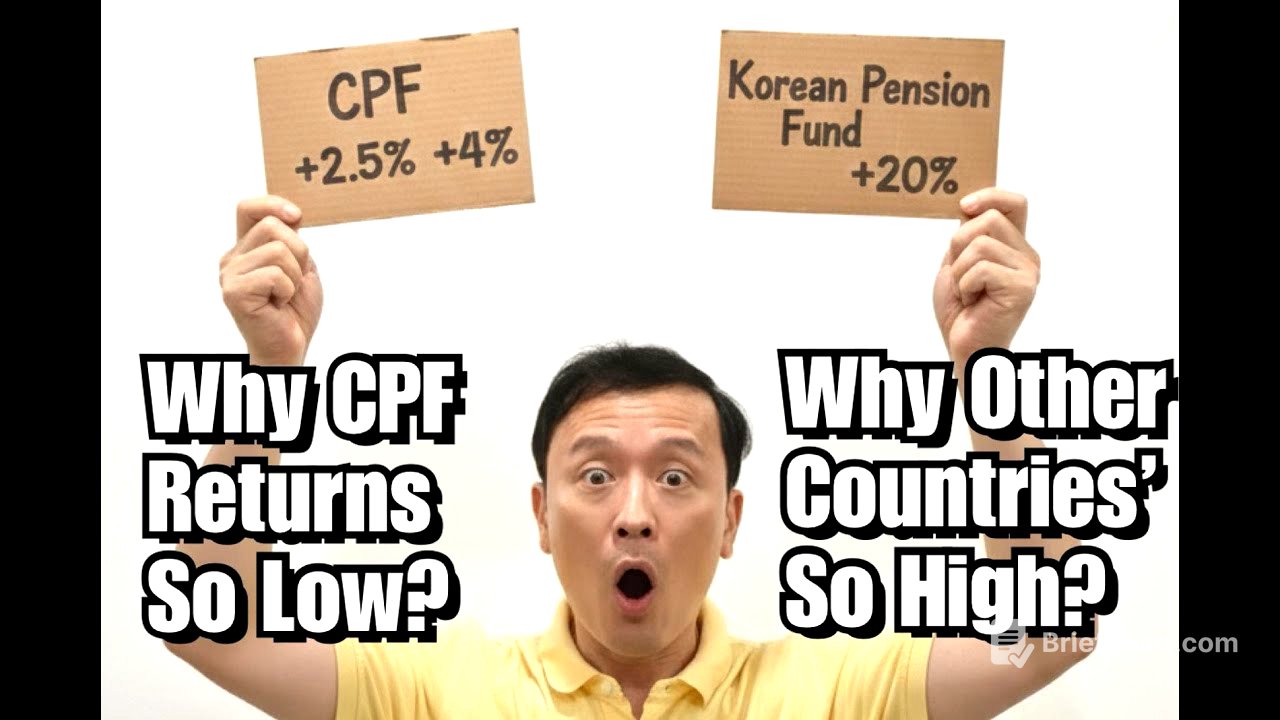
The author discusses an article highlighting the South Korean pension fund's projected 20% return for the year, which sparked a comparison with Singapore's CPF returns of only 2.5% to 4%. This observation leads to a broader investigation into various countries' pension fund performances, including Canada, Australia, and Norway, to understand the reasons behind the disparity in returns. The author expresses surprise at the potential returns of the South Korean pension fund, noting that such returns on CPF could significantly extend one's retirement savings.
Comparative Analysis of Global Pension Fund Returns [2:13]
The author presents a comparative analysis of pension fund returns from various countries over the last 10 years. Canada's funds have returned approximately 9% annually, Australia 8%, Norway 7%, Korea 7-8%, and Malaysia around 6%, while Singapore's CPF has yielded a lower 2.5-4%. Despite the seemingly poor performance of the CPF, the author cautions against drawing immediate conclusions, emphasizing the need to examine the underlying systems and year-by-year returns to understand the reasons behind these differences.
Yearly Data Breakdowns and Volatility [3:39]
The author examines the year-by-year returns of pension systems in the US (California), Canada, Australia, Norway, Japan, and Malaysia, highlighting the volatility in these systems. For instance, the California Public Employees Retirement System (CalPERS) shows fluctuating returns, including a negative return of -6% during the 2022 inflation crash and a high of 21% in 2021. Similarly, the Norwegian system experienced significant volatility, with returns ranging from -14% to 20% in different years. The Japanese system also demonstrates high volatility, with returns fluctuating from -20% to 23%.
The Malaysian EPF System [6:34]
The author praises the Malaysian Employees Provident Fund (EPF) system, noting its consistent returns of over 5% even during financial crises and political changes. Despite potential trust issues among Malaysians regarding their government system, the EPF has shown remarkable stability and high returns compared to other countries, including Singapore. Historical data from 1995 onwards reveals consistently high returns, even during economic downturns like the 2001 dot-com bubble burst, where it still returned 5%.
Understanding the Singapore CPF System [9:22]
The author explains that the Singapore CPF system differs significantly from other countries' pension funds because it is designed to provide stable, government-backed returns with minimal volatility. Unlike investment-linked returns that can fluctuate with market conditions, the CPF offers a guaranteed 2.5% to 4% return, enshrined in the constitution, ensuring retirees have a predictable and secure income stream. This stability is maintained regardless of market crashes or economic crises, providing social stability and financial security for Singaporeans.
Trade-offs and Design Outcomes [12:03]
The author emphasizes the fundamental trade-off between higher returns and higher risk in financial systems. Many countries opt for higher returns at the expense of greater risk, while Singapore has chosen stability and lower risk with its CPF system. This decision is a deliberate design outcome, ensuring the government can protect its population from market volatility and provide a reliable retirement safety net. While there is room to argue for slightly higher returns, the current system prioritizes stability and predictability.
Potential Improvements to the CPF System [14:23]
The author suggests potential improvements to the CPF system, such as creating an optional CPF-run investment fund that allows individuals to participate in market-linked returns. This new account, separate from the existing OA, SA, MA, and RA, could offer government-underwritten features that the private sector cannot provide. Alternatively, individuals can invest their OA funds themselves, as demonstrated by the author's own CPF investments in the S&P 500, which have yielded significant returns.
Conclusion: CPF's Role and Individual Investment [16:46]
In closing, the author concludes that the CPF has effectively fulfilled its role as a retirement safety net, providing stable and secure returns. While the CPF could potentially create an investment fund for those seeking higher returns, individuals also have the option to manage their own CPF investments. Ultimately, the decision to prioritize risk or stability lies with the individual, as the current system allows for both approaches.