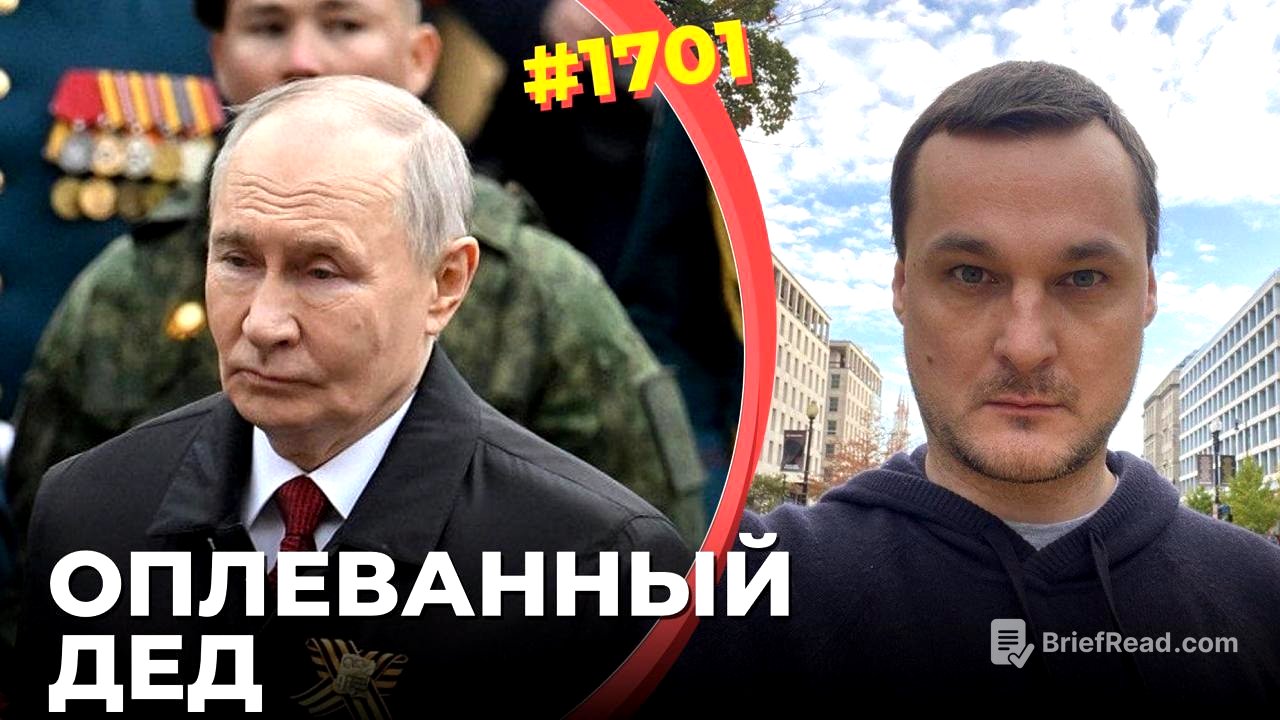
TLDR;
This YouTube video features Ivan Yakovina discussing the current state of Russian politics and military actions, particularly in the context of the war in Ukraine. He analyzes the symbolic importance of the May 9th parade, the impact of Ukrainian President Zelensky's actions, and the potential future of Putin's regime. Yakovina suggests that Putin's grip on power is weakening, and internal pressures, combined with military failures, could lead to significant changes within the next year.
- The May 9th parade was a sign of Putin's weakening power.
- Zelensky's actions are effectively trolling Putin and his regime.
- Putin's regime is likely to face internal challenges and potential ousting within the next year due to military failures and elite dissatisfaction.
Putin's Weakened Position and Zelensky's Trolling [0:02]
The Victory Day parade had a diminished and almost comical format, attended by unusual guests from Central Asia and Africa, along with North Koreans displaying peculiar weaponry. This spectacle contrasted sharply with the traditional image of a grand celebration. Zelensky's decree was a form of mockery towards Putin and his PR team, causing visible discomfort among Russian officials like Peskov. Ignoring Zelensky's actions would have been a better strategy, as Peskov's response only amplified the ridicule.
The Future of the May 9th Parade and Shifting Perceptions of History [4:29]
The May 9th parade may be the last of its kind with Putin present, especially with increasing threats and Ukraine's growing military capabilities. The significance of May 9th is changing as the generation that experienced World War II passes away, and Russia's current actions in Ukraine tarnish the historical importance of the victory over fascism. Putin's association of the Soviet Union's victory with his current war is damaging the symbol of that victory.
Putin's Fascist Tendencies and Grotesque Displays of Power [6:23]
Putin seems to be unconsciously drawn to figures like Adolf Hitler, reflecting a similar ideology and the current Russian regime is more akin to fascism than nazism. The displays of power, such as the orchestrated performances during the "Day of Victory" celebrations and marches of widows, are becoming increasingly absurd. These displays are reminiscent of the decline of other totalitarian regimes, such as Hitler's final parades.
Potential Collapse of Putin's Regime [9:50]
Despite not facing an immediate invasion like Hitler, Putin's regime is under threat due to potential defeat in Ukraine, which Z military correspondents are already talking about. Russia's budget deficit and military struggles, such as the vulnerability of the land route from Crimea to Mariupol, indicate a depletion of resources. A stalemate on the front lines could trigger internal processes leading to a change in regime, as the Russian elite seek to return to a normal life and avoid a fate similar to that of Hitler's generals.
The Nature of Russia's Defeat and Internal Threats to Putin [13:46]
Putin's end may come not through a traditional 20th-century defeat, but through a targeted drone strike orchestrated by someone within his inner circle. The Russian elite, unlike their Nazi counterparts, are more interested in self-preservation and may turn against Putin. Zelensky's recent actions represent an unprecedented level of trolling towards Russia, highlighting Putin's weakened state and inability to respond effectively.
Repression and Potential for Rebellion [16:51]
While the regime continues to use repression, widespread killings of the elite could provoke a revolt. Military figures, who face constant threats, are the most likely to initiate action against Putin. A significant military failure could lead to a repeat of the Prigozhin situation, with widespread discontent among Russian soldiers potentially leading to a march on Moscow.
Putin's Inability to Respond and His Self-Destructive Path [19:36]
Putin's inability to respond to Ukrainian actions, such as the attacks on aviation coordination centers, demonstrates his weakness to his inner circle. His main opponent is himself, as his refusal to end the war, driven by a criminal mindset, is his biggest threat. Putin's fear of striking the center of Kyiv is influenced by concerns about Ukrainian retaliation, the ineffectiveness of targeting empty buildings, and potential backlash from figures like Trump.
The Unlikely End to the War and the State of the Russian Army [23:14]
Despite attempts at negotiation, Putin is unlikely to end the war while he is alive and in power, as it goes against his core beliefs. The Russian army has transformed into a large gang formation, focusing on small-scale incursions rather than large military operations. The army is characterized by tired, injured soldiers and outdated equipment, resembling something out of "Mad Max." Drones are the only area where the Russians have a technological advantage.
Stalled Negotiations and Future Prospects [26:41]
Negotiations between Russia and Ukraine have stalled, with Russia demanding the withdrawal of Ukrainian troops from Donbass, particularly from Slavyansk and Kramatorsk, which Ukraine refuses. Russia may attempt to seize these cities by force, but it will be a difficult and costly endeavor. Any hope that Trump will persuade Zelensky to withdraw troops is futile.