TLDR;
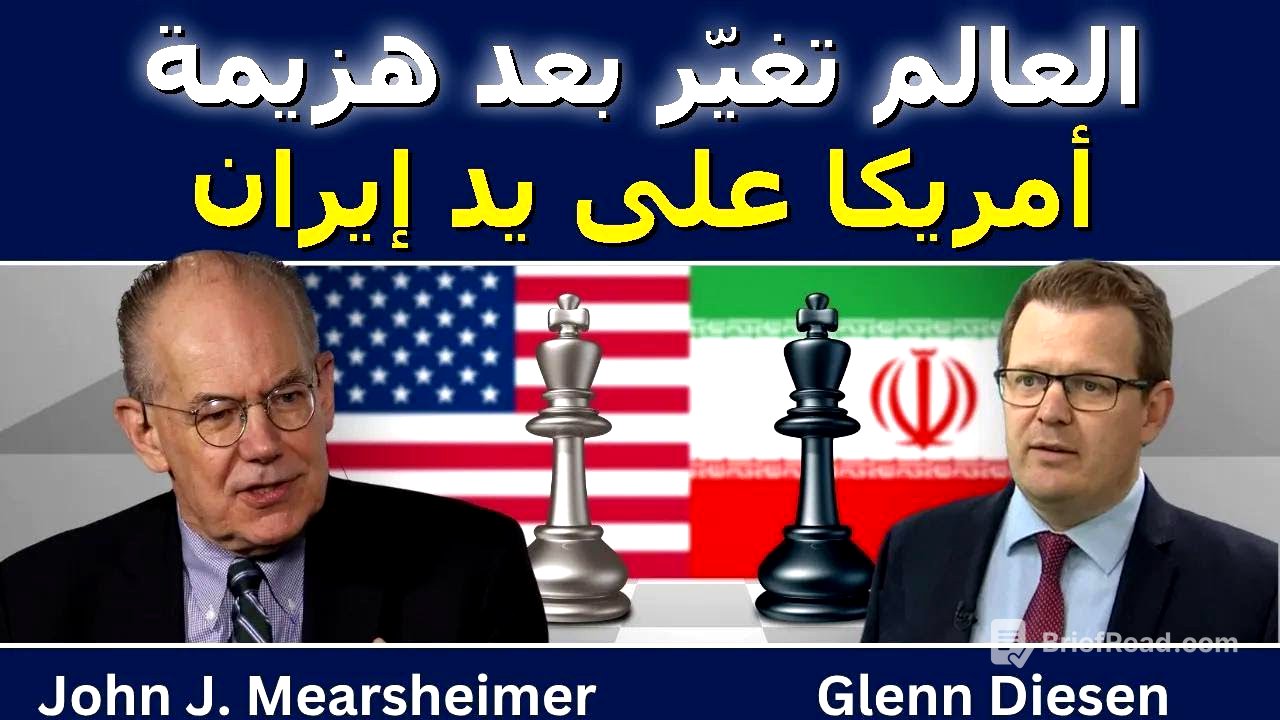
This video features a discussion with Professor John Mearsheimer, focusing on the recent conflict involving Iran and the United States, with an emphasis on the role of President Trump, potential outcomes, and broader geopolitical implications. The conversation covers Trump's contradictory statements, the economic factors driving the conflict, and the potential for a shift in global power dynamics.
- Trump's conflicting messages indicate a desire to end the conflict to avoid a global economic crisis.
- The failure to achieve initial objectives against Iran has significant implications for US foreign policy and its relationship with allies.
- The potential for internal instability in Israel and the risk of nuclear escalation are discussed.
- The conversation also touches on the rationality of state actions, using the examples of Russia's invasion of Ukraine and NATO expansion.
Intro [0:04]
The host introduces Professor John Mearsheimer to discuss the current geopolitical situation, particularly focusing on President Trump's actions regarding Iran. The conversation aims to clarify the seemingly contradictory messages and understand the underlying dynamics of the conflict.
Trump's Conflicting Messages and the Drive to End the War [0:19]
Professor Mearsheimer explains that President Trump is desperate to end the conflict with Iran, fearing a global economic depression worse than that of the late 1920s. Trump's contradictory statements, such as threatening to destroy Iranian civilization and then proposing negotiations based on Iran's ten-point plan, reflect his desperation to achieve a ceasefire. This plan means that none of the initial demands will be met and negotiations will be based on Iran's demands.
The Absence of a Ceasefire and the Failure of Initial Objectives [6:34]
Mearsheimer asserts that there is no actual ceasefire because Iran has not opened the Strait of Hormuz due to ongoing Israeli attacks on Hezbollah in Lebanon. He emphasizes that negotiations cannot begin without a ceasefire. The initial objectives of the war, including regime change,denuclearization, elimination of ballistic missiles, and cessation of support for proxies, have not been achieved. Iran now controls the Strait of Hormuz, enhancing its influence.
Iran's Enhanced Influence and the Impact on US Military Presence [8:20]
Iran's control over the Strait of Hormuz and its continued possession of ballistic missiles provide it with significant leverage. Mearsheimer notes that most of the 16 US bases in the region have been destroyed or significantly damaged. He questions whether Gulf states will want the US to rebuild these bases and whether the US will want to do so, given Iran's demand for the US to leave the region.
Economic Factors and the Role of China and Russia [14:57]
Mearsheimer suggests that the primary driver behind the push to end the conflict is the potential impact on the global economy. He believes that China and Russia, fearing the long-term consequences of the war on global food and energy supplies, pressured Iran to negotiate. He also notes that Iran has an interest in prolonging the conflict to increase its leverage in negotiations.
The Potential for Renewed Conflict and the Looming Defeat [18:43]
Mearsheimer believes that Trump has already conceded defeat, as evidenced by his acceptance of Iran's ten-point plan. He dismisses the idea of sending ground troops, stating that it would only worsen the situation. He also points out that Israel is undermining efforts to achieve a ceasefire by continuing its attacks on Hezbollah.
The Impact on US-Israeli Relations and the Risk of Nuclear Escalation [33:12]
Mearsheimer argues that the conflict has damaged the relationship between the US and Israel, as it has become clear that Israel pushed the US into the war. He suggests that this could lead to internal turmoil in Israel and increase the risk of Israel using nuclear weapons against Iran, which they perceive as an existential threat.
The Political Fallout for Trump and the Shift in Global Power Dynamics [43:34]
Mearsheimer believes that the conflict will damage Trump's presidency and further erode America's standing in the world. He argues that Trump's unilateral approach and disregard for international institutions had already weakened US foreign policy before the conflict. The failure in Iran will exacerbate these issues, leading to a more multipolar world where the US has less influence.
The Impact on NATO and European Security [55:39]
Mearsheimer predicts that Trump will blame the Europeans for the failure in Iran, further straining transatlantic relations and weakening NATO. He suggests that European countries will need to develop their own defense strategies to deal with Russia, as they can no longer rely on the US.
The Impact on the War in Ukraine [1:00:10]
Mearsheimer believes that the US will not provide Ukraine with the weapons it needs to prevail in the conflict with Russia. He suggests that Trump will blame the Europeans for the likely defeat of Ukraine, while also refusing to provide them with the resources to prevent it.
The Rationality of State Actions and the Case of Iran [1:06:20]
Mearsheimer discusses the concept of rationality in international relations, arguing that states act rationally when they pursue policies based on logical and persuasive theories. He contrasts the rationality of Russia's invasion of Ukraine, which he sees as based on a coherent theory of deterring NATO expansion, with the irrationality of Trump's decision to attack Iran, which lacked a viable theory of victory.
The Difficulty of Ending Wars and the Case of Ukraine [1:23:03]
Mearsheimer notes the difficulty of ending wars once they have begun, due to sunk costs and the tendency to demonize the enemy. He suggests that the economic consequences of the conflict with Iran may create incentives to end it quickly. He also argues that European leaders have come to believe that Russia poses an existential threat, making it difficult for them to change course and seek a negotiated settlement in Ukraine.