TLDR;
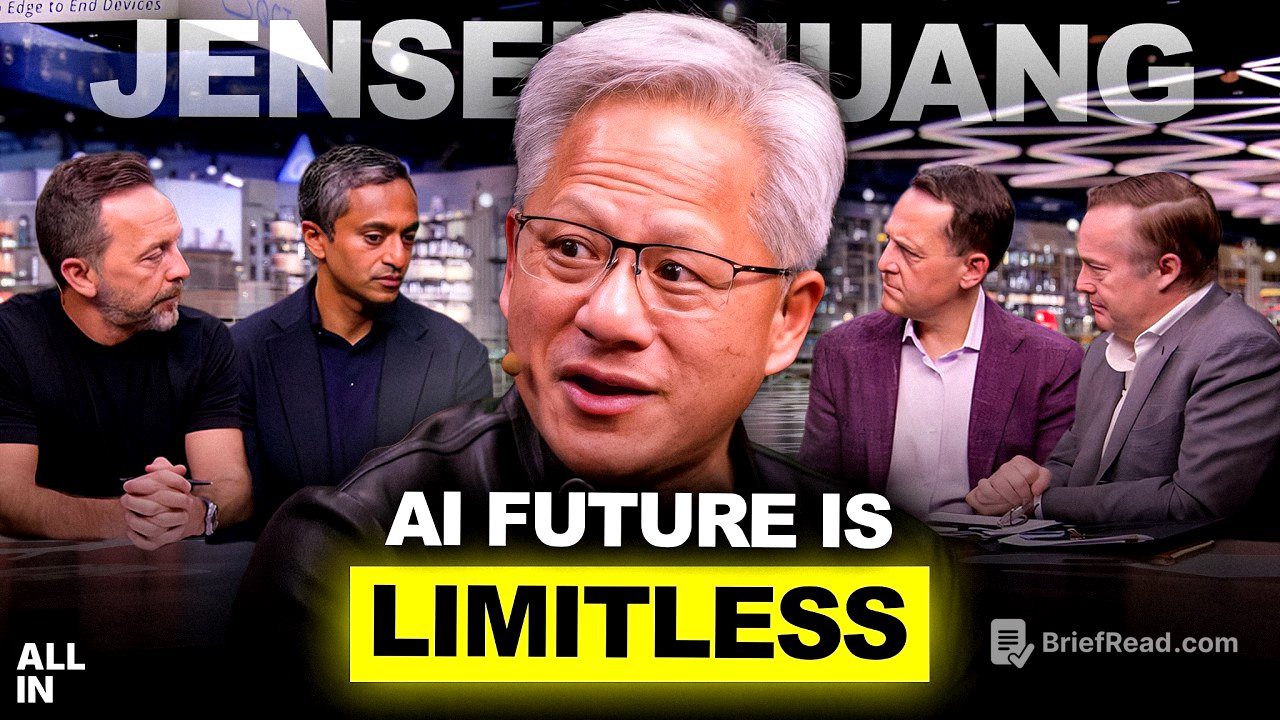
This special episode of the All-In Podcast features an interview with Jensen Huang, CEO of NVIDIA, discussing the company's advancements in AI, its strategic direction, and its vision for the future of technology. Huang addresses topics such as disaggregated inference, the AI factory concept, the role of AI agents, and the impact of AI on various industries, including healthcare and robotics. He also touches on regulatory concerns, global competition, and the importance of fostering innovation while addressing potential risks.
- NVIDIA's transition from a GPU company to an AI factory.
- The concept of disaggregated inference and its implications for computing.
- The role of AI agents in revolutionizing industries and enhancing productivity.
- The importance of balancing innovation with responsible AI development and regulation.
- NVIDIA's commitment to global collaboration and addressing challenges in the AI landscape.
Introduction [0:00]
The All-In Podcast preempts its weekly show for a special episode featuring Jensen Huang, CEO of NVIDIA. The discussion highlights NVIDIA's significant presence and impact across various industries, particularly in the tech and AI sectors.
Airwallex Advertisement [0:00]
Airwallex is introduced as an AI-native platform for global accounts, cards, and payments, designed to facilitate international transactions as if they were local. Unlike other platforms that bolt AI onto existing infrastructure, Airwallex is built from the ground up for the intelligent era.
Groq Acquisition [0:00]
The conversation briefly touches on NVIDIA's acquisition of Groq, with a lighthearted comment about the perceived impact on one of the podcast hosts.
NVIDIA's AI Factory and Disaggregated Inference [0:00]
Jensen Huang introduces Dynamo, NVIDIA's operating system for the AI factory, which utilizes disaggregated inference. Disaggregated inference involves breaking down the complex processing pipeline of inference and running different parts on different GPUs or heterogeneous computing resources. This approach led to the acquisition of Mellanox and the integration of various computing elements like GPUs, CPUs, switches, and networking processors. NVIDIA is evolving into an AI factory company, offering a range of options for high-value inference, with a recommendation to allocate around 25% of data center space to Groq LPU GPU combos.
Agentic Processing and Vera Rubin [0:00]
NVIDIA has transitioned from large language model processing to agentic processing, which involves accessing working memory, long-term memory, and various tools. This requires handling diverse workloads with different types of models, leading to the creation of Vera Rubin, a system designed to run these diverse AI tasks. The addition of Groq processors, along with storage processors (Bluefield), CPUs, and networking processors, expands NVIDIA's total addressable market (TAM) by 33% to 50%. These components work together to power the computer of the AI revolution, focusing on AI agents.
Embedded Applications and Edge Computing [0:00]
There are three main computing systems: one for training AI models, one for evaluating them (Omniverse), and one at the edge for robotics. The robotics computer can range from self-driving cars to small devices like teddy bears. NVIDIA is working on transforming telecommunications base stations into part of the AI infrastructure, extending AI capabilities to edge devices in factories, warehouses, and other locations.
Inference Revolution and Cost Efficiency [0:00]
Jensen Huang emphasizes that inference is growing exponentially, not just scaling. He addresses concerns about the cost of NVIDIA's inference factory, stating that a $50 billion factory can produce the lowest cost tokens due to its extraordinary efficiency. While the initial investment may seem high, the increased throughput and efficiency make it more cost-effective than cheaper alternatives. The key is to focus on the cost of tokens generated rather than the price of the factory itself.
NVIDIA's Strategy and Decision-Making [0:00]
As the CEO of the most valuable company in the world, Jensen Huang explains that his role involves defining the strategy and vision for NVIDIA. The company focuses on projects that are exceptionally challenging and tap into its unique strengths. NVIDIA seeks opportunities that have never been done before and require significant effort and innovation.
Long-Tail Businesses and Future Growth [0:00]
Physical AI is a large category addressing a $50 trillion industry that has been largely untouched by technology. NVIDIA started this journey 10 years ago and is now seeing significant growth, with physical AI becoming a multi-billion dollar business. Digital biology is also nearing a "ChatGPT moment," with the ability to represent and understand genes, proteins, and cells expected within the next few years, potentially revolutionizing the healthcare industry. Agriculture is another sector where NVIDIA sees significant inflection.
Desktop AI and Open Source Agents [0:00]
The discussion shifts to the desktop, highlighting the growing interest in running local models and the impact of open-source agents. Jensen Huang notes three inflection points in the AI space: generative AI (driven by ChatGPT), reasoning (grounded information), and agentic systems (exemplified by ClaudeCode and Open Claude). Open Claude is culturally significant because it demonstrates what an AI agent can do and reinvents computing with its memory system, file system, skills, and resource management capabilities. This creates a personal AI computer that is open source and runs everywhere.
Open Source and Governance [0:00]
Open Claude formulates a computing model with a memory system, file system, skills, and resource management, defining a personal artificial intelligence computer that is open source and runs everywhere. NVIDIA is contributing to securing and governing these agentic systems to protect privacy and security.
AI Regulation and Policy [0:00]
The rapid paradigm shift in AI may render some existing and proposed AI legislation moot. Jensen Huang emphasizes the need to inform policymakers about the true nature of AI, clarifying that it is computer software, not a biological being or alien entity. He cautions against allowing doomerism and extremism to influence policy decisions and stresses the importance of promoting the diffusion of AI in the United States to maintain national security.
Anthropic and Responsible AI Development [0:00]
Jensen Huang praises Anthropic for its technology, focus on security and safety, and desire to warn people about the capabilities of AI. However, he advises caution against extreme and catastrophic predictions that lack evidence, as they can be more damaging than helpful. Technology leaders should be more circumspect, moderate, balanced, and thoughtful in their communications.
AI Revenue Scaling and Market Diversity [0:00]
While Anthropic and OpenAI are significant players, AI is very diverse, with open models being the second most popular category. Jensen Huang believes that the industry is on a curve where revenues will scale with intelligence. The transition from generative AI to reasoning required 100 times more computation, and the move to agentic systems requires another 100 times more. Agentic systems get work done, leading to increased consumption and revenue potential.
Token Consumption and Engineer Efficiency [0:00]
Jensen Huang discusses the importance of token consumption for engineers, stating that a $500,000 engineer should consume at least $250,000 worth of tokens annually. This reflects a paradigm shift where AI is used to enhance productivity and creativity. The goal is to eliminate thoughts of tasks being too hard or taking too long, allowing engineers to focus on innovation.
Auto Research and Enterprise Software [0:00]
Open Claude's timing with breakthroughs in large language models is crucial. The ability of these models to use tools will drive further innovation. Enterprise software is not going to be destroyed but will be used by 100 times more agents, enhancing its value.
Open Source and Proprietary Models [0:00]
Jensen Huang believes that both proprietary and open-source models are essential. Proprietary models offer general intelligence, while open models allow industries to capture and control their domain expertise. Many startups are adopting an open-source-first approach before moving to proprietary models.
Global AI Diffusion and National Security [0:00]
Jensen Huang discusses the importance of global AI diffusion and the need for the United States to lead in AI technology. He expresses concern that current regulations have caused NVIDIA to lose market share in China. He emphasizes that national security is diminished when the U.S. does not have access to critical resources and technologies. The goal is for the American tech stack to be widely used globally, allowing other countries to build their own AI applications.
Global Conflicts and Supply Chain Risks [0:00]
Jensen Huang addresses concerns about conflicts around the world and their impact on NVIDIA. He expresses support for NVIDIA's employees and families in the Middle East and reaffirms the company's commitment to Israel. Regarding Taiwan, he emphasizes the need to re-industrialize the United States, diversify the manufacturing supply chain, and exercise restraint in international relations.
Self-Driving Technology and Autonomous Vehicles [0:00]
NVIDIA believes that everything that moves will eventually be autonomous. The company aims to enable every car company to build self-driving cars by providing the necessary computing systems, operating systems, and reasoning capabilities. NVIDIA is open to various forms of collaboration, whether it's providing individual components or working on the entire self-driving system.
Competition and Market Share [0:00]
NVIDIA is the only AI company that works with every other AI company, building foundation models and offering a full stack of solutions. Despite competition from companies like Google and Amazon, NVIDIA is gaining market share due to its velocity, comprehensive AI infrastructure, and the growth of open models.
Analyst Forecasts and AI's Potential [0:00]
Jensen Huang believes that analysts underestimate the scale and breadth of AI. He argues that AI is much bigger than just the top hyperscalers and that NVIDIA's potential is not limited by traditional market models. The company's focus on solving the AI infrastructure problem positions it for significant growth.
Data Centers in Space [0:00]
NVIDIA is already involved in space, with radiation-hardened CUDA-enabled systems in satellites. The company is exploring the architecture of data centers in space, recognizing the challenges of cooling and radiation. The goal is to perform tasks like imaging and image processing directly in space rather than sending data back to Earth.
Healthcare and AI Applications [0:00]
NVIDIA is involved in several areas of healthcare, including AI physics for drug discovery, AI agents for diagnosis and assistance, and physical AI for robotic surgery. The company envisions AI agents integrated into medical instruments, enhancing interactions between patients, nurses, and doctors.
Robotics and Automation [0:00]
Robotics is poised for significant growth, with robots expected to be prevalent in various aspects of life within three to five years. China's strength in microelectronics, motors, and rare earth elements positions it as a key player in the robotics industry. Robots will unlock economic mobility and enable new opportunities for individuals.
Future of Robotics and Economic Impact [0:00]
Robots will address labor shortages and enable virtual presence, allowing people to operate robots remotely. They will also facilitate space exploration and colonization by providing resources and enabling factories on the moon. The increasing revenue from models and agents will drive further investment in infrastructure, unlocking more capabilities.
Model Companies and Moats [0:00]
Dario Amodei forecasts significant revenue growth for model and agent companies, potentially reaching a trillion dollars by 2030. The moat for these companies lies in deep specialization and connecting agents with customers to create a flywheel effect.
AI's Impact on Jobs and the Future of Work [0:00]
Jensen Huang emphasizes that AI will transform jobs rather than eliminate them entirely. He uses the example of chauffeurs becoming mobility assistants and pilots benefiting from autopilot technology. He advises young people to become experts in using AI, as this will be a valuable skill in the future.
Advice for Young People and Education [0:00]
Jensen Huang advises young people to focus on deep science, math, and language skills. He highlights the importance of language skills, as language is now the programming language of AI. He also shares a story about computer vision and radiology, illustrating how AI can enhance jobs rather than replace them.
Conclusion [0:00]
Jensen Huang concludes with a positive outlook on the future of AI, emphasizing the importance of humility and responsible development. He encourages everyone to embrace the positive potential of AI and work towards a future where technology benefits all of humanity.