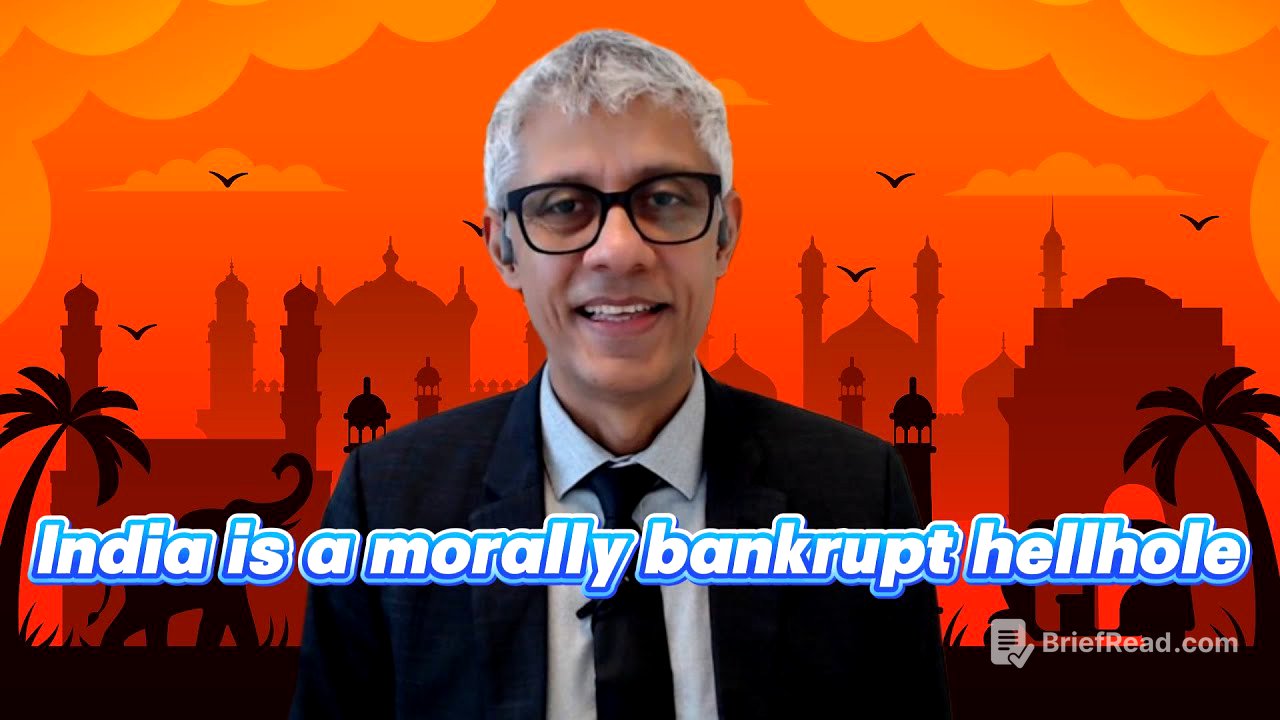
TLDR;
The speaker discusses the pervasive issues within Indian society, including corruption, lack of accountability, and a culture of submissiveness and exploitation. He argues that concepts like fairness, justice, and trust are alien to the Indian mindset, leading to a dystopian environment where personal gain and power dynamics dominate. He also touches upon the failure of institutions, the prevalence of lying and cheating, and the impact of these cultural norms on Indian immigrants in the West.
- Corruption and lack of accountability are rampant.
- Concepts of fairness, justice, and trust are largely absent.
- Submissiveness and exploitation are deeply ingrained in the culture.
- Institutions are corrupted and ineffective.
- These cultural norms have implications for Indian immigrants in the West.
Intro [0:00]
The speaker introduces the topic by stating his intention to explain how Indian culture has become cancerous, warping and provoking everything that the West has provided it, which has significant implications for the West because immigrants keep pouring in. He aims to outline the structure, or lack thereof, that renders life in India a constant drudgery filled with moment-to-moment exploitation and abuses.
Personal Experience with Corruption and Apathy [0:03]
The speaker recounts an incident from his time at a university in India where a young boy was sodomized and raped by janitors. Despite reporting the crime to the police and university officials, no action was taken. The authorities and fellow students even threatened him with grave consequences if he pursued the matter further. This experience highlights the deep-seated corruption and apathy within the Indian system, where material reward is often the only motivator for action.
Cultural Values and the Absence of Fairness [1:42]
The speaker explains that doing one's job is often seen as effeminate in Indian culture, and shirking responsibilities is considered a sign of maturity. There is a lack of pride or honor in doing what is right. He argues that concepts like fairness, justice, trust, empathy, and impartiality are alien to the Indian mind, and people cannot differentiate between right and wrong. Even when there is no personal cost involved in delivering fairness or justice, Indians often prefer not to do it, as doing the right thing is seen as a sign of weakness.
Submissiveness and the Pecking Order [4:24]
The speaker discusses how Indians are indoctrinated to be submissive, addressing those in authority as "sir," even after living in Western countries for years. However, this show of submissiveness should not be mistaken for respect, as respect is another concept alien to Indians. Calling someone "sir" reflects their view of that person as stronger in the interaction, consistent with the mindset of "might is right." In the Indian system, individuals are either higher or lower in the pecking order, and achieving equality is impossible. Saying "please" and "thank you" are seen as signs of weakness.
Institutional Corruption and Lack of Rationality [6:12]
The speaker asserts that Indians cannot maintain the institutions established by the British, which have been hollowed out and corrupted, becoming predatory. The constitutions and laws hold no value, with bribes and connections being the only driving forces. Bribes are openly conducted, even in front of judges, and street smartness is highly valued, with criminals who evade justice being socially celebrated. Rationality is absent, and when someone is cheated, they rarely seek justice, instead rationalizing cheating others.
Cycle of Abuse and Deceit [7:59]
The speaker describes a cycle of abuse where men abuse women, women abuse children, and children abuse animals. Higher caste individuals abuse lower caste individuals, but lower caste groups also fight among themselves to establish a hierarchy. People lie openly, and while everyone knows this, they continue to lie anyway. Most people feel no cognitive dissonance because they cannot distinguish between truth and falsehood, often convincing themselves of their lies to the point where they can no longer differentiate between myth and reality.
Dystopian Reality and Cultural Traits [9:18]
The speaker describes India as a dystopian society where conversations are driven solely for personal gain, with a preference for win-lose scenarios. There is a strong element of sadism in the culture, and those closest to you will often turn out to be your biggest enemies. People build high fences around their properties, fully aware that their neighbors would encroach on their land if given the chance.
India as the Grandfather of the Third World [10:33]
Drawing on his extensive travel experience, the speaker identifies India as the "grandfather of the third world." A significant portion of the population relies on free grains from the government, and a large percentage of children are stunted. He states that he has never met an Indian who is not constantly plagued by concerns stemming from a lack of trust in family, friends, and institutions.
Might is Right and Abuse of Power [12:34]
The speaker reflects on his childhood experiences, where "might is right" underpinned everything. Animalistic instincts were hardwired into individuals, and power was invariably abused, with those in control believing they had a god-given right to exploit, dominate, and dehumanize others. Questioning authority or expecting those in authority to perform their duties led to immediate retribution. Those in positions of authority believe they are there for personal gain, whether through bribery, sadism, or the pursuit of reverence, expecting others to prostrate themselves before them. He has never witnessed someone in authority take the initiative to address a problem they were responsible for.



![🧄🍜🔥 "Spice Up Your Day Garlic Masala Maggi for a Flavorful Twist! 🧄🍜🔥" [Video] | Easy and tasty, Easy food items, Yummy indian recipes](https://wm-img.halpindev.com/p-briefread_c-10_b-10/urlb/aHR0cHM6Ly9pLnBpbmltZy5jb20vNzM2eC84Zi8yMy9kNi84ZjIzZDY3NzNkZjgyNDYyMmE0YTg4ZDViNDAxZGUxMi5qcGc=.jpg)