TLDR;
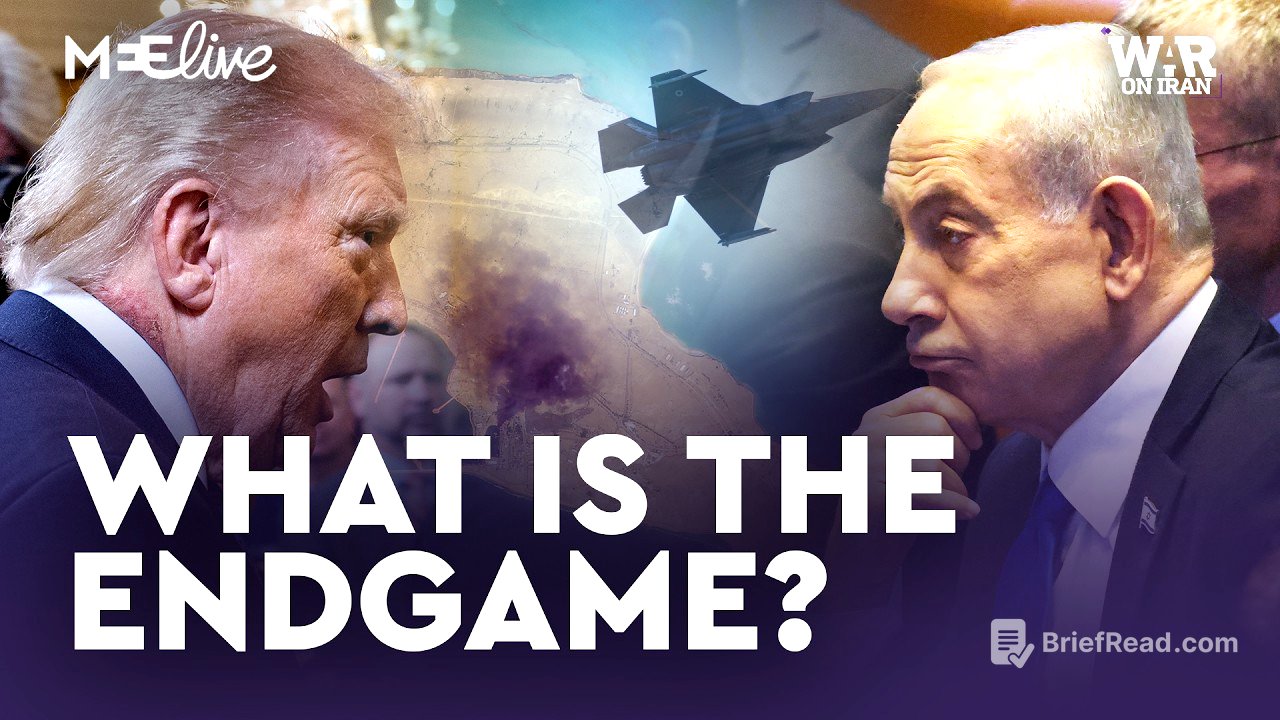
This video provides an analysis of a hypothetical regional war in 2026 involving Iran, the US, and Israel. It examines the military strategies of each key player, the potential duration and consequences of the war, and the underlying motivations driving the conflict. The discussion includes the perspectives of US and Israeli experts, shedding light on the complex dynamics and potential outcomes of the war.
- Iran aims to weaken the US's resolve by targeting Gulf states and global energy infrastructure.
- The US's strategy is unclear, with conflicting messages about regime change and a potential lack of anticipation regarding Iran's response.
- Israel, under Netanyahu, has a long-standing desire to confront Iran, potentially driven by political motivations and a desire to reshape the Middle East.
War Overview and Key Players [1:12]
The war began with US and Israeli air strikes on Iran, leading to Iranian retaliation against US air bases and involvement of countries like Bahrain, Kuwait, Iraq, Syria, Lebanon, Jordan, Cyprus, Saudi Arabia, Qatar, the UAE, and Oman. Hezbollah joined the conflict by launching rockets at Israel, prompting Israeli strikes on Beirut and seizures in southern Lebanon. While NATO supports the US, the UK and EU have shown ambivalence, and China supports Iran's right to peaceful nuclear energy while calling for negotiations. The reasons for the war are unclear, with the White House citing preemptive strikes but struggling to justify the imminent threat posed by Iran.
Iran's Military Strategy [4:53]
Iran's strategy is to undermine the United States' will to fight by targeting the Arab Gulf monarchies, which they perceive as a weak link. They are focusing their attacks on the UAE, Kuwait, Oman, and Saudi Arabia, including a significant strike on the US embassy in Riyadh. Iran is also targeting key energy infrastructure, such as Fujairah, to disrupt the global economy through increased energy prices. The aim is to pressure the Gulf States to lobby Trump to halt the attacks.
Gulf States' Response and US Support [6:20]
The Gulf States, particularly Qatar, Bahrain, and the UAE, have been significantly affected by the conflict, challenging their image of stability. There is internal debate within the Gulf on whether to join the US offensive or push for a ceasefire. Qatar has taken a surprisingly assertive stance. The Gulf States are facing a shortage of interceptors like Patriot and THAAD, and the US is reportedly struggling to replenish these supplies, prioritizing the defense of Israel.
Iran's Long-Term Strategy and US Miscalculations [8:12]
Iran aims to prolong the war, betting that they can outlast the Gulf States and deplete their interceptor supplies, leaving the Arabian Gulf coastline vulnerable to Iranian drones. This strategy seeks to deny Trump a quick victory. The US strategy is unclear, with Trump expressing surprise at Iran's response in targeting the Arabian Gulf, despite prior warnings from Gulf states and Iran about potential repercussions.
US Motives and the Epstein Files [10:09]
The US's objectives are unclear, with Trump oscillating between regime change and supporting Iranian opposition groups. Some suggest the war is a distraction from the Epstein files, while others believe Trump thought he could quickly achieve regime change, emboldened by the situation in Venezuela. However, analysts have pointed out that Iran is not Venezuela, and regime change cannot be implemented in the same way due to Iran's deep-rooted institutions and religious ties.
Israel's Strategy and Netanyahu's Motivations [13:58]
Netanyahu has a long history of trying to involve the US in attacking Iran, with varying approaches over the years. While Israel is ostensibly committed to regime change, it's unclear how this can be achieved through aerial attacks alone. The US has no vested interests in this war, and the claim that Iran was developing missiles to hit the US is unsubstantiated. Netanyahu may be using the war to deflect from his legal troubles and the failures surrounding October 7, 2023, aiming to reshape the narrative and improve his political standing.
Diverging Interests and the Duration of the War [20:27]
The situation presents a unique case of two leaders with different motivations: Trump seeking a distraction and Netanyahu aiming to salvage his political image. While the Israeli public is more attuned to the issue of Iran, there is a risk of Americans resenting being dragged into a war by Israel. The duration of the war is a critical factor, particularly regarding the sustainability of the Gulf States and Israel, with the latter heavily reliant on US support.