TLDR;
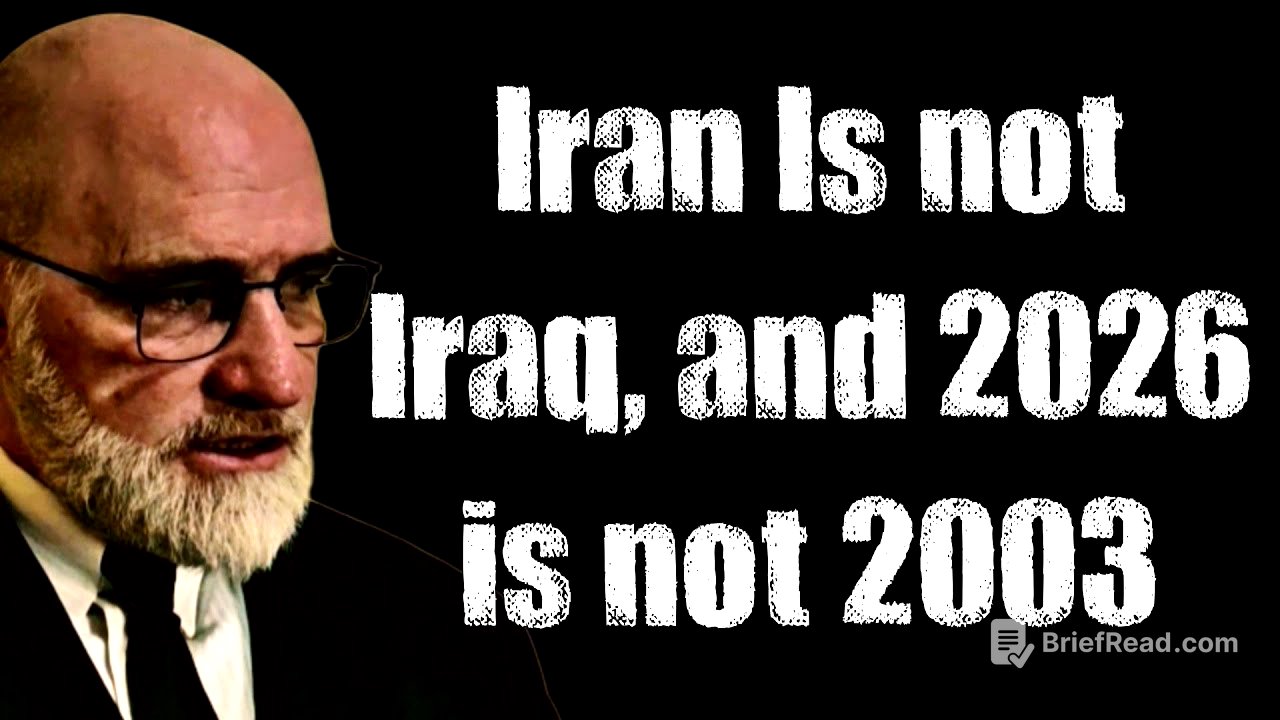
This video discusses the recent events in Iran, including the strikes on Iranian officials and the country's response. It argues that these events are not a straightforward attack on Iran but rather an externally enforced conclusion to an internal power struggle between pragmatists and hardliners. The speaker suggests that the strikes were a way to remove obstacles to regional integration and that the events have accelerated the movement towards a new regional architecture.
- The strikes on Iran were not a regime change operation but a regime reshuffle, targeting hardliners who opposed regional integration.
- Iran's response, including the closure of the Strait of Hormuz, revealed the weakness of the hardliner's strategic model.
- The Gulf states are using the attacks as justification for a managed reduction of the American military presence in the region.
- Israel's position has been drastically degraded, and it is now required to integrate into the regional economy on terms set by the Gulf States.
- The Muslim world's power lies in capital, energy, geography, and institutional architecture, not in proxies and missiles.
Introduction: Iran Situation Overview [0:00]
The speaker addresses the current volatile situation in Iran, marked by war, missile strikes, and leadership succession concerns. Despite the real deaths, destruction, and humiliation, the speaker believes the dominant frame of regime change is a misunderstanding. While a faction within Iran's political structure faces an existential threat, Iran itself is not under existential threat. The speaker emphasizes that Iran's future depends on regional integration, which has been hindered by the IRGC hardliners.
Dismantling Regional Management Pillars [1:13]
To facilitate regional transition, three elements must be dismantled: militant groups, Iran's sectarian posture, and Zionism. These pillars have maintained regional destabilization for the past 50 years within the post-World War II global order, which is now being dismantled. The speaker acknowledges the real deaths and destruction but suggests the prevailing understanding of the situation is flawed.
Internal Power Struggle in Iran [3:44]
Iran has been undergoing an internal power struggle since at least 2023, with pragmatist elements within the government seeking to reorient the country towards regional integration, Vision 2030, and economic development. The IRGC hardliners have resisted this shift, as their power and relevance are tied to maintaining proxies and a state of siege. The speaker suggests that the strikes on Iran were contracted externally to resolve this internal standoff, aligning the strategic interests of Iranian pragmatists, Gulf states, and the US administration.
Operation Epic Fury: An Internal Coup [6:59]
The strikes on Iran, dubbed "Operation Epic Fury," are characterized as an externally enforced conclusion to an internal coup, rather than a classic regime change. The targeting was specific, focusing on the IRGC command structure and figures associated with the hardline faction, rather than the institutions of the system. While the method is brutal and the civilian cost is real, the speaker argues that the operation is a regime reshuffle aimed at removing obstacles to regional integration.
Iran's Response: Behavior of a Cornered Animal [9:41]
Iran's response, including attacks on Gulf States and the closure of the Strait of Hormuz, is interpreted as the behavior of a cornered animal by the hardliners. These actions are seen as an existential move by those who understand their era is ending. The closure of Hormuz, in particular, is viewed as a fundamental weakness, inflicting collective punishment on the world and endangering global food and energy security.
China's Intervention and the Weakness of Hardliner Strategy [12:22]
China's swift intervention, demanding the reopening of the Strait of Hormuz, reveals the weakness of the hardliner's strategic model. The hardliner's greatest weapon, the ability to hold global energy and trade hostage, ends up being hostage to someone else's interest. The Gulf States, having absorbed Iranian missile attacks, are now seeking replenishment from China and Russia, potentially leading to a managed reduction of the American military presence in the region.
Israel's Degraded Position and the Opportunity for Regional Integration [18:33]
Israel's military dominance is being degraded, creating an opening for regional integration negotiations on different terms. The conflict has cost Israel significantly in terms of military capacity, political capital, and economic resources. A narrative is developing that Israel is responsible for the regional conflict, potentially leading to a pivot away from Israel by the US. Vision 2030 requires Israel to be integrated into the regional economy on terms set by the Gulf States, necessitating a constraint on Israel's unilateral military capability.
The Path Forward: A Regional Architecture Managed by the Gulf States [22:50]
Both the Iranian hardliners and the Israeli military are being compressed towards a regional order where neither can dictate the terms. The Gulf states, operating through the emerging multipolar architecture with China and Russia, are positioned to manage the region collectively. While the events are not necessarily a victory, they represent a transition towards a regional architecture that the Muslims have been trying to build for years.
Practical Implications and Counter-Narratives [31:02]
The speaker outlines several practical implications and counter-narratives. First, emphasize that a nuclear deal was within reach just days before the strikes, exposing the pretext for the attack as false. Second, introduce the distinction between hardliners and pragmatists in Iran. Third, insist on Gaza accountability in any post-war normalization framework. Finally, build relationships with the Iranian pragmatist network and pay attention to the economic distress signals in Israel.
Conclusion: A Step in the Right Direction [35:56]
The speaker concludes that the recent events, as difficult and upsetting as they may be, represent a step in the right direction. The Muslim world's power lies in capital, energy, geography, and institutional architecture, not in proxies and missiles. The region is moving towards a genuine multipolarity, with China and Russia embedded as stakeholders. The transition may be costly, but it is buying something real: a regional architecture that promotes integration, stability, and prosperity.