TLDR;
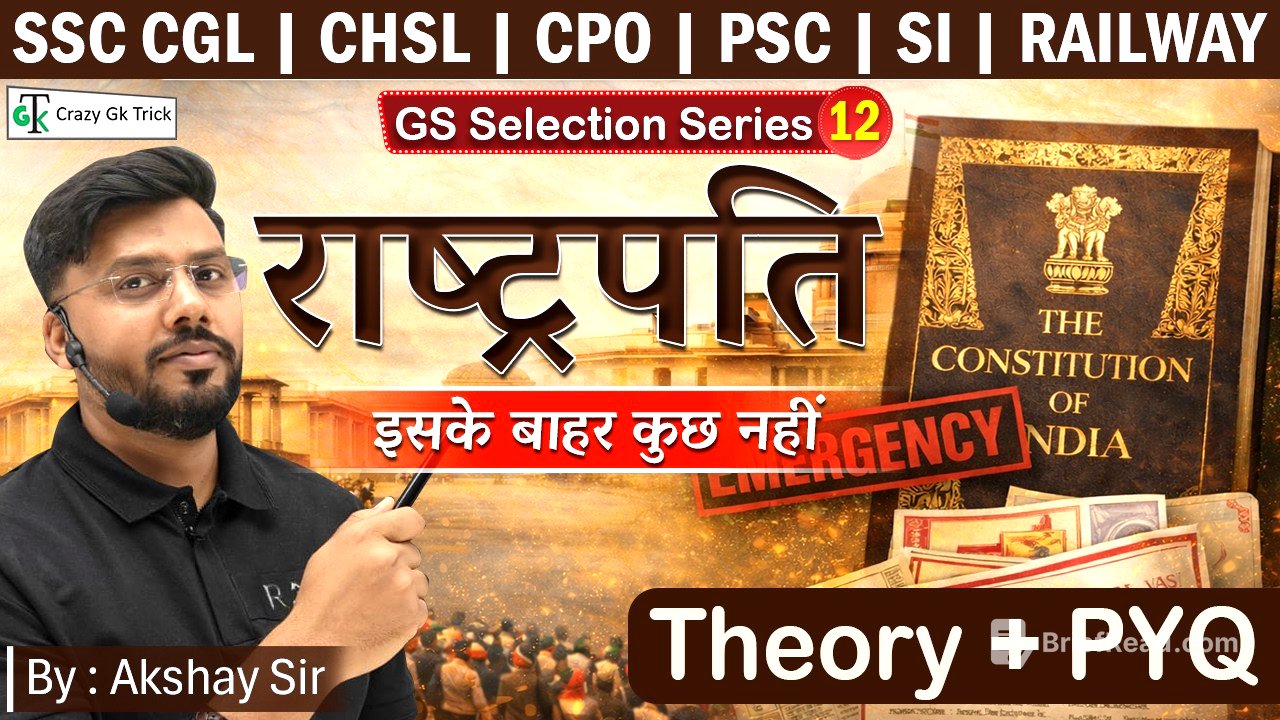
This video provides a comprehensive overview of the President of India, covering constitutional positions, key articles, election process, legislative and executive powers, judicial powers, relationship with the Parliament, impeachment process, special situations, and important facts. It also includes a practice test with questions from previous years' exams to help viewers prepare effectively.
- Constitutional position and key articles related to the President of India.
- Election process, legislative, executive, and judicial powers of the President.
- Impeachment process, special situations, and important facts related to the President.
Introduction [0:07]
The video introduces a session on the President of India, a crucial topic in Indian Polity with frequent questions in various exams. The session aims to explain the topic in a simple, clear, and exam-oriented manner, focusing on points directly relevant to exams. The presenter offers a systematic, point-by-point explanation in the sequence typically followed in exams.
Constitutional Position of the President [1:17]
The President of India is the constitutional head of the country, serving as the formal head while the real executive power lies with the Council of Ministers. All official functions are performed in the name of the President. Additionally, the President is the supreme commander of the armed forces, taking salutes during the Republic Day parade, symbolizing their constitutional and formal status.
Important Articles Related to the President [2:33]
Article 52 states that there shall be a President of India, ensuring the mandatory existence of the presidential post. Article 53 vests the executive power of the Union in the President, meaning the central government's executive functions operate through the President as per the constitution. Article 54 details the electoral college for the President's election, specifying who can elect the President. Article 55 explains the process of the President's election, including the voting method and principles. Article 56 sets the term of office for the President at five years. Article 58 outlines the qualifications required to become President. Article 59 clarifies that the President cannot be a member of the Parliament or any state legislature. Article 60 concerns the oath taken by the President before assuming office. Article 61 describes the impeachment process for removing the President for violating the constitution. Article 62 deals with vacancies in the presidential office and the provisions for new elections.
Election of the President [4:57]
The method of election for the President is adopted from Ireland. The President is elected by an electoral college comprising elected members of the Lok Sabha, Rajya Sabha, and state legislative assemblies. Nominated members of Parliament, members of legislative councils, and members of the Jammu and Kashmir legislative assembly are not included in the electoral college. Key articles related to the election are Articles 54, 55, and 71.
Legislative Powers of the President [6:29]
The President has significant legislative powers, including the power to summon and prorogue sessions of Parliament. The President can call a joint sitting of both houses under Article 108. When Parliament is not in session, the President can issue ordinances under Article 123, which are temporary laws. The President addresses the Parliament at the first session, as provisioned in Article 87. The President also has pocket veto power, allowing them to indefinitely delay a bill. Additionally, the President's approval is necessary for every money bill, which requires a certificate from the Speaker of the Lok Sabha.
Executive Powers of the President [7:40]
The President appoints the Prime Minister, as stated in Article 75, initiating the formation of the government. According to Article 74, the Council of Ministers advises the President, meaning the President acts on their advice. Article 77(1) stipulates that all executive actions are taken in the name of the President, ensuring administrative decisions are officially in the President's name. Article 356 allows the President to impose President's rule in a state, initially for two months. Article 239(2) enables the President to appoint a state's Governor as the administrator of a neighboring Union Territory.
Judicial Powers of the President [9:06]
Article 72 grants the President the power to grant pardons, reprieves, respites, or remissions of punishment, including the power to pardon a death sentence. Article 124(2) states that the President appoints the judges of the Supreme Court. The President also transfers judges of the High Courts. Under Article 143, the President can seek advice from the Supreme Court, known as advisory jurisdiction.
President and Parliament [9:57]
Under Article 80, the President can nominate 12 members to the Rajya Sabha from fields like literature, science, art, and social service. However, Article 59 specifies that the President cannot be a member of either house of Parliament, although they retain certain constitutional rights.
Impeachment of the President [10:34]
The President can be removed from office only for violating the Constitution, as per Article 61. The impeachment process can start in either house of Parliament, and the resolution must pass with a two-thirds majority of the total members of that house. This rigorous process ensures the stability and dignity of the President's office.
Special Situations [11:08]
If both the President and Vice-President's offices are vacant, the Chief Justice of India assumes the functions of the President. An example of this occurred in 1969 when Chief Justice M. Hidayatullah served as the acting President. Additionally, a state's Governor takes their oath of office before the Chief Justice of the High Court of that state.
Important Facts [12:09]
Article 342 gives the President the power to specify Scheduled Tribes. Article 361 provides constitutional protection to the President and Governors. President's Rule applies only to states, not districts or Union Territories. The President's post is fundamentally that of a nominal executive.
Practice Test [13:08]
The video includes a practice test with questions from previous years' exams.
- The supreme commander of the armed forces in India is the President, as per Article 53.
- The process of removing the President for violating the constitution is called impeachment, as per Article 61.
- In the absence of both the President and Vice-President, the Chief Justice of India performs the duties of the President.
- The electoral college for the President's election includes elected members of the Lok Sabha, Rajya Sabha, and state legislative assemblies.
- The power to specify Scheduled Tribes is under Article 342.
- A Governor takes the oath of office before the Chief Justice of the High Court.
- The power to appoint Supreme Court judges is under Article 124(2).
- The power to issue ordinances is under Article 123, held by the President.
- The appointment of the Prime Minister is under Article 75.
- President's rule is provisioned under Article 356.
- The power to call a joint sitting of both houses of Parliament is under Article 108.
- Constitutional protection to the President and Governors is provided by Article 361.
- A money bill presented for the President's assent must be certified by the Speaker of the Lok Sabha.
- Article 59 specifies that the President cannot be a member of either house of Parliament or a state legislature after being elected.
- Keeping a bill pending indefinitely is known as the President's pocket veto.
- President's rule under Article 356 is initially for two months.
- A Governor can reserve a bill for the President's consideration under Article 200.
- The method of election of the President is taken from the Constitution of Ireland.
- Article 71 deals with matters related to the election of the President and Vice-President.
- The President can appoint a state's Governor as the administrator of a neighboring Union Territory under Article 239(2).
- The President addresses a joint session of Parliament after general elections under Article 87.
- The President has special advisory powers through the Supreme Court under Article 143.
- Article 74 provides for a Council of Ministers headed by the Prime Minister to aid and advise the President.
- The President holds the position of a nominal executive in the Indian political system.
The video concludes with a question for viewers to answer in the comments regarding the minimum quorum required for the Lok Sabha.