TLDR;
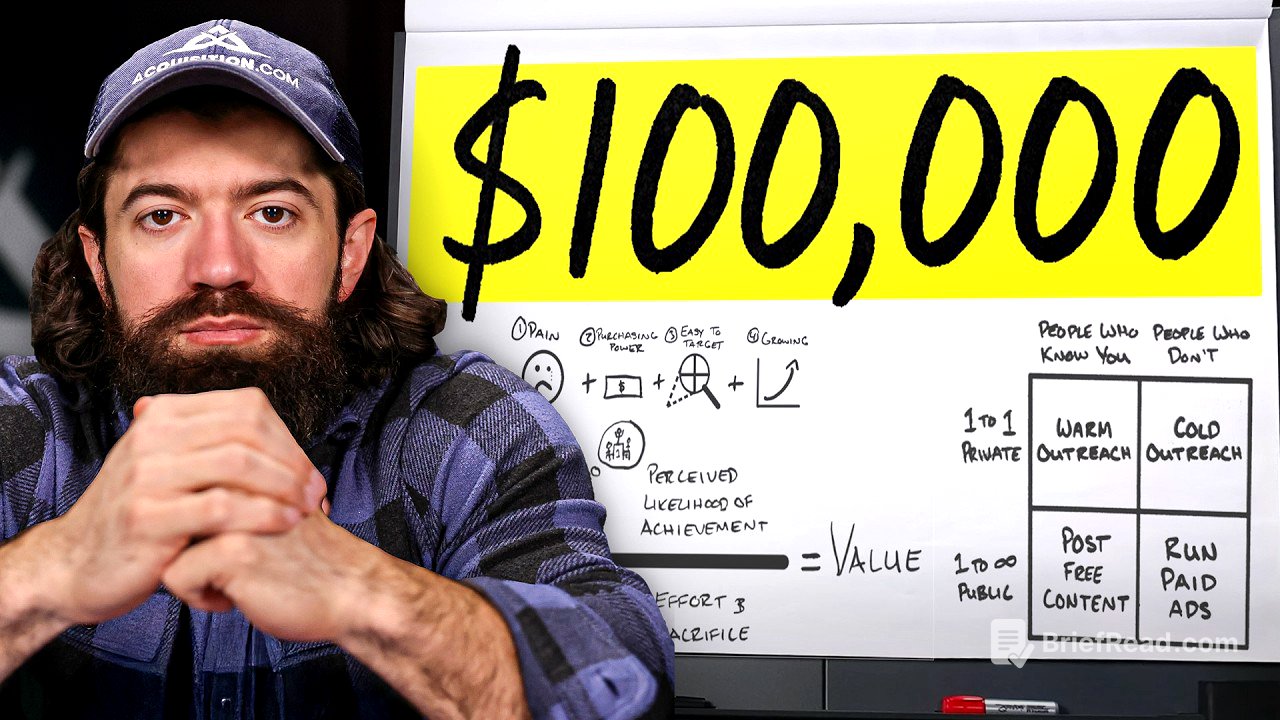
Alex Hormozi shares a six-step roadmap to achieving your first $100,000, emphasizing that this financial milestone provides a sense of security and enables long-term thinking. The steps include cutting costs aggressively, saving time by focusing on high-impact activities, researching profitable skills, dedicating time to learning, strategically spending money on tools and resources, and avoiding lifestyle inflation to bank the earnings. The ultimate goal is to increase active income and achieve financial stability, which serves as a foundation for pursuing bigger dreams.
- Cut costs to free up capital for risk-taking and investment.
- Maximize time efficiency by focusing on high-value activities and minimizing distractions.
- Research and acquire skills that are already in demand and generate income.
- Invest strategically in tools, implementation support, and trial attempts to accelerate learning and growth.
- Resist lifestyle inflation to accumulate savings and reach the $100,000 milestone.
Intro [0:00]
Alex Hormozi reflects on his personal experience, noting that achieving $100,000 in his bank account was the moment he felt wealthiest, as it alleviated daily financial worries and allowed him to focus on long-term goals. He contrasts this with later financial successes, emphasizing that basic financial security is crucial for pursuing larger ambitions. He introduces a six-step roadmap designed to help viewers achieve their first $100,000.
Step 1: Cut All Costs [0:57]
The first step involves drastically reducing expenses to free up cash for investments and skill development. This includes eliminating dining out, buying only from discount grocery stores, minimizing clothing purchases, and opting for the cheapest possible living arrangements, such as living with family or roommates. The goal is to minimize spending on food, shelter, and transportation to create a cash flow that can be reinvested.
Step 2: Save Time [3:33]
The second step focuses on time management, particularly for those with a nine-to-five job. Instead of wasting free time, dedicate the hours before and after work to productive activities. Hormozi suggests a "444 split": four hours for promotion, four hours for delivery, and four hours for building the business. He also emphasizes the importance of understanding whether you are in "maker" mode (focused, uninterrupted work) or "manager" mode (interactions and communications) and scheduling your day accordingly to minimize task switching and maximize productivity.
Step 3: Research a Skill People Already Pay For [7:29]
The third step involves identifying and researching skills that are already in demand and that people are willing to pay for. For B2B, this could include advertising, content creation, or funnel building. For B2C, analyze personal spending habits to identify potential service offerings. Hormozi advises focusing on one product or service for one avatar on one channel until reaching $1 million in revenue, following the "111 rule."
Step 4: Spend Time Learning [8:49]
The fourth step emphasizes the importance of effective learning, which Hormozi defines as a change in behavior in the same condition. He stresses that consuming content is not enough; it must translate into actionable steps. He advocates for 10,000 iterations with feedback loops to improve skills. The fastest way to learn is by hiring someone skilled and learning from them directly. He outlines a process for learning from first-party data, which includes doing a lot of volume, analyzing the top 10%, identifying key differences, and avoiding the mistakes of the bottom 90% while emulating the top 10%.
Step 5: Spend Money in the Right Places [11:32]
The fifth step involves strategically spending money on tools, implementation help, and trial attempts. Tools may include software like CRMs or landing page builders. Implementation help can involve courses, communities, or tutoring. Trial attempts involve spending money on activities like running ads or creating content. The goal is to leverage these investments to save time and accelerate progress.
Step 6: Do Not Increase Your Lifestyle [13:24]
The final step is to avoid lifestyle inflation. Hormozi advises living below your means and prioritizing saving and reinvesting earnings. He shares personal anecdotes of maintaining a low-cost lifestyle even when earning a substantial income. The key is to focus on building wealth rather than appearing wealthy, and to continuously invest in learning to increase earning potential. He concludes by reiterating the importance of these six steps in achieving financial stability and enabling the pursuit of larger goals.




![Inertia & Newton's First Law of Motion - [1-5-4]](https://wm-img.halpindev.com/p-briefread_c-10_b-10/urlb/aHR0cDovL2ltZy55b3V0dWJlLmNvbS92aS9RQXNucFI2YnFRby9ocWRlZmF1bHQuanBn.jpg)