TLDR;
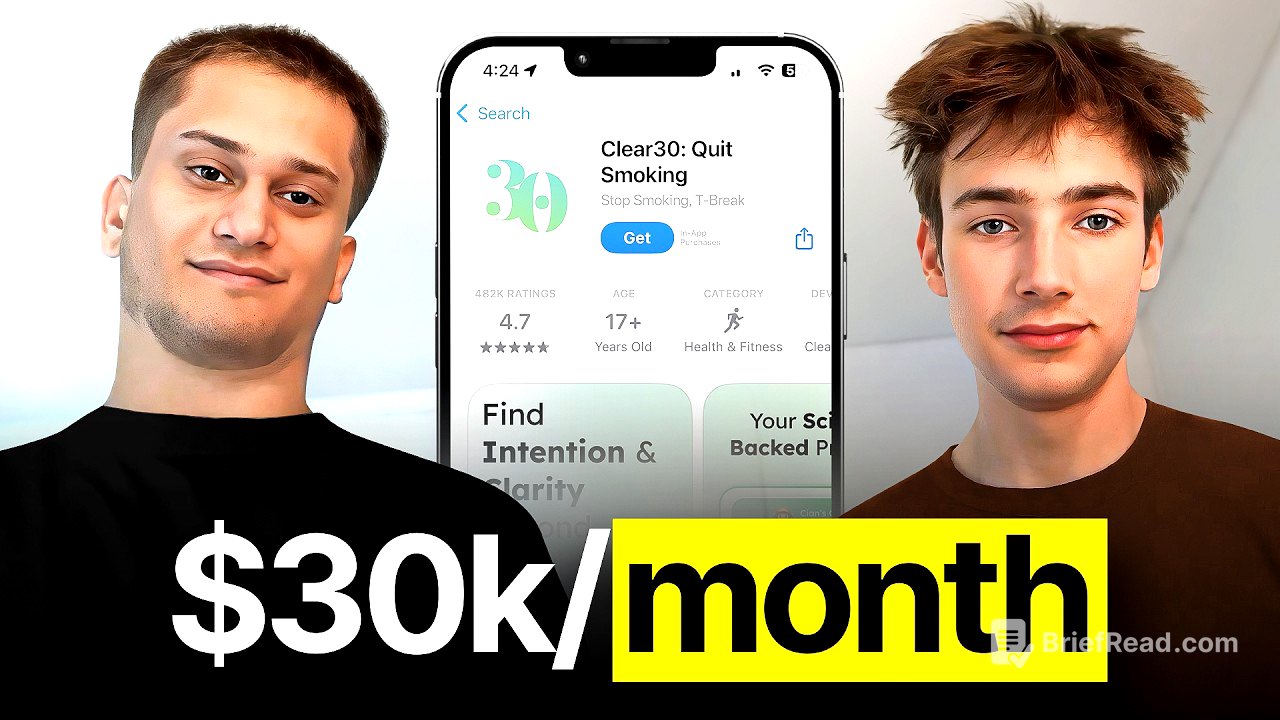
This video features an interview with the co-founders of Clear 30, an addiction recovery app, who share their strategies for tripling their app revenue in just eight weeks. They discuss their journey from initial struggles to achieving significant growth through systematic testing and optimization of ad creatives, onboarding flows, and paywalls. Key takeaways include the importance of paid advertising, understanding user motivations, and focusing on the value proposition in the onboarding process.
- Paid advertising is more effective than organic reach for initial growth.
- Specificity in ad targeting and messaging resonates with users.
- A well-crafted onboarding experience significantly boosts conversion rates.
- Highlighting the value proposition and addressing user pain points increases engagement.
- Continuous testing and optimization are crucial for sustained revenue growth.
Introduction to Clear 30 [1:50]
Asher and Thatcher, the co-founders of Clear 30, introduce their app, which is designed to help people stop smoking weed or moderate their usage. Clear 30 is a science-based program developed with their clinical psychologist co-founder, Dr. Fred Munch. They acknowledge their initial naivety in the app world but highlight their recent success in scaling the app, going from $10,000 to $30,000 in monthly subscriptions.
From Zero to $10K: The Initial Struggle [2:55]
The co-founders discuss the challenges of reaching their first $10,000 in revenue, particularly the difficulty of making the first dollar. They experimented with various organic methods, including posting free content, using influencers, and trying Reddit and SEO. However, they found that paid advertising was the most effective way to scale their user base and revenue. They emphasize the importance of having a product that converts and building a flywheel through paid acquisition.
Crafting Effective Paid Ads [4:13]
Asher and Thatcher share insights into creating successful paid ads, emphasizing the importance of understanding their target demographics and using persuasion techniques. They focus on being specific in their ad messaging, calling out relatable situations to grab attention. They also highlight the significance of age demographics in conversion rates, noting that older users (26-30) convert at almost double the rate of younger users (18-20). They stress the need to balance creative, funny ads with more mature, problem-focused ads to appeal to different audiences.
Attribution and Data Analysis [8:08]
The Clear 30 team uses various tools, including Amplitude, to track their return on ad spend and trial starts from different channels. They annotate their onboarding process to understand why specific choices were made. They found that asking users where they came from (e.g., Instagram, TikTok) was helpful in determining who was converting. This data helps them monitor ad spend and balance their efforts across different platforms.
The Power of Onboarding: From $10K to $30K [9:12]
The co-founders attribute their exponential growth from $10,000 to $30,000 to optimizing their onboarding process. They emphasize that 85% of users decide whether to pay for an app within the first 5 minutes. By studying successful onboarding processes from apps like Cali and Twitter, they tailored their onboarding to clearly convey the value of Clear 30. They collect data early in the onboarding process to identify drop-off points and understand user intent.
Onboarding Flow and Key Questions [9:40]
The Clear 30 onboarding process begins with an intro screen that paints a dream outcome of 30 days without weed. They focus on showing users what they will gain from the app, using abstracted graphics and copy that emphasizes unlocking potential. They personalize the experience by asking for the user's name and using it in subsequent questions to create a conversational feel. They also ask about the user's goals and triggers for smoking, using this information to tailor the experience and demonstrate social proof.
Value Communication and Friction [11:19]
Clear 30 communicates value by showing the dream outcome, the likelihood of achieving it, and minimizing the perceived time, effort, and sacrifice. They ask users what they want to achieve with Clear 30, providing a list of short-term and long-term goals. They also highlight social proof by showing that a high percentage of users improve mental clarity. They note that friction, such as spending time thinking about goals and triggers, can be beneficial as it increases commitment.
Highlighting Pain Points and Presenting Solutions [13:38]
The onboarding process includes a presentation mode that highlights the user's current pain points and contrasts them with the potential future. They show users how their weed use compares to others and emphasize the money they are spending. They also provide sources and scientific backing for their data to build credibility. The next step involves showing users where Clear 30 can take them, emphasizing the value equation and highlighting the benefits of the program.
Additional Onboarding Questions and Value [16:34]
The onboarding process continues with questions designed to make users feel like heroes and commit to change. They ask about past experiences with changing cannabis habits and how users plan to use the app. They also set expectations by stating that the app costs money, framing it as a fair exchange for the value provided. They collect phone numbers to communicate with users via SMS, sending personalized and helpful messages.
Review Glitch and Social Proof [21:03]
Clear 30 prompts users to leave a review before they can see the app's reviews, a strategy they learned from Cali. This has led to a significant increase in positive reviews on their app store page. They also provide value by giving personalized feedback based on the user's answers, reinforcing the idea that the app is designed for them.
Paywall Testing and Optimization [22:45]
The co-founders discuss their paywall testing and optimization process. Their initial paywall highlighted the app's features in a carousel. However, they found that showing what users would get within the trial, outlining the first seven days of the program, increased conversion rates from 20% to 30%. This new paywall emphasized the program's system and the dream outcomes users could expect.
Key Takeaways and Future Plans [29:46]
The co-founders emphasize the importance of giving the onboarding process intention and care, as it makes everything else in the business easier. They focus on one key thing at a time and double down on it until it hurts. For the future, they plan to scale their paid ads, pursue B2B partnerships, and explore upsells and downells to increase the lifetime value of their users.