TLDR;
This episode of The Verge's "Version History" explores the rise and fall of TiVo, a revolutionary device that allowed users to pause, rewind, and record live TV. The discussion covers TiVo's impact on the television industry, its innovative features like the "peanut" remote and recommendation algorithm, and its ultimate failure to maintain market dominance due to competition and strategic missteps.
- TiVo's core innovation was giving users control over live TV, fundamentally changing how people consumed media.
- The "peanut" remote and user-friendly interface were key to TiVo's early success.
- Strategic errors, such as patent litigation and failure to adapt to streaming, led to TiVo's decline.
Intro [0:00]
The episode introduces TiVo as a groundbreaking device that gave viewers unprecedented control over live television. It highlights the ability to pause, rewind, fast forward, and record TV shows, emphasizing the transformative impact TiVo had on the viewing experience.
Guests Introduction and Early Experiences with TiVo [0:42]
The host introduces Neil Patel and Emily Nussbaum, who share their early experiences with TiVo. Emily describes TiVo as a "life-changing device" due to its ability to reliably record shows, unlike the difficult VCRs. Neil, a gadget blogger in the mid-2000s, saw TiVo as a revolutionary Linux computer that disrupted the TV industry, despite its limited adoption.
The Genesis of TiVo: From Media Server to Pausing TV [4:56]
The story of TiVo begins in the mid-90s with Mike Ramsey and Jim Barton, who worked at Silicon Graphics. They initially envisioned a home media server but pivoted to focus on the ability to pause live TV, inspired by the simple desire to pause and go to the bathroom. This insight proved to be a game-changer, addressing a common frustration with live television.
The Impact of TiVo on Television and the Naming of the Company [8:08]
The ability to pause and rewind TV changed the nature of television, making it less ephemeral and allowing viewers to revisit and discuss shows. The company was originally named Teleworld, but later changed to TiVo, combining "TV" with "IO" (input/output) to represent its function as a device that interacts with television.
TiVo's Design and Early Development [11:27]
TiVo hired the design firm IDO to create a personable and user-friendly device. They chose to use a hard drive for storage, which was more reliable than VCRs. The creators visited Paul Allen, the co-founder of Microsoft, to demo the product. They opted to build their own version of Linux to ensure stability, leading to controversy in the Linux community.
The Linux Controversy and the Peanut Remote [14:43]
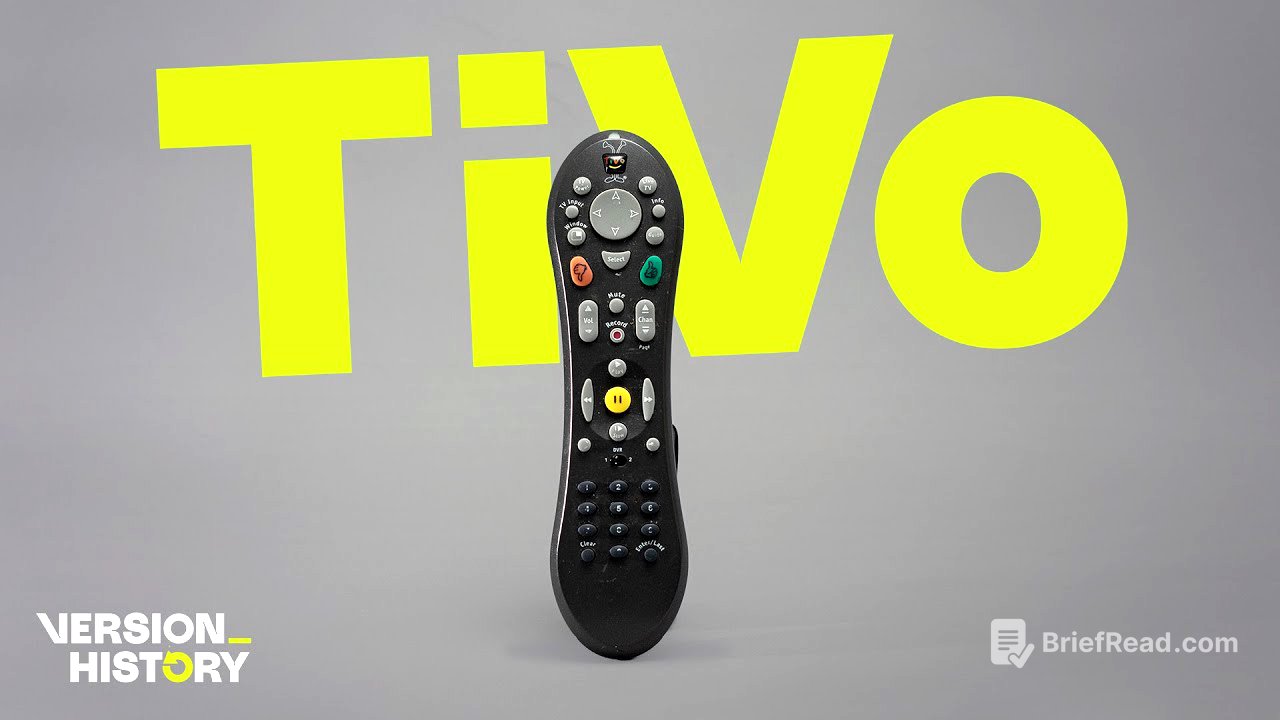
TiVo's decision not to contribute its version of Linux back to the open-source community caused a rift, with some accusing TiVo of "TiVoization." The remote control, known as the "peanut" remote, was a key part of TiVo's design, emphasizing usability and ease of use. The remote featured a prominent pause button and thumbs up/thumbs down buttons for recommendations.
Connecting TiVo to the Internet and the Recommendation Algorithm [19:05]
TiVo connected to the internet via a phone line to update program data and provide recommendations. The recommendation algorithm, while innovative, sometimes produced odd results, such as recommending kung fu shows based on a user's love for "Buffy the Vampire Slayer." This led to users becoming self-conscious about their viewing habits.
The Early Days of TiVo and Popular Shows of the Era [23:42]
In its early days, TiVo had limited storage capacity (14-30 hours) and was relatively expensive. The most popular shows of 1999-2000 included "Who Wants to Be a Millionaire," "ER," "Friends," and "Touched by an Angel." TiVo offered a lifetime service option for a one-time fee, which later became a point of contention.
TiVo's Partnerships and Distribution Challenges [26:18]
TiVo partnered with companies like Philips and DirecTV to manufacture and distribute its devices. The Philips TiVo was the most widely recognized. These partnerships were essential due to the lack of modern supply chain capabilities.
The Impact of TiVo on Advertising and the Rise of DVRs [28:47]
TiVo's ability to skip commercials caused panic in the advertising industry. Replay TV, a competitor, faced legal issues for having a button that immediately skipped commercials. TiVo successfully argued that fast-forwarding through ads still constituted "seeing" them. Cable companies initially hated TiVo but later partnered with it.
TiVo's Challenges and Missed Opportunities [32:59]
TiVo faced challenges as cable companies transitioned to digital cable and encrypted signals. The company's peak number of subscribers was 1.7 million in 2008. TiVo gave away thousands of devices to Hollywood insiders to promote the product.
TiVo in Popular Culture and the Personal Connection to the Device [37:22]
TiVo appeared in popular TV shows like "Sex and the City," highlighting the personal connection people had with their TiVo libraries. Users curated their recorded shows like playlists, reflecting their personality and taste.
The Decline of TiVo and the Rise of Competitors [40:39]
TiVo's functionality was eventually copied by other DVRs, including those offered by cable companies. TiVo became a patent troll, suing other companies for infringing on its patents. This diverted resources from innovation and led to its decline.
Alternate Histories for TiVo and the Cable Companies' Response [42:25]
One alternate history suggests TiVo could have licensed its software for a low price to become ubiquitous. However, cable companies favored a centralized, on-demand streaming model over TiVo's distributed storage approach. TiVo's architecture, designed for a VCR-like experience with a hard drive, did not adapt to the cloud-based future.
The End of TiVo and Emily's Loyalty [47:28]
TiVo was eventually sold to Rovi for $1.1 billion and became a larger patent troll. Despite its decline, Emily Nussbaum remained loyal to TiVo, using it until she eventually switched to Roku.
Version History Questions: Time Matrix and Peak TiVo [49:18]
The panel discusses where TiVo fits on the time matrix, concluding it was the right idea at the right time but ultimately failed. They identify "peak TV remote" and "peak TV sound effects" as highlights of the TiVo era.
Version History Questions: Could TiVo Have Been Saved? [54:17]
The panel considers whether TiVo could have been saved, suggesting a strategy of giving away devices to create addiction to the sounds. They discuss whether the youth will ever make TiVo cool again, concluding that it is unlikely.
Version History Questions: What Feature to Apply to Current Devices? [56:15]
The panel identifies TiVo's search functionality, particularly "swivel search," as a feature that should be applied to current streaming devices. They lament the poor search capabilities of modern devices compared to TiVo's.
Version History Questions: Hall of Fame Criteria and Lasting Impact [58:05]
The panel evaluates TiVo against the Version History Hall of Fame criteria: doing something truly new, being remarkably good or bad, and having a lasting impact. They cite a story about Donald Trump's "super TiVo" as evidence of TiVo's lasting impact on the cultural consciousness.
TiVo Enters the Hall of Fame and Conclusion [1:01:36]
TiVo is inducted into the Version History Hall of Fame. The panel concludes by thanking the guests and encouraging viewers to support The Verge by subscribing and reading their work.