TLDR;
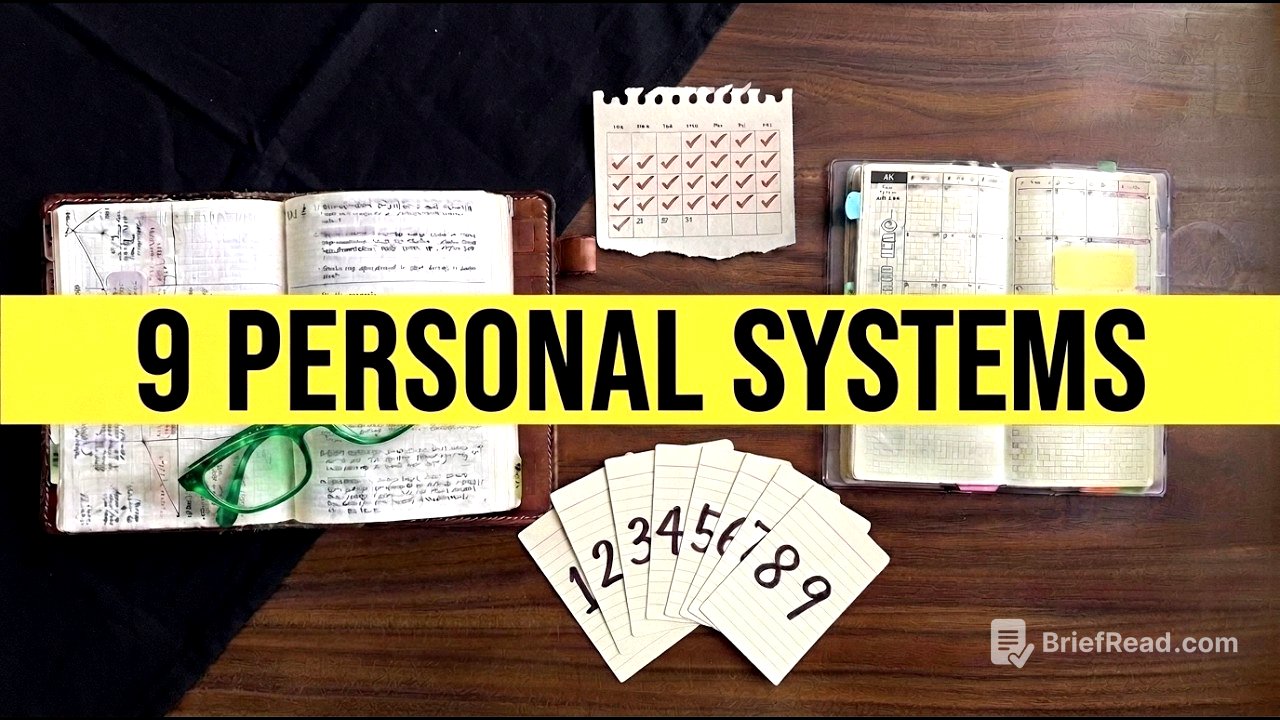
This video presents nine powerful personal systems designed to help individuals achieve high performance and consistency in their lives. The systems focus on pacing, capturing ideas, and enhancing performance by learning from experiences.
- The 20 Mile March emphasizes consistent effort regardless of the day's circumstances.
- The Fake Commute promotes generating ideas during unstructured time.
- The Regret Minimization Framework helps make important decisions by considering potential regrets.
- The 25/5 Rule encourages focusing on top priorities while avoiding distractions in lower-tier goals.
- The Twelve Problems technique allows for targeted curiosity on unsolved questions.
- The 13 Virtues provide a structured approach to self-improvement through focused attention on personal qualities.
- The Small Room Test advocates for testing ideas in low-stakes environments.
- The Opponent Film Study emphasizes studying opponents or challenges extensively for better preparation.
- Pain Plus Reflection encourages learning from pain to create actionable rules for the future.
Introduction [0:00]
The video highlights that high performers build personal systems to maintain an edge. These systems are designed to improve how one paces themselves, generates ideas, captures important information, and recovers from setbacks. It introduces nine systems sourced from various successful individuals that can be implemented in daily life.
Part One: Systems for Pace [0:29]
This section discusses two systems that help manage time and consistency. It emphasizes redefining consistency as a design challenge rather than a willpower challenge.
1. The 20 Mile March (Jim Collins) [0:45]
Jim Collins introduces the 20 Mile March, which involves setting both a minimum and maximum daily target to ensure consistency without burnout. This method ensures that even on bad days, a person achieves a minimum goal, while on good days, they do not overdo it and compromise future performance. The concept is illustrated through two expeditions to the South Pole, where the steady-paced team succeeded while the erratic team failed.
2. The Fake Commute (Sara Blakely) [2:30]
Sara Blakely's system involves taking an aimless drive to cultivate creativity. Instead of sitting at a desk to brainstorm, she utilizes this "fake commute" to think freely, resulting in ideas like the name Spanx. This practice highlights the importance of having undirected time for brainwaves to occur rather than feeling pressured to generate ideas.
Part Two: Systems for Capture [4:22]
The next four systems focus on capturing insights and signals that can drive personal development.
3. The Regret Minimization Framework (Jeff Bezos) [4:57]
Jeff Bezos advocates projecting oneself to the age of 80 to assess decisions by asking if one would regret not pursuing an opportunity. This framework shifts focus from immediate concerns to long-term regret, leading to decisive actions. Bezos applied this when deciding to start Amazon, knowing he would regret not exploring the internet's potential.
4. The 25/5 Rule (Warren Buffett) [7:15]
Warren Buffett’s system recommends writing down 25 goals, identifying the top five, and actively avoiding the remaining 20. These lesser goals can distract from what truly matters, transforming them into an "avoided all costs" list rather than backup plans. This method helps maintain focus on priorities critical to success.
5. The Twelve Problems (Richard Feynman) [9:15]
Richard Feynman’s system involves keeping a fixed list of twelve unsolved problems to guide learning. By always checking new information against this set list, useful breakthroughs arise. This focused curiosity helps in converting random knowledge into meaningful insights.
6. The 13 Virtues (Benjamin Franklin) [11:24]
Benjamin Franklin’s self-improvement system involves selecting specific virtues to focus on weekly. By tracking progress through a grid and marking successes and failures, individuals can see patterns over time, creating a sustainable approach to cultivating personal qualities instead of overwhelming themselves with broad goals.
Part Three: Systems for Performance [14:00]
The final three systems emphasize preparation and learning from experiences, particularly in high-stakes situations.
7. The Small Room Test (Chris Rock) [14:14]
Chris Rock suggests testing new material in small, low-stakes venues before significant performances. This approach allows for refining content through feedback, ensuring only the most effective material is presented. This method emphasizes the importance of audience reaction over personal perception.
8. The Opponent Film Study (Kobe Bryant) [16:13]
Kobe Bryant's preparation involved rigorously studying opponents through game footage. By analyzing behaviors and tendencies, he gained an advantage during games, knowing how opponents would act. This strategic preparation is about understanding the challenges faced beforehand rather than improvising under pressure.
9. Pain Plus Reflection (Ray Dalio) [18:28]
Ray Dalio emphasizes learning from painful experiences through a structured reflection process. He suggests documenting the moment of pain quickly, understanding the patterns behind it, and converting that reflection into actionable principles. This approach creates a rule-based system to prevent repeating mistakes, turning failures into growth opportunities.