TLDR;
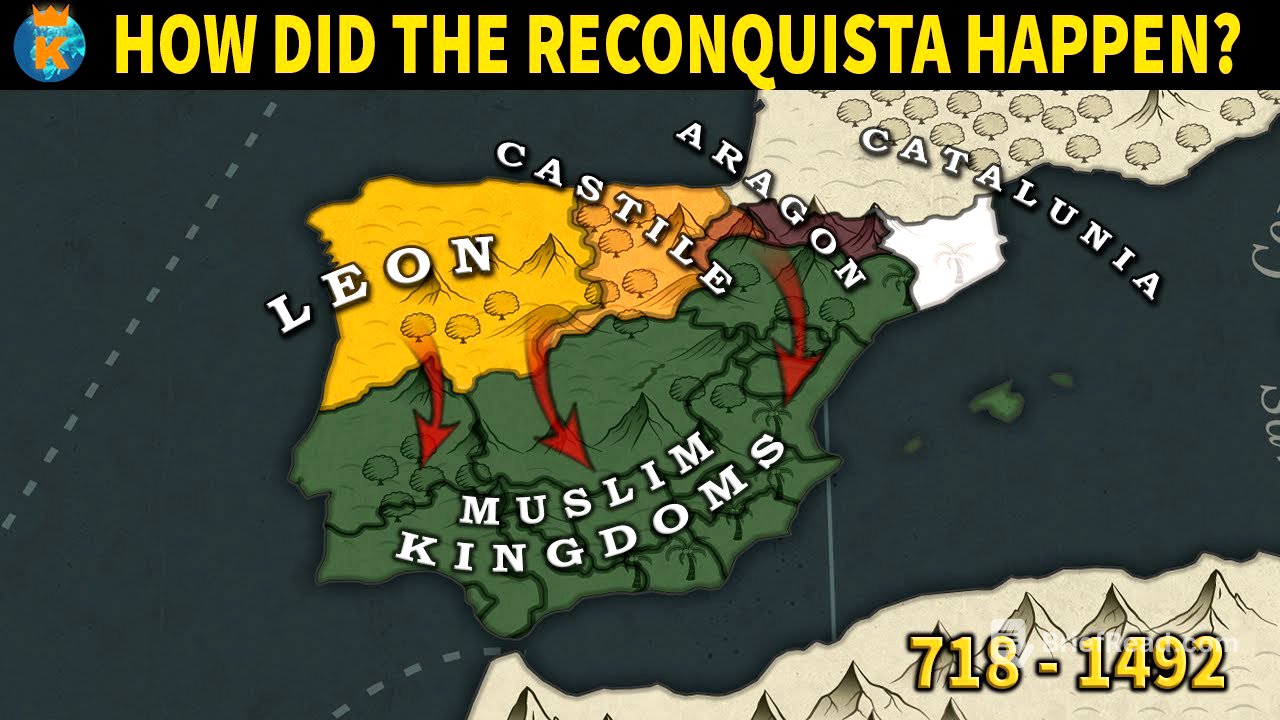
The Reconquista was a series of campaigns and clashes between Christian and Muslim forces in the Iberian Peninsula, lasting nearly eight centuries. It began after the Umayyad Caliphate's conquest of Hispania in 711 and concluded with the fall of Granada in 1492. The Christian kingdoms of Asturia, Castile, Leon, Catalonia, Navarre, and Portugal gradually expanded their territories, facing challenges such as internal conflicts, Muslim reinforcements from Africa (Almoravids and Almohads), and the decision to allow the Muslim Kingdom of Granada to exist under Castilian suzerainty for an extended period. The unification of Castile and Aragon under the Catholic Monarchs, Ferdinand II and Isabella I, led to the final push against Granada and the subsequent expulsion of Jews and Muslims from the Iberian Peninsula.
- The Reconquista was a centuries-long struggle between Christian and Muslim forces in the Iberian Peninsula.
- Key events include the Battle of Covadonga, the fall of Toledo, the Battle of Sao Mamede (leading to the independence of Portugal), and the fall of Granada.
- Internal conflicts among Christian kingdoms and Muslim factions, as well as external interventions from Africa, influenced the pace of the Reconquista.
- The Reconquista concluded with the unification of Spain under the Catholic Monarchs and the expulsion of Jews and Muslims.
The Beginning of the Reconquista [0:00]
The Reconquista, or reconquest of the Iberian Peninsula, was a nearly 8-century-long power struggle between Christian kingdoms and Muslim caliphates. It started after the Umayyad Caliphate's conquest of Hispania in 711, which led to the destruction of the Visigothic Kingdom and put pressure on the Kingdom of Asturia. The first major event was the Battle of Covadonga, where Pelagius the Visigoth led a rebellion against the Umayyads in the Picos de Europa.
Early Stages and Christian Expansion [1:01]
Following the Battle of Covadonga, the Umayyads retreated, sparking a Christian crusader spirit in the region. However, the subsequent centuries saw slow progress in the reconquest due to the Muslim Caliphate consolidating power in Cordoba and the Christians needing time to organize. The Kingdom of Asturia gradually expanded, seizing the city of Leon in 924. By the 11th century, Christian kingdoms like Castile, Leon, Catalonia, and Navarre joined the Reconquista. In 1085, Toledo, the old Visigoth capital, fell to the Kingdom of Castile under King Alfonso VI.
Setbacks and Portuguese Independence [2:42]
The Christian advance was temporarily stunted when the Muslims called in the Almoravids from Africa. However, the Christian struggle continued. In Portugal, Afonso Henriques declared independence after the Battle of Sao Mamede in 1128, becoming the first King of Portugal. This independence was recognized by the Kingdom of Leon in 1143 and by the Pope in 1179, marking a significant victory for the Christians.
Almohad Defeat and Continued Christian Gains [4:38]
Instability within the Muslim territories aided the Christian cause. The Almoravids were defeated by the Almohads in the 12th century. In 1212, a united Christian force crushed the Almohads at Las Navas de Tolosa, paving the way for further reconquest. Ferdinand III of Castile and Leon united his lands and launched a campaign to retake Muslim territories. Cordoba fell in 1236, and by 1250, most of the Iberian Peninsula was back in Christian hands, except for the Kingdom of Granada.
Kingdom of Granada and Cultural Exchange [5:13]
The Kingdom of Granada remained Muslim under Castilian suzerainty, paying tribute to the Castilian king. Ferdinand III initially tried to expel all Muslims but realized the economic consequences. Alfonso X of Castile established the Escuela de Traductores in Toledo to translate Arab literature. James I of Aragon and Alfonso III of Portugal expanded their borders, further consolidating Christian control.
Final Push and Fall of Granada [7:19]
Despite occasional skirmishes, the Battle of Rio Salado marked the final major clash. In 1469, the kingdoms of Castile and Aragon were united by the marriage of Ferdinand II and Isabella I, forming the Catholic Monarchy. They decided to conquer the Kingdom of Granada, laying siege in 1491. Prince Boabdil of Granada surrendered to the Catholic Monarchs on January 2, 1492, marking the end of Muslim rule in the Iberian Peninsula.
Aftermath and Legacy [9:09]
The Christian victory was seen as redemption for the Fall of Constantinople. The Alhambra Decree banished practicing Jews from the Catholic Monarchy, and mandatory conversions to Catholicism were imposed on Jews and Muslims. The Spanish Inquisition continued the harsh legacy of the Reconquista. The fall of Granada is still celebrated by many Iberian Christians as a great victory.
Summary of the Reconquista [10:10]
The Reconquista was a series of campaigns between Muslims and Christians in the Iberian Peninsula, with the Christians aiming to regain their territory. The nearly 8-century duration was due to infighting among Christian states, Muslim reinforcements from Africa, and the decision to allow the Kingdom of Granada to exist for some time. Ultimately, the Christians recaptured their land, avenging the defeat of the Byzantines.




![[#찐시황] "강세장 신호탄 쐈다…외인 선물 7천억 매수의 의미" / 반도체주의 급등, 랠리의 끝은 아직 멀었다ㅣ이권희 대표](https://wm-img.halpindev.com/p-briefread_c-10_b-10/urlb/aHR0cDovL2ltZy55b3V0dWJlLmNvbS92aS80bUM0NTh6SDVwSS9ocWRlZmF1bHQuanBn.jpg)