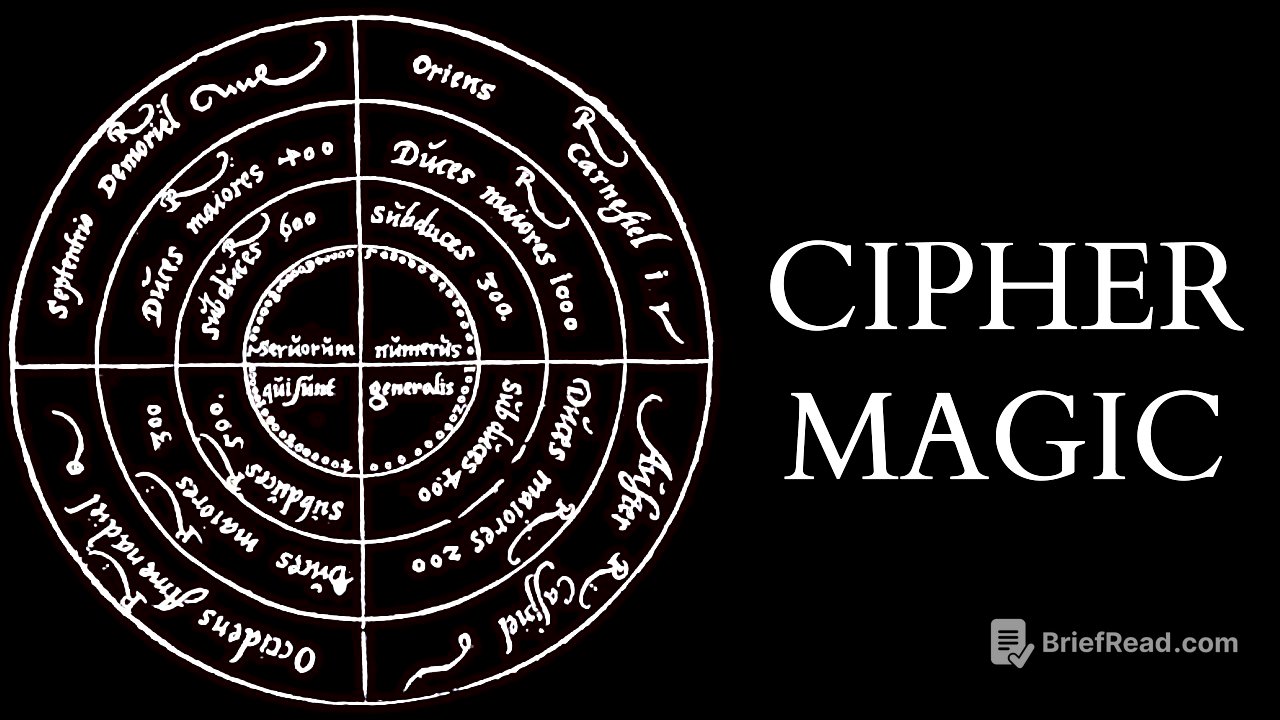
TLDR;
This video discusses the life and works of Johann Trithemius, a 16th-century abbott known for his controversial practices of magic and cryptography. The narrative encompasses his claims of conjuring angels, creating unbreakable ciphers, and the nature of his writings on demonology along with a detailed examination of his significant work, Staganographia, which combines elements of magic, astrology, and cryptography.
- Trithemius was accused of necromancy and dark sorcery.
- Staganographia is a key work aiming to establish unbreakable ciphers and communication through angelic means.
Trithemius and His Aims [0:00]
In 1499, Trithemius wrote to his friend about a divine art called Staganographia that involved creating unbreakable ciphers, learning Latin quickly, and using angels to send messages over great distances. His letter was received with horror as the recipient had died, causing Trithemius to gain a reputation as a dark sorcerer. The chapter explores whether his practices were rooted in angelic magic or hidden demonic conjuration. Trithemius was a foundation for modern cryptography and inspired notable figures like Agrippa and John Dee.
The Formative Years of Trithemius [3:20]
Born in 1462, Johan Heidenberg, also known as Trithemius, was passionate about learning from a young age. Despite opposition from his stepfather, he pursued education secretly and became an abbott at Spanheim Abbey at age 21. Trithemius was known for significantly expanding the abbey's library and his strict nature led to friction with monks. He resigned in 1505, later gaining a post at St. James Abbey until his death in 1516.
Trithemius's Writings and Conflicts [5:21]
He was prolific in writing, including on monastic history and spirituality, yet his works revealed internal contradictions. There was a growing fear of demonic witchcraft during his lifetime influenced by the Malas Malificarum, which shaped his views on witchcraft and necromancy as bound to human sin. Trithemius held that demonic phenomena required human cooperation, believing that God allowed such manifestations as tests of free will.
The Rise of Occult Philosophy [6:28]
Trithemius had a nuanced perspective on magic and scholarship, challenging views of his time. He rejected the belief in mere natural magic, asserting all magic originates from either angelic or demonic sources, critiquing clerical practices that attempted to manipulate demons for personal gain. His writings detailed witchcraft's connections to ethical and spiritual weaknesses.
The Nature of Magic and Knowledge [7:47]
In his theory, Trithemius suggested the importance of moral purity and divine illumination for those wishing to practice magic. He condensed his thoughts into 11 principles governing magical practice, emphasizing faith, virtue, and knowledge as essential for successful magical endeavors. This chapter formulates a framework for bringing “sacred magic” back to its purer form, which should involve a deep understanding of the universe.
Staganographia: A Comprehensive Study [9:21]
Trithemius's Staganographia is introduced as both a theoretical and practical work. It comprises three sections—two completed and one incomplete—focused on the communication of secret messages through angelic means. Trithemius outlines various spirits, including their nature and how to use them for effective communication. A practical example provided shows invoking a specific spirit to send a message, highlighting the meticulous procedures required for engaging with the supernatural.
The Controversy and Impact of Staganographia [11:00]
The initial reception of Staganographia led to sensational rumors of Trithemius's involvement in necromancy, damaging his standing and leading to scrutiny from both the church and scholarly circles. Historical accounts detail a shift in his reputation, where previously respected works became associated with witchcraft. Despite this, the book gained notoriety among those involved in occult practices, influencing notable figures like John Dee and Giovanni Battista.
Legacy of Trithemius and His Works [12:37]
Despite Trithemius’s death in 1516, his ideas influenced future generations of occultists, cryptographers, and philosophers. Many of his systems, such as those seen in techniques for securing messages, served as a framework for later occult systems. His work, while mired in controversy, was foundational for the development of modern cryptography and has had a lasting impact on esoteric traditions throughout history.
The Intersection of Occultism and Cryptography [14:21]
The video concludes by arguing that Trithemius’s work embodies a convergence of angel magic and cryptographic systems, suggesting that both served as means for spiritual illumination. It questions how he could have intertwined his spiritual aspirations with methods of secrecy and suggests that this dual focus has made him both a revered and misunderstood figure in the realm of Western esotericism.
Final Thoughts on Trithemius [15:59]
Trithemius is portrayed as a complex character, too Christian for contemporary occultists yet too occult for mainstream Christian interpretations. His contributions to magic, cryptography, and the philosophies surrounding the occult remain crucial for understanding the development of Western esoteric traditions, anchoring his significance within this domain.