TLDR;
This video explains the concept of heat, which is the transfer of energy from a higher temperature object to a lower temperature one. It discusses the mechanisms of heat transfer: conduction, convection, and radiation, along with practical demonstrations using simulations. The video aims to clarify the kinetic theory behind these processes.
- Heat is the transfer of energy from hot to cold objects.
- The three methods of heat transfer are conduction, convection, and radiation.
Introduction to Heat Transfer [0:07]
Mr. Andersen introduces the topic of heat transfer, emphasizing that it occurs between objects of differing temperatures. He demonstrates this by touching a metallic and a non-metallic surface, both at room temperature, to explain why the metal feels colder. This is due to its ability to conduct energy more effectively than the non-metallic surface.
Methods of Energy Transfer [0:43]
The video outlines three ways to transfer energy into or out of an object: performing work on it, removing material, or heating it up. Heat is defined as energy transfer due to temperature differences. The chapter sets the foundation for understanding how energy moves between environments.
Types of Heat Transfer [1:11]
Three primary methods of heat transfer are explained: conduction, convection, and radiation. Conduction occurs through direct contact with an object, while convection happens through the movement of fluids (liquids or gases). Radiation, on the other hand, transfers energy through electromagnetic radiation without the need for a medium.
Demonstration of Heat Transfer [1:43]
Using a PHET simulation, Mr. Andersen demonstrates adding heat to a solid object inside a canister and observes how this energy affects molecular movement, transitioning the state from solid to liquid to gas. He also discusses pulling energy away using ice, showing how the kinetic energy of the molecules decreases as heat is removed.
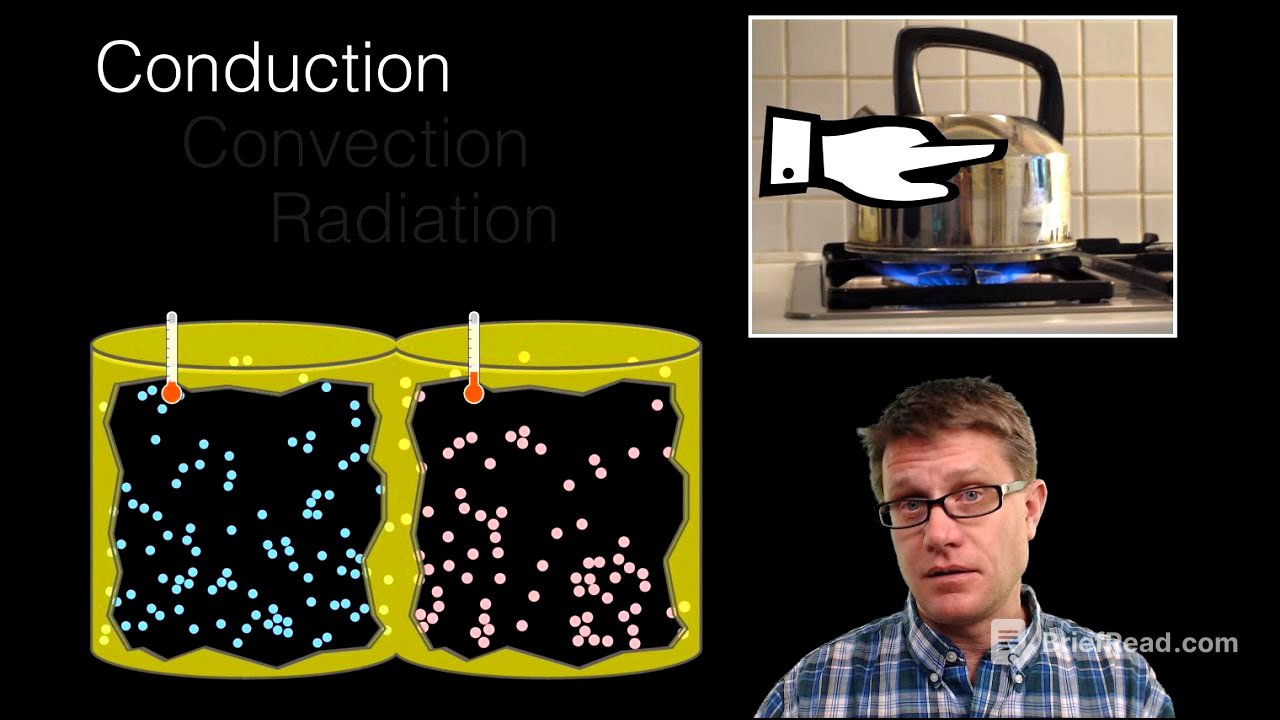
Conduction Mechanism [2:24]
The chapter elaborates on conduction, illustrating how touching a hot object, like a tea kettle, transfers energy to your finger by vibrating the molecules. The collision of molecules between the hot and cold surfaces is highlighted as a mechanism of energy transfer, emphasizing that the final temperatures will equalize.
Convection Process [3:01]
Mr. Andersen illustrates convection through the example of heating water in a tea kettle. As the water at the bottom heats up, it becomes less dense and rises, while the cooler water descends, creating a convection current. This process is not limited to liquids; it can also occur in gases.
Radiation Explained [3:36]
The chapter concludes with an explanation of radiation, where energy is transferred through electromagnetic waves, such as light from the sun or an infrared bulb. This form of heat transfer excites the molecules of the objects it hits, resulting in energy transfer. The summary emphasizes the different ways energy can be transferred through heat: conduction, convection, and radiation.