TLDR;
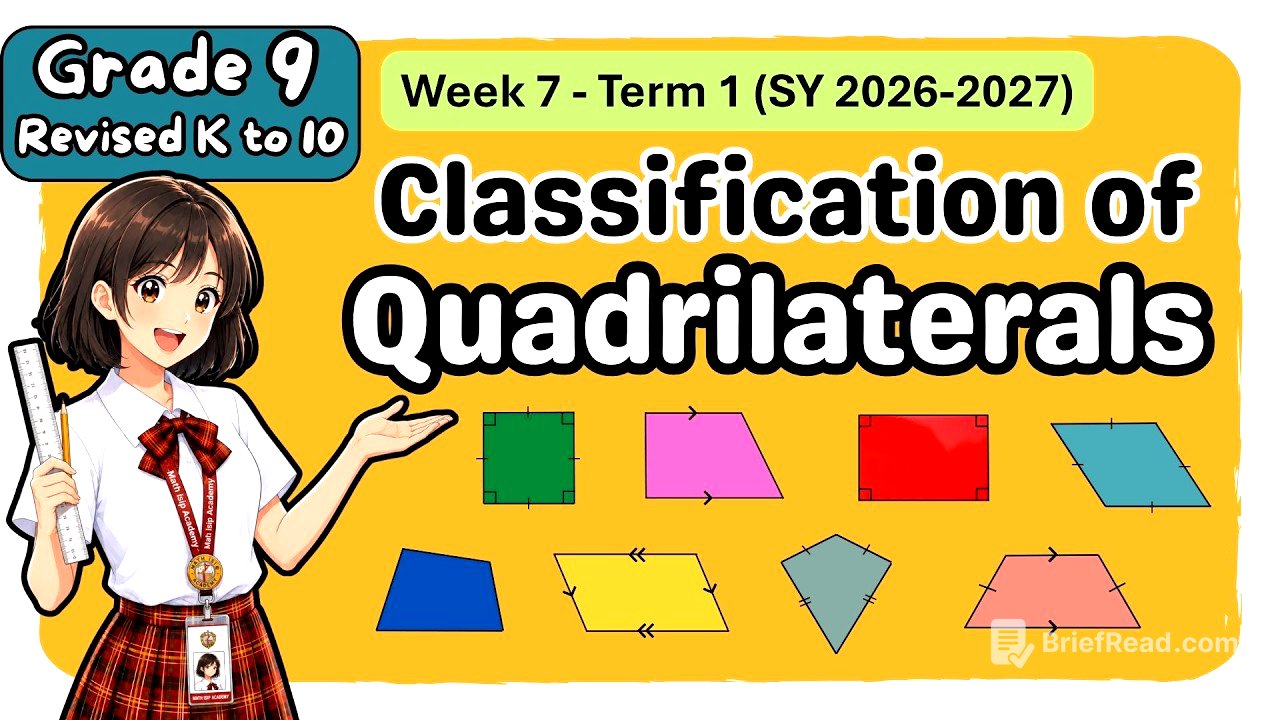
The tutorial focuses on the classification of quadrilaterals based on their properties and definitions. It covers the characteristics of various types of quadrilaterals, including trapeziums, trapezoids, parallelograms, rectangles, rhombuses, squares, kites, and isosceles trapezoids, along with explanations and visual representations of each.
- Introduction to quadrilaterals
- Classification by parallel sides
- Definitions of special types of quadrilaterals
Introduction to Quadrilaterals [0:00]
The lesson begins with an overview of quadrilaterals, defining them as simple closed polygons made of four line segments, which include four vertices and four angles. The instructor emphasizes recognizing the common characteristics of quadrilaterals, such as having four sides and angles, and the need for formal definitions to classify them accurately.
Classification of Quadrilaterals [4:23]
Quadrilaterals can be classified according to their parallel sides. The lesson first covers trapeziums, which are quadrilaterals with no pairs of parallel sides, making them general quadrilaterals. Next, trapezoids are introduced, which are defined by having exactly one pair of parallel sides. The legs of the trapezoids are identified as the non-parallel sides, with bases being the parallel sides.
Types of Parallelograms [8:32]
The video further examines parallelograms, defined as quadrilaterals with two pairs of opposite parallel sides. It introduces specific types of parallelograms: rectangles, defined as parallelograms with four right angles; rhombuses, characterized by having four congruent sides; and squares, which must have both four congruent sides and four right angles. The relationship between squares, rectangles, and rhombuses is explained.
Special Quadrilaterals: Kites and Isosceles Trapezoids [13:57]
The lesson then explains kites, defined as quadrilaterals with two distinct pairs of adjacent congruent sides. Isosceles trapezoids are also highlighted, characterized by having congruent non-parallel sides. The instructor stresses the significance of understanding these definitions for accurate classification.
Hierarchy of Quadrilaterals [17:45]
To summarize, a hierarchy of quadrilaterals is presented, detailing their categories based on the presence of parallel sides. The instructor emphasizes the classification system: trapeziums (no parallel sides), parallelograms (two pairs of parallel sides), and trapezoids (one pair of parallel sides), along with their special types.
Identifying Quadrilaterals with Visual Representations [19:50]
The tutorial proceeds with exercises for identifying quadrilaterals based on given figures and markings. It instructs viewers to recognize characteristics to determine the specific classification of various quadrilaterals, illustrating through multiple examples and responses.
Conclusion [22:55]
In concluding the lesson, the instructor revisits the initial question about which figure stands out from the others, metaphorically relating it to human diversity. The importance of respecting differences while recognizing equality among all is emphasized, reinforcing a sense of community within mathematics. The video ends with a call to action for viewers to practice identifying quadrilaterals independently.