TLDR;
This Grade 6 TLE (Technology and Livelihood Education) lesson focuses on food preservation, covering the selection of quality ingredients, safety practices, and the importance of preserving food to extend its shelf life while maintaining nutritional value. The lesson includes interactive activities like identifying tools, solving puzzles related to food preservation, and quizzes to reinforce learning.
- Importance of selecting fresh, high-quality ingredients for food preservation.
- Guidelines for choosing fruits, vegetables, fish, meat, and eggs for preservation.
- Essential safety and hygiene practices during food preservation.
- Interactive activities to reinforce learning and assess understanding.
Introduction [0:13]
The video starts with a welcome message to the learners, introducing the topic of the day, which is about food preservation. The teacher expresses excitement for the lesson and sets the tone for a fun and educational experience.
Reminders: Dos and Don'ts [1:32]
Before starting the lesson, some rules are given. Students are encouraged to comment only their answers, treat others with respect, and stay focused. They are instructed not to disturb other students, use inappropriate language, or post inappropriate stickers.
Learning Competencies [1:56]
The learning competencies for the lesson are outlined, focusing on preserving food by applying principles and skills in food preservation processing. This includes selecting food to be preserved based on the availability of raw materials, market demands, and trends in the community, as well as observing safety rules in food preservation and processing.
Identifying Tools and Equipment [2:39]
The lesson includes a section on identifying the tools and equipment used in food preservation. Examples include a meat grinder (used to mince and puree meat), a colander (used for draining liquid from food), a baster (used to drizzle juice or liquid on meat), cheesecloth (used for making or wrapping cheese), and a bowl (used for serving or mixing ingredients).
Guessing Game: Solve the Puzzle [4:17]
An interactive guessing game is introduced, where students solve a puzzle picture related to food. Questions prompt students to think about the picture, how to select food for preservation (choosing fresh and nutritious food), and why safety rules are important in food preservation (to extend the shelf life of foods).
What is Food Preservation? [4:57]
Food preservation is defined as the science of extending the shelf life of food while maintaining its nutritional quality and preventing the growth of unwanted microorganisms. The goal is to prevent spoilage and delay the changes in freshness, taste, and nutritive value that make food unfit for consumption.
Proper Selection of Ingredients: Fruits [5:36]
The success of food preservation starts with the proper selection of ingredients. For fruits, the guidelines include choosing fruits that are free from bruises and decays, smooth, have a natural smell, are heavy, have a good shape, are at the right degree of ripeness for the recipe, and have a pleasing aroma.
Proper Selection of Ingredients: Vegetables [6:37]
For vegetables, the guidelines include selecting those that are right in color, free from insect bites, bruises, and worms, heavy and firm, have leaves and stems that are crisp, and have a well-attached stem.
Proper Selection of Ingredients: Fish [7:16]
When selecting fish for food preservation, it should have firm flesh, no foul odor, clear and bright eyes, bright red gills, and shiny and tight scales.
Proper Selection of Ingredients: Meats [7:53]
For meats, the guidelines include ensuring they have a firm and fine texture, no foul odor, fats are well distributed, beef is red in color, pork is pinkish, beef fat is yellowish, pork fat is white, and the skin has a stamp of approval from the animal industry.
Proper Selection of Ingredients: Eggs [8:38]
When selecting eggs for food preservation, the shells should be slightly rough, the egg should sink in water, it should appear clear when placed before a light, and the yolk should stand firm.
Healthy and Safety Practices in Food Preservation [9:06]
Food preservation should be done safely and sanitarily. The steps include preparing necessary tools, equipment, and ingredients before starting, washing hands thoroughly before handling food, concentrating on the task to avoid accidents, sitting down while working to avoid fatigue, knowing how to use the tools and equipment, keeping the work area clean, working as fast as possible to minimize air exposure, labeling all ingredients to avoid mistakes, and returning everything to their respective storage after use.
Trivia: Did You Know? [10:51]
Interesting facts are shared, such as an apple a day keeps the doctor away due to its antioxidants and flavonoids. Eating dark green vegetables provides vital carotene (a form of vitamin A), and consuming fish can help prevent headaches due to fish oil.
Activity 1: Classify Me [11:51]
Students classify foods based on the qualities in selecting raw materials for food preservation. Examples include identifying fish based on bright red gills, eggs based on shells being slightly rough, meat based on well-distributed fats, vegetables based on being free from insect bites, and fruits based on their natural smell.
Activity 2: C or IC (Correct or Incorrect) [13:12]
Students identify whether statements about food preservation practices are correct (C) or incorrect (IC). Examples include washing hands before handling food (correct), standing all the time while working (incorrect), returning everything to storage after use (correct), working slowly to avoid air exposure (incorrect), and keeping kitchen utensils out of children's reach (correct).
Activity 3: Answer Correctly as Fast as You Can [15:08]
Students answer questions related to the lesson as quickly as possible. The questions cover preparing tools before starting, concentrating to avoid accidents, knowing how to use tools, keeping the work area clean, and labeling ingredients to avoid mistakes.
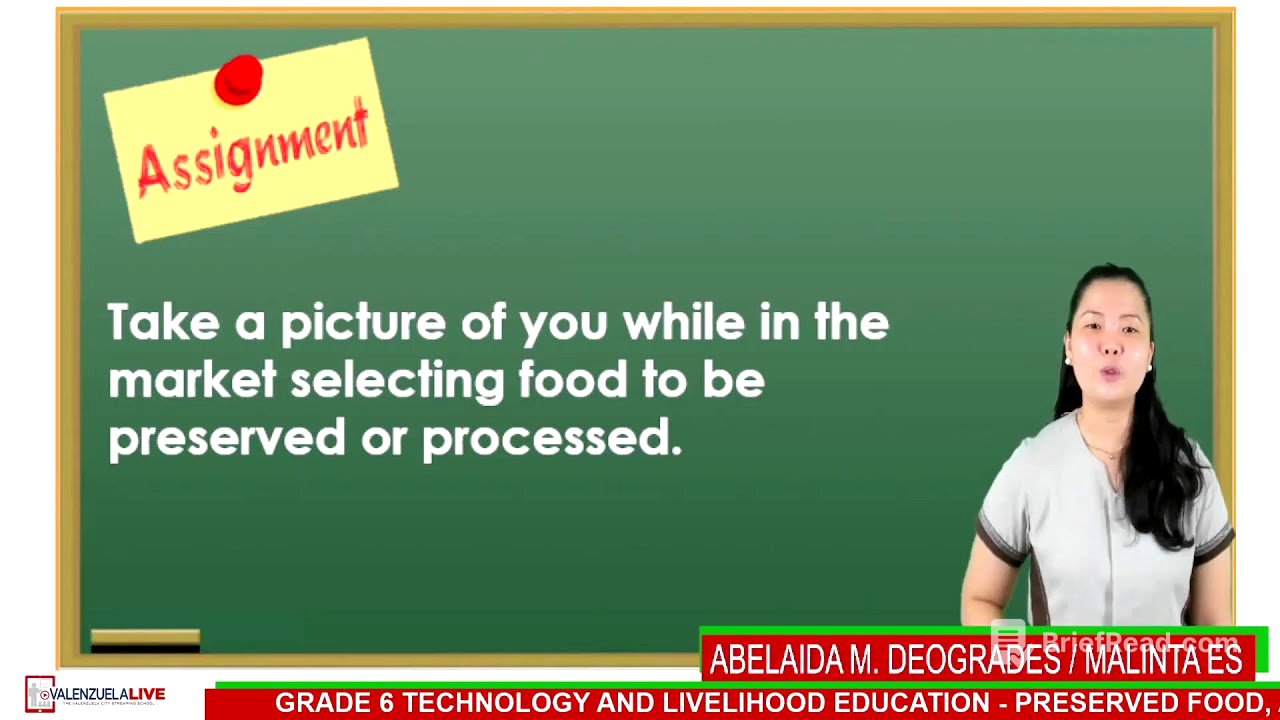
Assignment [16:42]
The assignment involves taking a picture while selecting foods to be preserved at the market with a parent or guardian. If not allowed to go to the market, students can use raw materials bought by their parents.
Q & A [17:13]
A question is answered about whether the nutritional value of food is affected when it is preserved or processed. The response explains that nearly every food preparation process reduces the amount of nutrients, especially when food is exposed to high levels of heat, light, or oxygen. Nutrients can also be washed out during cooking processes like boiling.
Acknowledgement and Closing [18:30]
The video acknowledges the module writers, editors, illustrators, content validators, and the management team. The teacher expresses hope that the students enjoyed and learned a lot from the lesson, and encourages them to keep up the good work.