TLDR;
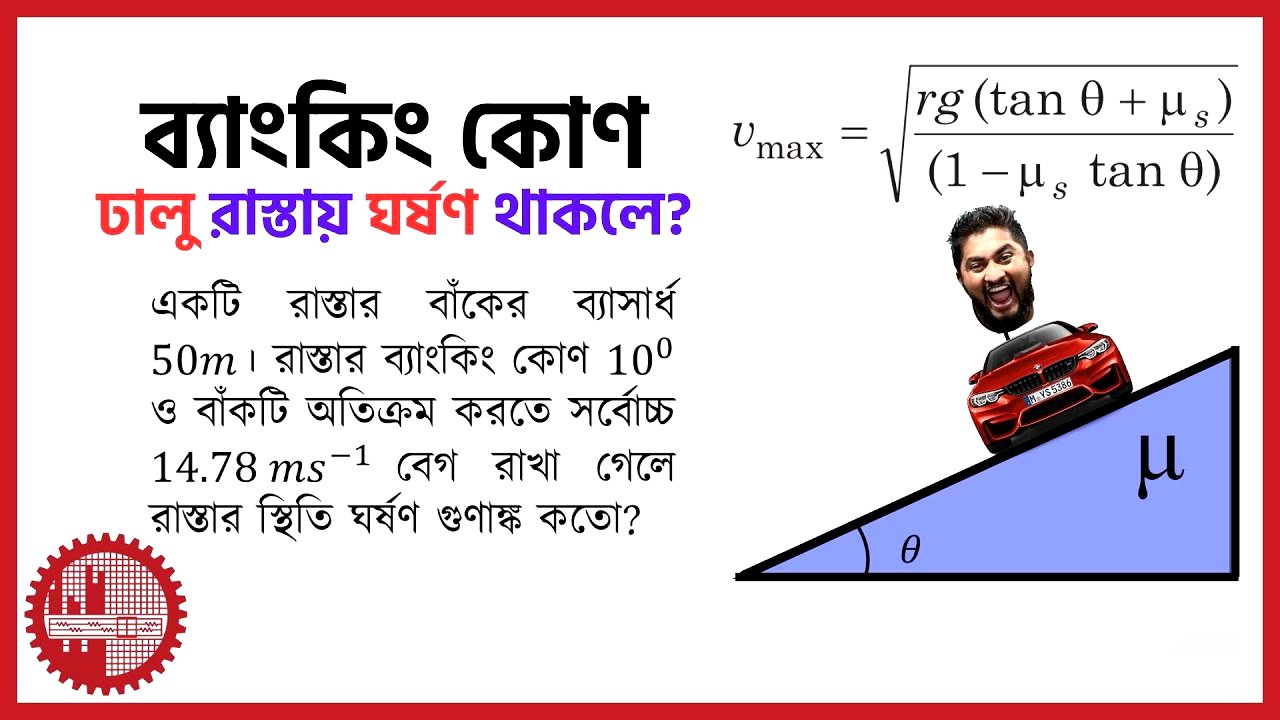
The video discusses the concept of maximum speed for vehicles negotiating curves without skidding, focusing on the principles of friction and the forces acting on a vehicle. Key points include the formulas relating speed to friction, the gravitational force, and the angles involved in the motion.
- Maximum speed is determined by friction and gravitational forces.
- Key equations include those for calculating the normal reaction force and maximum speed at which a vehicle can travel in a curve.
Understanding Forces in Vehicle Motion [0:14]
The video begins by introducing the friction angle and the forces acting on the vehicle, emphasizing the importance of these factors in determining maximum speed. It highlights that the friction angle, represented by theta, plays a critical role in the vehicle's dynamics.
Calculating Speed In Relation to Friction [0:58]
Next, the discussion moves towards calculating maximum speed. The speaker provides numerical examples, breaking down the formulas and explaining how the combination of friction and gravitational components affects the speed at which vehicles can safely negotiate curves.
Max Speed and Normal Reaction Force [1:28]
Continuing, the video delves deeper into the relationship between the maximum speed of a vehicle and its normal reaction force on a curved path. It covers calculations involving the forces of friction and gravitational pull, detailing the mathematical relationships involved.
Friction and Angle of Incline [2:51]
The chapter discusses how the angle of incline (lambda) interacts with friction to determine the limits of speed. The author demonstrates through equations and angles how adjusting the incline affects the vehicle's ability to maintain its trajectory.
Equations for Maximum Speed [4:28]
The presentation moves on to specific equations, laying out the variables that influence maximum speed. The relationships are thoroughly explained, providing a mathematical foundation for understanding vehicle dynamics in curved motion.
Importance of Normal Reaction Force [6:48]
Here, the significance of the normal reaction force is emphasized. The video elaborates on how this force affects the overall stability and safety of vehicles on curves while linking it to frictional forces and gravitational effects.
Final Calculations and Real-world Application [9:27]
In the final section, the author summarizes key calculations and their practical implications for vehicle design and safety. Ensuring vehicles can navigate curves at appropriate speeds without skidding highlights the intersection of physics and engineering in automotive applications.