TLDR;
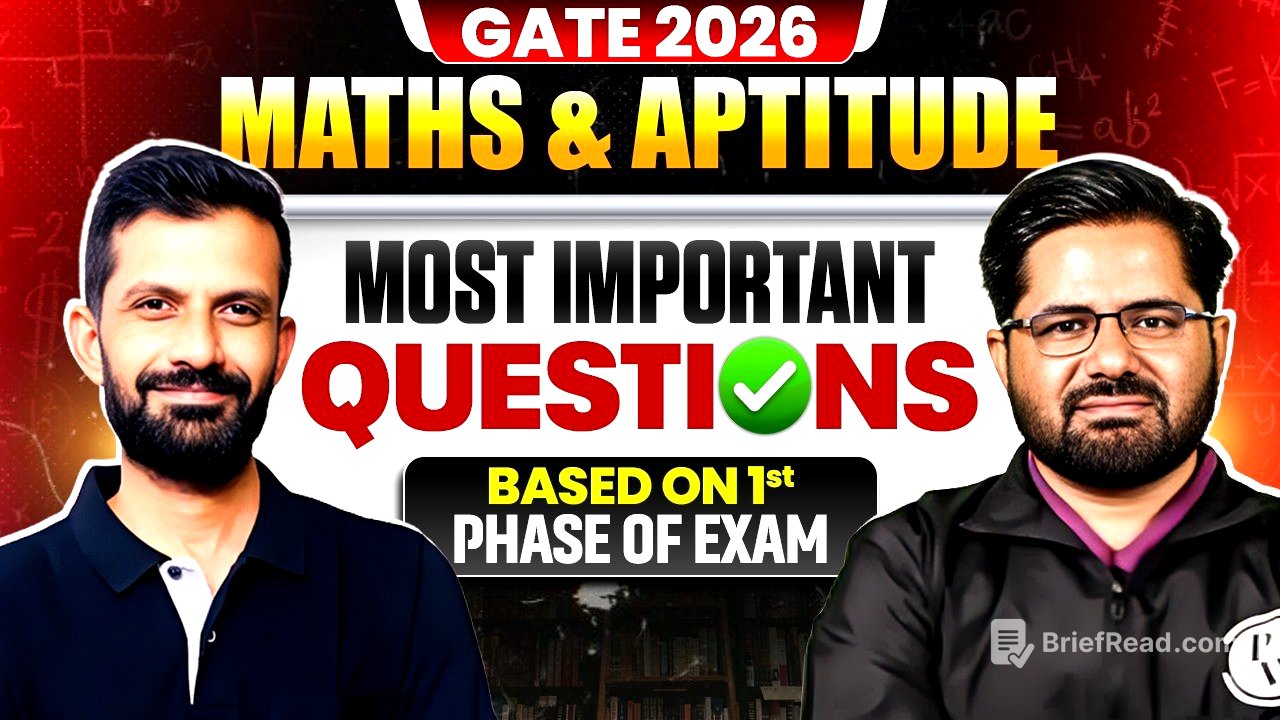
This YouTube session by GATE Wallah provides a comprehensive review of key mathematical concepts and problem-solving techniques relevant to the GATE exam. The session analyzes memory-based questions from recent GATE papers, focusing on topics like linear algebra, calculus, probability, and statistics. It also includes practice questions and strategies for tackling different types of problems, with a special emphasis on time management and avoiding common mistakes. The session also covers general aptitude questions.
- Linear Algebra: Determinants, eigenvalues, Cayley-Hamilton theorem, system of equations, LU decomposition.
- Calculus: Limits, continuity, Maclaurin series, maxima/minima, Jacobians, integration.
- Probability & Statistics: Conditional probability, binomial distribution, normal distribution, expected value, standard deviation.
- General Aptitude: Counting theory, numbers, mensuration, geometry, cubes, dices, calendars, verbal ability.
Introduction and Session Overview [0:37]
The session aims to assist students preparing for the GATE exam on the 14th and 15th, particularly those in EC, Electrical, Civil, and Mechanical branches. It focuses on questions from the CS, XE, and Instrumentation branches, covering memory-based questions and additional practice on untouched topics. A separate session for DA-specific topics is scheduled for the 11th at 10 PM on the EC/CS channel. The speaker encourages DA students to attend the current session to review linear algebra, calculus, and probability questions.
Linear Algebra: Determinants and Matrix Operations [3:53]
The instructor begins with a question on determinants, where a 4x4 matrix has a determinant of 3, and students are asked to find the determinant of 2A. The solution involves using the property that the determinant of a scalar multiple of a matrix is the scalar raised to the power of the matrix size times the determinant of the original matrix, resulting in an answer of 48.
Linear Algebra: System of Equations and Infinite Solutions [5:16]
A general question is presented, asking for what values of alpha and beta the given simultaneous equations have an infinite number of solutions. The approach involves forming an augmented matrix and using row operations to find the rank. For infinite solutions, the rank of the coefficient matrix and the augmented matrix must be equal and less than the number of variables. This leads to the conditions alpha = 3 and beta = 12.
Linear Algebra: System of Equations and Number of Solutions [8:36]
The session tackles a question from the Instrumentation branch regarding the number of solutions of ax = b. By forming an augmented matrix and performing row operations, the rank of A is found to be 2, while the rank of AB is 3. Since the ranks are not equal, no solution exists for the system of equations.
Linear Algebra: Cayley-Hamilton Theorem and Eigenvalues [11:09]
A question involving the Cayley-Hamilton theorem asks for the set of all eigenvalues of matrix P, given that P satisfies a certain matrix equation. The approach involves replacing the matrix P with lambda in the characteristic equation and solving for lambda. The eigenvalues are found to be 1, 1, and 2, so the set of eigenvalues is {1, 2}.
Linear Algebra: Properties of Matrices and Eigenvalues [14:32]
The session presents a theoretical question asking which statement is NOT true. The correct answer is that for an invertible matrix A, the eigenvalues of A and A inverse are identical, which is false because the eigenvalues of A inverse are the reciprocals of the eigenvalues of A.
Linear Algebra: Eigenvectors and Eigenvalues [17:26]
The session addresses a question where an eigenvector of a matrix is given, and the corresponding eigenvalue needs to be determined. By using the equation ax = lambda x, it is found that the given vector is not an eigenvector of the matrix because it leads to an invalid result (-1 = 0).
Linear Algebra: Determinants, Eigenvalues, and Invertibility [19:59]
A question from the XE branch involves a matrix A, and the task is to determine which statements are true. The determinant of A is calculated as -2, making option A false. The eigenvalues are found to be 1, -1, and 2, confirming that all eigenvalues are real numbers, making option C true. It's also determined that A - 2i is non-invertible, making option B false. The eigenvalues of A inverse are 1, -1, and 1/2, making option D true.
Linear Algebra: LU Decomposition [25:49]
The session tackles an LU decomposition question, where the goal is to find the value of alpha in a given decomposition. The approach involves multiplying the LTM and unit UTM matrices and comparing the result with the original matrix to solve for the unknowns. The presenter emphasizes that such lengthy questions should be saved for the end of the exam.
Linear Algebra: Multiplicity of Eigenvalues [33:30]
A question from the CS branch asks about the maximum multiplicity of an eigenvalue for an n x n matrix. The answer is n, as an eigenvalue can repeat up to n times.
Linear Algebra: System of Equations and Infinite Solutions (Detailed) [34:48]
The session revisits a system of equations problem, seeking the value of ab for infinite solutions. The determinant of the coefficient matrix is set to zero, yielding a = ±4. For a = 4, b is found to be 6, and for a = -4, b is -6, but in both cases, ab = 24.
Linear Algebra: Eigenvalues and Trace [39:49]
A question from Environmental Science asks to identify the correctly listed eigenvalues of a given matrix. The solution uses the property that the sum of eigenvalues equals the trace of the matrix. By calculating the trace (17) and comparing it with the sums of the options, the correct option (C) is quickly identified.
Linear Algebra: Properties of Matrices and Eigenvalues (Detailed) [42:12]
The session presents a multiple-select question about the properties of matrices. It's determined that the system is non-homogeneous, the matrix is non-singular, not skew-symmetric, and the eigenvalues are real.
Calculus: Continuity and Limits [45:53]
A question from the CS branch involves a function f(x) that is continuous at x = 0, and the task is to find c1 + c2. The approach involves setting c2 = 0 to avoid an infinite limit, and then using the condition that the limit of f(x) as x approaches 0 equals f(0) to find c1 = 3. Therefore, c1 + c2 = 3.
Calculus: Maclaurin Series Expansion [50:19]
The session addresses a practice question on Maclaurin series expansion. The goal is to find the value of 4q - 2p, given the Maclaurin series expansion of e^(2x) * cos(x). By expanding both functions and comparing coefficients, p is found to be 2 and q is 3/2, leading to an answer of 2.
Calculus: Continuity and Differentiability [54:03]
A question on discontinuity and differentiability from the CS branch is tackled. The function f(x) = x|x/2| is analyzed by breaking it into cases for x < 0 and x > 0. It's determined that f(x) has a maxima at x = 0, f'(x) is continuous, and f''(x) is non-differentiable.
Calculus: Continuity and Differentiability (Detailed) [1:00:01]
The session examines a question from the Instrumentation branch about the continuity and differentiability of f(x) = x|x|. By breaking the function into cases for x < 0 and x > 0, it's found that f(x) is both continuous and differentiable.
Linear Algebra: Advanced Matrix Problem [1:01:55]
The presenter revisits a complex matrix problem involving a 4x4 matrix with elements 0 and 1, where each row and column has an even number of ones. The solution involves determining the number of such matrices.
Calculus: Maxima and Minima [1:05:59]
A question from Environmental Science asks for the minimum value of a given function. By finding the critical points using the first derivative and applying the wavy curve method, the local minimum is determined. The minimum value is then calculated by substituting the x-value of the local minimum into the original function.
Calculus: Jacobian Determinant [1:09:20]
The session includes a practice question on Jacobians. Given u and v as functions of x and y, the goal is to find the partial derivative of xy with respect to uv at the point (1, 1). The approach involves calculating the Jacobian of uv with respect to xy, and then taking its reciprocal to find the desired partial derivative.
Calculus: Integration and Properties of Functions [1:11:31]
A question from the CS branch involves evaluating a definite integral. By recognizing that the integral can be split into odd and even functions, and using the properties of odd functions, the integral is simplified.
Calculus: Definite Integrals and Symmetry [1:14:59]
The session addresses a question involving a definite integral with a sine function. By recognizing the integral as a "question of country" (a standard integral), it's known that the value is independent of the parameter. This allows the integral to be split and evaluated, resulting in an answer of zero.
Calculus: Integration Techniques [1:17:16]
A question from Environmental Science requires evaluating an integral. The approach involves using substitution (cos x = t) to simplify the integral and then applying standard integration techniques.
Calculus: Area Calculation [1:20:15]
The session presents a straightforward question about finding the area in the first quadrant bounded by a line and the coordinate axes. The area is calculated as the area of a triangle, using the formula 1/2 * base * height.
Probability: Base Theorem [1:21:50]
The session addresses a question involving Bayes' theorem. Given a factory with three machines producing items with different defect rates, the task is to find the probability that a defective item was produced by machine B. The approach involves using Bayes' theorem to calculate the conditional probability.
Probability: Expected Value [1:27:15]
A question from the CS branch asks for the expected value of a discrete random variable. The expected value is calculated using the formula Σ(pi * xi), where pi is the probability of each outcome xi.
Probability: Conditional Probability and Binomial Distribution [1:35:53]
The session tackles a challenging question involving conditional probability and the binomial distribution. Given a fair coin tossed six times, the task is to find the conditional probability of event E1 (at least two heads in attempts 2, 4, and 6) given event E2 (number of heads equals the number of tails in attempts 1, 2, 3, and 5). The approach involves calculating the probabilities of E1, E2, and their intersection, and then using the formula for conditional probability.
Probability: ATM Pin Problem [1:41:34]
The presenter addresses a question about generating a four-digit ATM pin with at least one digit repeated. The solution involves calculating the total number of possible ATM pins and subtracting the number of ATM pins with no repeated digits.
Probability: Normal Distribution [1:43:50]
The session includes a question on the normal distribution. Given the mean and standard deviation, the task is to find the probability that a value falls between 26 and 40. The approach involves converting the x-values to z-scores and using the properties of symmetry to find the required probability.
Probability: Expected Value and Continuous Distributions [1:49:16]
A question from the XE branch involves finding the expected value of a continuous random variable. The approach involves using the formula for expected value, which is the integral of x * f(x) over the given range.
Probability: Normal Distribution Parameters [1:53:32]
The session addresses a question from the CS branch about identifying the parameters of a normal distribution. By comparing the given probability density function with the standard form, the mean and standard deviation are easily determined.
Probability: Standard Deviation and Data Analysis [1:55:36]
A question from Environmental Science involves calculating the standard deviation for a given set of data. The approach involves calculating the average and then using the formula for standard deviation, taking into account that the sample size is small (less than 30).
Probability: Basic Probability Calculation [2:00:31]
The session includes a basic probability question from Environmental Science. Given 26 cards with English alphabets, the task is to find the probability of picking either E or S. The solution involves using the addition theorem for probability.
Statistics: Median Calculation [2:02:18]
A question from the Instrumentation branch asks for the median of a given data set. The approach involves arranging the data in ascending order and finding the middle value.
Probability: Conditional Probability and Coin Tosses [2:04:10]
The session concludes with a challenging probability question from the CS branch involving conditional probability and coin tosses. The problem requires careful consideration of the conditions and the use of logical reasoning to determine the number of favorable outcomes.
Differential Equations: Classification of PDEs [2:19:32]
The session addresses a question from the XE branch about classifying a partial differential equation (PDE). By comparing the coefficients with the general form, it's determined that the PDE is hyperbolic for y > 1 and elliptic for y < 1.
Differential Equations: Linearity and Exactness [2:22:18]
A question from Environmental Science asks about the nature of a given differential equation. It's determined that the equation is linear, homogeneous, and non-exact.
Vector Calculus: Green's Theorem [2:24:27]
The session includes a question on Green's theorem. By applying Green's theorem, the line integral is converted into a double integral, which is then evaluated to find the area of the region.
Complex Analysis: Cauchy's Integral Formula [2:26:30]
A question from the Instrumentation branch involves evaluating a complex integral using Cauchy's integral formula. The approach involves identifying the pole and calculating the residue, and then applying the formula to find the value of the integral.
Series: Summation and Fourier Series [2:28:29]
The session concludes with a question involving a series and Fourier series. By recognizing the series as a telescoping series, its value is easily determined. The value of the limit is found using L'Hopital's rule.
General Aptitude: Tournament Problem [2:39:45]
The session transitions to general aptitude questions, starting with a tournament problem. The question asks how many games must be played in a 64-player single-elimination tournament to determine a winner. The solution involves recognizing that each game eliminates one player, so 63 games are needed to reduce the field to a single winner.
General Aptitude: Credit Allocation Problem [2:42:31]
A student needs to enroll for a minimum of 60 and a maximum of 70 credits, divided among projects, core courses, specialization, and electives. Core and project credits are fixed, specialization has a minimum requirement, and the goal is to maximize elective credits. The solution involves maximizing total credits and minimizing the other categories to find the maximum possible elective credits.
General Aptitude: Dice Rolling Probability [2:47:54]
A fair six-faced die is rolled twice, and the numbers are recorded. The probability that the number appearing on the second roll is an integer multiple of the number appearing on the first roll is calculated. The solution involves listing all possible outcomes and identifying those that satisfy the condition.
General Aptitude: City Visiting Problem [2:50:48]
A salesperson wants to visit each city once and return to the starting point. The question asks which of two city networks allows this. The solution involves trying to trace a path that visits each city exactly once and returns to the start.
General Aptitude: Logical Reasoning [2:53:26]
Given the statement "When it is raining, peacocks dance," the task is to identify the statement that is necessarily true. The correct answer is "When peacocks are not dancing, it is not raining."
General Aptitude: Profit and Loss [2:58:22]
A man sells two units of stock A and one unit of stock B. The cost and selling prices are given, and the profit is calculated.
General Aptitude: Grid Shading Problem [3:00:11]
A rectangular area is to be covered by square tiles of different sizes. The minimum number of tiles needed is determined.
General Aptitude: Age Arrangement Problem [3:02:19]
Four people of different ages make statements about their ages relative to each other. The youngest person is identified based on the statements.
General Aptitude: Direct and Indirect Speech [3:12:35]
A sentence in direct speech is given, and the correct form in indirect speech is chosen.
General Aptitude: Paper Folding and Cube Construction [3:14:54]
A paper is folded along dashed lines to construct a cube. The shaded region appears on the outer surface of the cube. The correct option is identified.
General Aptitude: Number Series [3:55:06]
A number series is given, and the missing number is identified.
General Aptitude: Vocabulary and Analogies [3:59:12]
The correct pair of words to fill the blanks is chosen.
End of Session [4:24:39]
The session concludes with a summary of the topics covered and encouragement for the upcoming GATE exam.