TLDR;
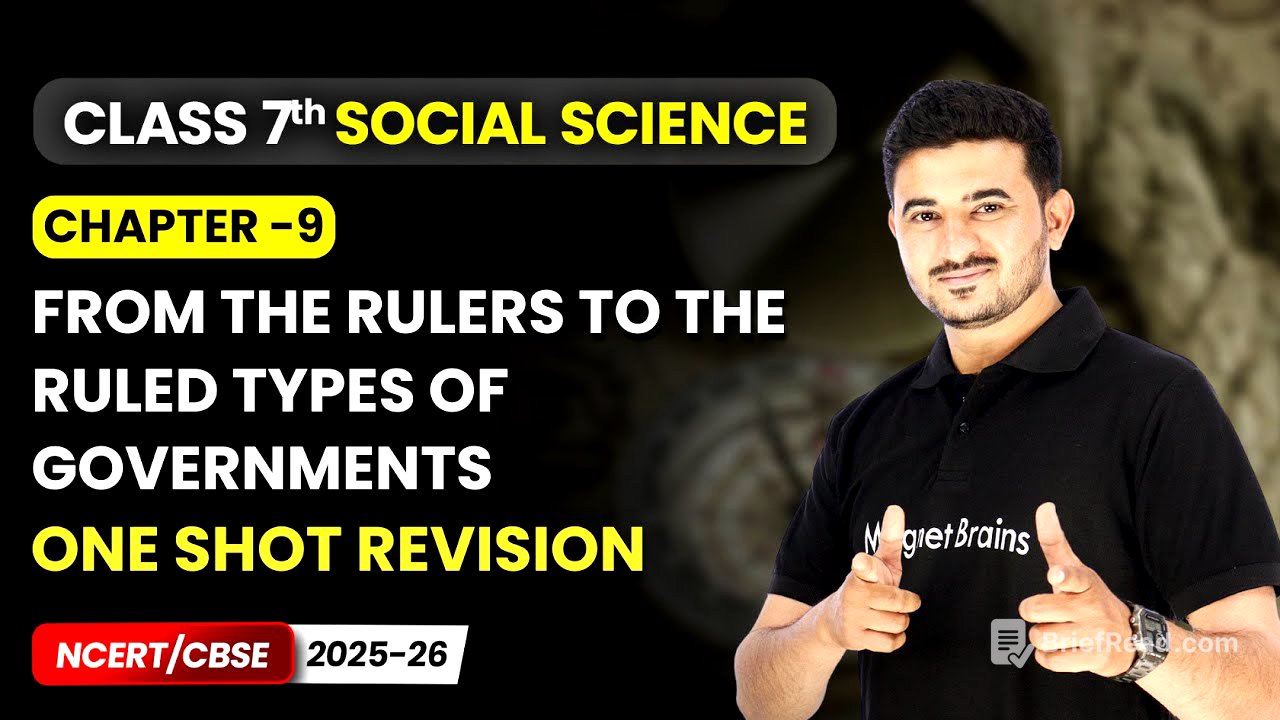
This video provides a comprehensive overview of Chapter 9, discussing various forms of government, types of democracy, organs of government, features of democracy, and the challenges it faces. It also touches upon early democratic traditions in India and the advantages of democracy.
- Forms of government include democracy, dictatorship, monarchy (absolute and constitutional), theocracy, and oligarchy.
- Democracy can be direct or representative, with representative democracy further divided into parliamentary and presidential forms.
- Organs of government are the legislature, executive, and judiciary, each with distinct functions and operating independently.
- Key features of democracy are universal adult franchise, equality before the law, freedom of speech and expression, government accountability, and an independent judiciary.
- Challenges to democracy include corruption, wealth inequality, excessive government control, media manipulation, and the need for vigilant citizens.
Introduction [0:00]
The lecture begins with an introduction to Chapter 9, which focuses on different types of governments and how they function. The discussion covers forms of government, how governments run countries, and the specifics of democracy.
Forms of Government [0:42]
The video explains several forms of government. Democracy is defined as a government chosen by the people, where citizens vote for representatives who make important decisions. Abraham Lincoln's definition of democracy as "government of the people, by the people, and for the people" is highlighted. Dictatorship is described as a system where a powerful individual or a small group holds all the power, exemplified by figures like Hitler and leaders in North Korea. Monarchy is a system where a king or queen rules. Absolute monarchy, where the ruler has full power, is exemplified by Saudi Arabia. Constitutional monarchy, where the king is a figurehead and actual power resides in a parliament, is exemplified by Britain. Theocracy is a government based on religion, where religious leaders hold supreme power, as seen in Vatican City and Iran. Oligarchy is a system where a small group of wealthy individuals rule, influencing government policies.
Types of Democracy [7:15]
Democracy is a popular form of government where the people rule and decide who governs the country. Direct democracy involves citizens directly participating in law-making, while representative democracy involves citizens electing representatives to make decisions on their behalf. Direct democracy is exemplified by Switzerland, while representative democracy is exemplified by India and the USA. Representative democracy is further divided into parliamentary and presidential forms. Parliamentary democracy, as seen in India, involves an elected parliament that chooses a Prime Minister who leads the country with the support of a Council of Ministers. Presidential democracy, involves the direct election of a president who serves as the head of the executive branch, regardless of parliamentary support.
Organs Of government [15:30]
The organs of government are divided into the legislature, executive, and judiciary. The legislature, such as the Parliament, makes the rules. The executive, which includes the Prime Minister, implements these rules. The judiciary interprets the laws and ensures justice, operating independently to prevent any one branch from becoming too powerful. This separation of powers ensures that no single entity can interfere in the matters of another.
Features of Democracy [17:26]
Democracy has several key features. Universal adult franchise ensures that every adult citizen has the right to vote, regardless of gender, caste, race, or religion. Equality before the law means that everyone is treated equally under the law, without discrimination. Freedom of speech and expression allows citizens to express their ideas and beliefs without restriction. The government is accountable to the people and works for the well-being of its citizens. An independent judiciary ensures fair and unbiased application of the law.
Democracy V/s Other system [20:30]
Democracy is compared to other systems like monarchy, where a hereditary ruler governs, dictatorship, where power is concentrated in one person, and oligarchy, where a few wealthy individuals rule. In contrast, democracy empowers the people to choose their leaders and participate in governance.
Early Democratic Traditions in India [21:27]
Ancient India had democratic practices, such as the Vajji republic, where people decided who would be king, and the Chola period, where village elections were conducted in Tamil Nadu. These examples demonstrate that democratic traditions existed in India long ago.
Advantages of Democracy [22:39]
Democracy protects the freedom of its people, allowing them to remove a government they dislike through voting. The government works to promote the welfare of its citizens.
Challenges to Democracy [23:16]
Democracy faces challenges such as corruption and wealth inequality. Governments may try to exert excessive control, undermining independent bodies like the judiciary. Media manipulation can also occur, where the press is influenced to promote the government's agenda. Citizens must remain vigilant, monitor government activities, and advocate for strong laws and a free media. Fair elections and an informed citizenry are essential for a healthy democracy.
Website Overview [25:35]
The lecture concludes by encouraging viewers to visit the YouTube channel, application, and website for more free courses and e-notes related to the topic.