TLDR;
This video simplifies the fishing process by presenting eight essential rigs that cater to various freshwater fishing situations. Understanding these rigs helps anglers manage their setups and improve their fishing confidence.
- Most anglers own more rigs than necessary; eight versatile setups suffice for most situations.
- Each rig is explained with its function, best use cases, and common mistakes to avoid.
- A decision matrix is provided for anglers to use based on water clarity, depth, cover, and target species.
The Essentials of Fishing Rigs [0:00]
The video introduces the concept that many anglers overcomplicate their tackle by owning an excess of rigs. Brian emphasizes that only a handful of key rigs are needed to fish effectively across various freshwater environments.
Rig 1: The Carolina Rig [1:20]
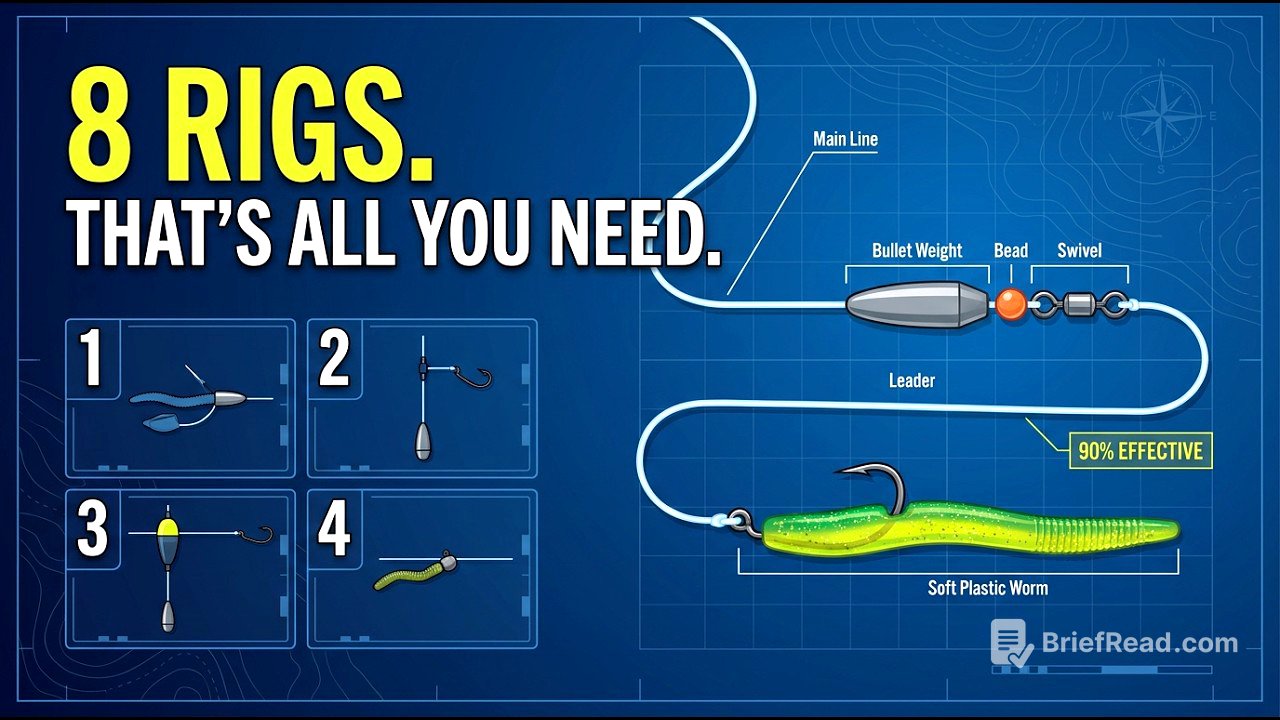
The Carolina rig is ideal for exploring large areas near the bottom. It consists of a sliding weight, bead, swivel, leader line, and hook. This rig enhances casting distance and bottom contact while allowing the bait to move naturally. The leader's length affects how close the bait remains to the bottom, with a common length of 18 to 24 inches. It performs best in open areas but is ineffective in thick cover due to the long leader tangling.
Rig 2: The Texas Rig [3:05]
The Texas rig is versatile and suitable for targeting specific areas like grass, wood, and docks. It comprises a bullet-shaped weight and a worm hook, with proper rigging ensuring the bait sits straight. Adjusting weight is crucial to maintain natural bait movement. Unlike the Carolina rig that focuses on searching areas, the Texas rig aims at specific targets.
Rig 3: The Drop Shot Rig [4:51]
The drop shot rig places the weight at the bottom and suspends the hook above it, allowing for precise bait depth control. This rig is effective for fish that are slow or holding at a certain depth. Gentle movements are crucial, and keeping the line slightly taut helps maintain bait delicacy. Pulling too tightly can lead to unnatural action.
Rig 4: The Ned Rig [6:24]
The Ned rig features a small soft plastic bait on a light jig head, making it simple yet effective in clear and pressured water. Its design resembles a small meal, and it works well when used near rocks and weeds. Subtle movements are key, and the rig should not be overworked. The exposed hook can snag vegetation, limiting its use to more open areas.
Rig 5: The Slip Float Rig [7:54]
The slip float rig controls bait depth and is easy to cast. It involves a bobber stop, bead, sliding float, and a hook. This rig is effective for panfish with worms or larger live bait for predators. The float serves as both depth control and bite indicator. A common mistake is setting the depth incorrectly, which can hinder bait effectiveness.
Rig 6: The Bottom or Three-Way Rig [9:26]
The bottom rig is designed for bottom-feeding fish and can be set up with a single sliding weight or a three-way arrangement. It allows fish to take bait without resistance. Adjustments should be made based on current strength in rivers, and a common mistake is adding too many components, which can lead to tangled setups.
Rig 7: The Alabama or Umbrella Rig [11:05]
The Alabama rig simulates a school of baitfish by featuring multiple small swimbaits attached to wire arms. It is effective in open water where fish are actively feeding. The rig requires appropriate tackle due to its weight and requires careful retrieval to maintain depth control. It’s not suitable for heavily vegetated areas.
Rig 8: The Weightless Soft Plastic Rig [12:28]
The weightless soft plastic rig uses a hook without any added weight, allowing the bait to fall slowly and naturally. It is particularly effective in shallow waters and around cover. Anglers should focus on subtle movements and not overwork the bait. A lighter setup is recommended to ensure a natural presentation.
The Rig Decision Matrix [13:50]
Choosing the right rig depends on answering four questions regarding water clarity, fish depth, cover present, and target species. Key recommendations are provided for each scenario, emphasizing simplicity and effectiveness over complicated setups. By learning these eight rigs and matching them to conditions, anglers can enhance their fishing experience.