TLDR;
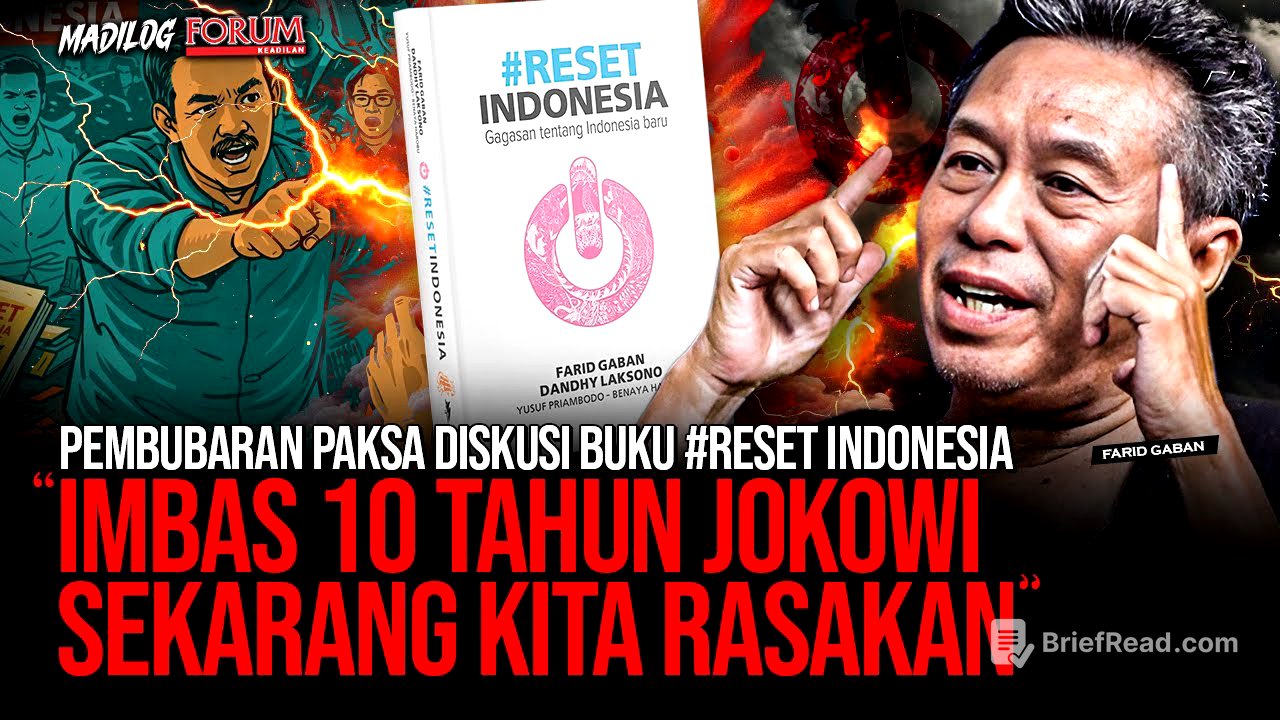
This YouTube video features an interview with Farid Gaban, a seasoned journalist and author of "Reset Indonesia." The discussion centers on the need to reset Indonesia due to widespread damage across various sectors, including environmental degradation, social conflicts, economic inequality, and political dysfunction. Gaban argues that relying solely on economic growth fueled by debt and foreign investment is unsustainable and detrimental to the nation's well-being. He advocates for a shift in mindset, emphasizing community empowerment through cooperatives, genuine democracy, and a focus on social justice and environmental sustainability. The conversation also touches on the historical context of Indonesia's economic policies, the role of political elites, and the importance of citizen participation in shaping a better future for the country.
- Indonesia needs a reset due to widespread damage across various sectors.
- Over-reliance on economic growth fueled by debt and foreign investment is unsustainable.
- Community empowerment through cooperatives and genuine democracy is crucial.
- A shift in mindset is needed, focusing on social justice and environmental sustainability.
- Citizen participation is essential for shaping a better future.
Introduction [0:00]
The host introduces Farid Gaban, a respected journalist and author, highlighting his extensive travels and deep reflections on Indonesia's current state. Gaban's book, "Reset Indonesia," serves as the basis for their discussion, which aims to explore the critical issues facing the nation and propose solutions for a more sustainable and just future. The host emphasizes the importance of understanding the root causes of Indonesia's problems and considering alternative paths forward.
Why "Reset" Indonesia? [3:48]
Farid Gaban explains why he chose the term "reset" rather than "restart" for his book. He argues that a simple restart, like rebooting a computer, is insufficient to address Indonesia's deep-seated issues. A reset involves reconfiguring and rearranging fundamental aspects of the country, including its software (policies) and hardware (infrastructure). Gaban believes that Indonesia needs a comprehensive overhaul to address the systemic problems that hinder its progress.
Problems and Solutions [4:50]
Gaban shares insights from his three expeditions across Indonesia, conducted over several years with different generations of travelers. These journeys revealed a worsening state of environmental damage, escalating social conflicts, excessive security measures, and growing economic inequality. He points out that while economic growth may be occurring, it often exacerbates existing disparities, with the poorest communities bearing the brunt of environmental disasters. Gaban stresses the need to redefine development goals, moving beyond mere economic growth to prioritize environmental protection, social justice, and genuine citizen participation.
Loss of Direction Since the New Order [10:21]
Gaban traces Indonesia's loss of direction back to the New Order era, when the country embraced a development model based on foreign investment and debt. He argues that this model, influenced by economist Walt Rostow's stages of economic growth, prioritized capitalist development and led to increased economic liberalization. The 1998 financial crisis exposed the vulnerabilities of this approach, but subsequent reforms failed to correct course, instead pushing for even greater liberalization under the guidance of the International Monetary Fund (IMF).
The Failures After 1998 [13:48]
Gaban explains that after the 1998 crisis, the dominant narrative was that the government was insufficiently liberal. This led to further liberalization and privatization, exemplified by the Memorandum of Understanding (MOU) with the IMF, which Gaban views as a severe surrender of sovereignty. While efforts were made to improve governance through institutions like the Corruption Eradication Commission (KPK), these efforts were ultimately undermined, leading to a situation where economic liberalization continued unchecked, while institutions meant to curb its excesses were weakened.
The Burden of Debt [16:19]
Gaban addresses the issue of Indonesia's debt, noting that despite periods of debt repayment, the country has continued to rely on debt financing through instruments like government bonds. He argues that the IMF's doctrines have become ingrained in economic policymaking, even without the IMF's direct involvement. The accumulation of debt, particularly in the last decade, has placed a significant burden on the country, with a large portion of the state budget allocated to interest payments.
The Need for a Change in Mindset [20:41]
Gaban emphasizes the need for a fundamental shift in mindset regarding economic development. He laments the decline of critical discourse and the dominance of a singular, pro-capitalist narrative. He calls for a revival of diverse perspectives and a more inclusive democracy that goes beyond elections and incorporates participatory elements, equality before the law, and a reduced role for political parties in candidate selection.
Building Democracy Through Cooperatives [25:36]
Gaban suggests building genuine cooperatives as a way to foster democracy and community empowerment. He highlights the principles of cooperatives, such as voluntary participation, democratic management, and collaboration, as essential for promoting economic and social well-being. He contrasts this approach with top-down initiatives like the "Koperasi Merah Putih," which he views as instruments of co-optation rather than genuine community-led development.
The Role of Political Parties [35:23]
Gaban critiques the current political system, arguing that it functions like a flawed machine that cannot self-correct. He calls for reforms to party laws, including allowing local parties and reducing the dominance of national parties. He emphasizes the need to shift away from a money-driven political culture and promote a system where politicians are motivated by public service rather than personal gain.
Citizen Participation and Civil Society [38:59]
Gaban stresses the importance of citizen participation and the role of civil society in driving change. He encourages people to organize themselves, build networks, and support individuals who are working for positive change in their communities. He suggests expanding the pool of potential leaders beyond traditional political elites to include individuals from civil society who have demonstrated a commitment to public service.
Overcoming Oligarchy [45:12]
Gaban discusses the challenges posed by oligarchy and the need to challenge prevailing measures of success. He suggests shifting the focus from economic growth to well-being and happiness, and promoting alternative indicators of progress, such as access to clean water. He argues that this shift in perspective can render existing political elites irrelevant and pave the way for a more just and sustainable society.
The Privatization of Water [47:57]
Gaban uses the example of water privatization to illustrate the consequences of neoliberal policies. He notes the irony of people having to buy water in a country with abundant water resources and highlights the disproportionate burden this places on low-income communities. He warns against further privatization of water resources, which would exacerbate social and economic inequalities.
Systemic Corruption [52:35]
Gaban connects the issue of water privatization to systemic corruption, arguing that laws and regulations that enable privatization are often driven by the financial interests of politicians. He reiterates the need to address the root causes of corruption by reforming the political system and promoting greater transparency and accountability.
The Breaking Point [54:16]
Gaban cautions that Indonesia may be approaching a breaking point, potentially triggered by economic factors such as the country's heavy debt burden. He notes that social and legal systems are already weakened, and a major economic shock could lead to widespread unrest. He emphasizes the urgency of implementing reforms to avert a crisis.
The Need for Revolutionary Patience [56:15]
Gaban acknowledges that significant change will take time and requires "revolutionary patience." He draws on his experiences during the 1998 reformasi movement to illustrate the challenges of transforming a deeply entrenched system. He calls for a shift in mindset, a commitment to education, and a willingness to challenge established norms.
A Broken System [58:27]
Gaban asserts that the political and legal components of Indonesia's system are fundamentally broken. He expresses concern over the erosion of trust in the legal system and highlights the prevalence of conflicts related to development projects, where communities are often divided and exploited.
Internal Colonialism [1:01:11]
Gaban suggests that Indonesia is experiencing a form of internal colonialism, where the government and corporations exploit communities for their own benefit. He emphasizes the need for bottom-up development approaches that prioritize community participation and well-being over top-down projects imposed without consultation.
The Patience of the People [1:03:49]
Gaban expresses his belief in the inherent goodness and tolerance of the Indonesian people. However, he warns that their patience has limits and that the elite must recognize the need for change to prevent social unrest. He points to past demonstrations as evidence of growing discontent and the potential for escalation if grievances are not addressed.
Conclusion [1:07:53]
In closing, the host summarizes the key takeaways from the conversation, emphasizing the need for a return to fundamental principles of justice and sustainability. He quotes Bung Hatta and Albert Schweitzer to underscore the importance of addressing poverty and living in harmony with nature. The host concludes by reiterating Gaban's call for a reset of Indonesia, not for the sake of mere progress, but for the sake of justice and sustainability.