TLDR;
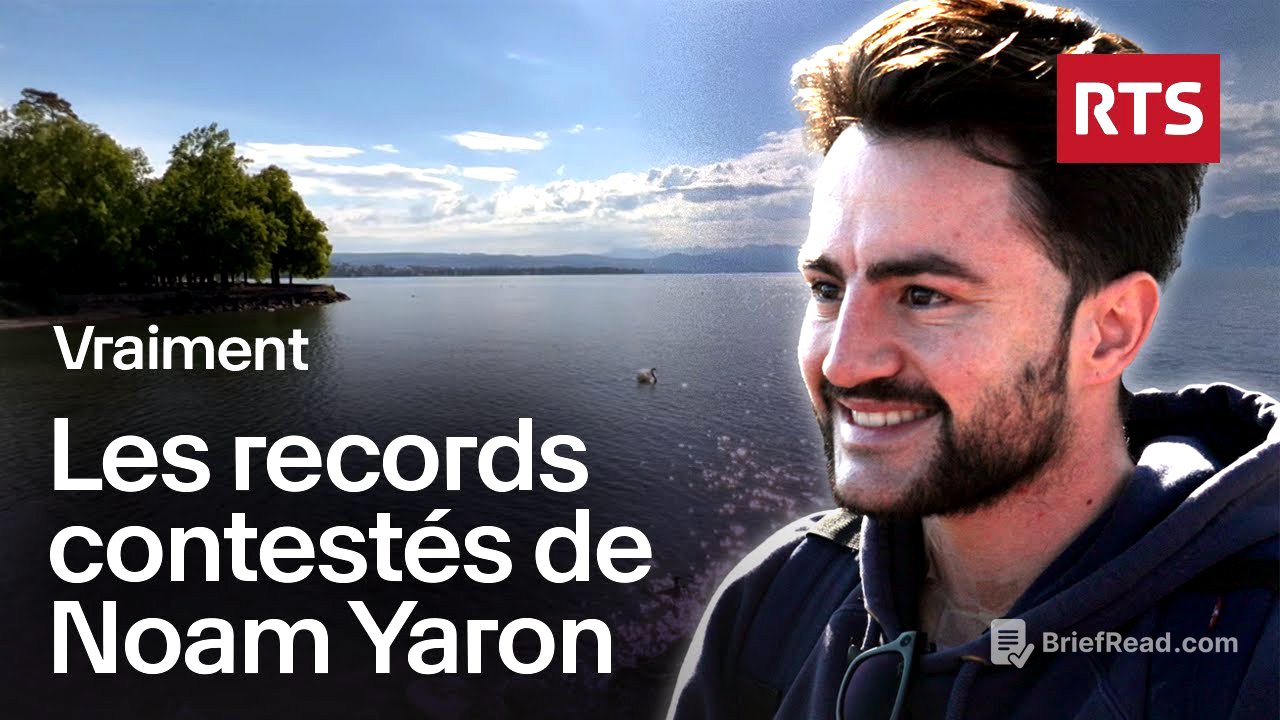
This investigation explores the claims and actions of Swiss swimmer Noam Yaron, who gained media attention for alleged world records and environmental advocacy. The investigation questions the validity of his records, the use of funds collected for environmental causes, and the accuracy of his public statements. It also examines his relationships with sponsors and the impact of his actions on the credibility of eco-conscious ventures.
- The validity of Noam Yaron's claimed world records is questioned, as official organizations have not ratified them.
- The use of funds collected for environmental conservation is scrutinized, with a small percentage directly allocated to scientific research.
- Claims made by Noam Yaron, such as sleeping while swimming, are examined and debunked by experts.
- Discrepancies are found in the collection of cigarette butts during public campaigns, with inflated numbers reported.
- Sponsorships with companies that have negative environmental impacts raise concerns about the authenticity of his environmental advocacy.
- A past crowdfunding campaign for a TV series remains unresolved, with contributors allegedly not fully reimbursed.
Introduction [0:00]
The report introduces Noam Yaron, a Swiss swimmer who has garnered media attention for his purported world records. The investigation aims to verify whether Yaron's records are legitimate and whether his efforts genuinely contribute to environmental preservation. It also questions the whereabouts of the funds raised during his athletic endeavors, which were intended to support Mediterranean conservation.
Analyse des données GPS [6:32]
The investigation team obtained GPS data from Noam Yaron's swim via an Instagram post that revealed the names of the accompanying yachts. This data was cross-referenced with information Yaron provided on a platform tracking his performance. To analyze the data, the team consulted Louis, a biomechanics and sports physiology expert at the University of Lausanne. Louis noted that without a personal tracking device on Yaron, the GPS data likely originated from the support boat, raising questions about its accuracy in reflecting Yaron's actual swimming. The data could not confirm whether Yaron was in the water or if he received assistance. The World Open Water Swimming Federation clarified that they did not validate Yaron's record, as longer assisted swims have been completed by others. They could only classify his swim as an assisted stage swim if he had finished.
Les fonds pour l’environnement : où sont-ils passés ? [14:05]
Noam Yaron collected 115,000 francs between 2024 and 2025 for his project, promising that the funds would support conservation efforts in the Mediterranean. The primary partner association, Objectif Environnement, is run by Yaron's girlfriend as president and his mother as treasurer. According to its statutes, the association supports sports challenges for environmental causes. Only 0.8% of the funds were allocated to scientific research during his last swim. Following inquiries, Yaron announced a project offering up to 10,000 francs for Mediterranean protection, potentially raising the total allocated to science and environmental protection to 2.9%. In comparison, French swimmer Remy Camu allocated one-third of his budget to sampling and analysis during his sports challenge.
Dormir en nageant : mythe ou réalité ? [17:02]
Noam Yaron has claimed to be able to sleep while swimming, suggesting that one part of his brain sleeps while the other maintains his position. Experts in sleep medicine were consulted at their annual conference. While some suggested hypnosis could achieve a similar effect, none could confirm the ability to sleep with only half the brain. Bertrand de la Gyclé, a sleep specialist, stated that such a phenomenon has only been observed in a rare species of blind dolphin. He suggested Yaron might be experiencing micro-sleeps, where the entire brain is briefly impacted.
Fact checking sur la collecte de mégots et subventions publiques [20:22]
Noam Yaron received 40,000 francs in public subsidies from the Federal Office for the Environment over four years for his cigarette butt collection challenge. He aimed to collect over one million cigarette butts in 10 days. During a visit to one of his collection events, discrepancies were found in the reported numbers. While Yaron claimed to have reached tens of millions of people through his posts, online investigators found his follower counts on various platforms to be significantly lower. Chloé Léger, another swimmer focused on environmental action, emphasized the importance of verifying the impact of environmental campaigns. An analysis of the cigarette butt collection revealed that the actual number collected was almost half of what was announced by Yaron. The Federal Office for the Environment confirmed that they would no longer provide public subsidies to Yaron's challenge after 2025.
Vérification de ses sponsors et impact sur l’environnement [29:35]
Noam Yaron discussed the ethical dilemma of accepting sponsorships from companies with questionable environmental records, such as tobacco companies and Total Energy, but claimed to have rejected them. However, a LinkedIn post revealed that Philip Morris was a partner in a cigarette butt collection event in 2025. Additionally, Banque Richelieu Monaco, a sponsor, invests in fossil fuels, with 6.9% of its investments negatively impacting sensitive areas. Nivea, another major sponsor, promotes a sunscreen that is only 89% biodegradable and contains a chemical UV filter, salicyate doctyle, suspected of being an endocrine disruptor. A study indicated that this filter could reduce egg production in copepods, essential for zooplankton.