TLDR;
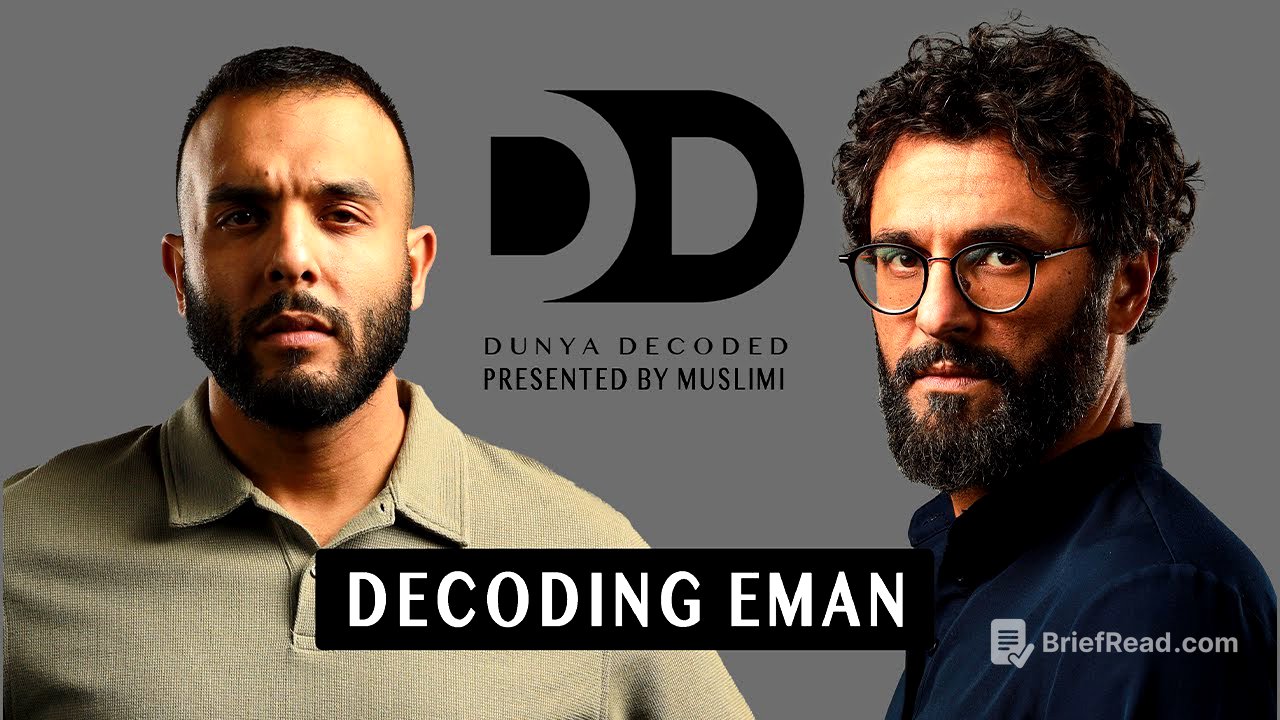
This video decodes the concept of Iman (faith) in Islam, emphasizing that it begins with negating what one perceives and affirming what Allah reveals in the Quran. It highlights the importance of seeing with the heart, not just the eyes, and understanding that true reliance should be on Allah, not on worldly means. The video also discusses how to strengthen Iman through glorifying Allah, focusing on good deeds, and recognizing that difficulties in life can be a way for Allah to bring one back to Him.
- Iman starts with negating perceptions and affirming Allah's words.
- Seeing with the heart is crucial.
- Reliance should be on Allah, not worldly means.
- Glorifying Allah and doing good deeds strengthen Iman.
- Difficulties can be a call to return to Allah.
Decoding Iman: The Key to Success in Life [0:00]
The video begins by stating that everyone seeks success, which starts with understanding Iman. Iman is described as a test from Allah, primarily through what we see and hear. Most people are engrossed in the outward appearances of the world and are heedless of the unseen system of Allah. Understanding Iman involves negating what we perceive and affirming what Allah tells us in the Quran.
The Essence of Iman: Negation and Affirmation [3:32]
The discussion highlights that Iman begins with negation, similar to the Islamic declaration of faith (shahada), which starts by negating all gods before affirming Allah. True understanding requires insight from the heart, not just sight from the eyes. The heart is the container of Iman, which allows one to see differently. Iman is defined as having certainty and allows a different type of seeing.
Seeing with the Heart: A Story of True Belief [6:09]
A story is shared about a Sahabi (companion of the Prophet) who describes waking up with true Iman, no longer interested in worldly matters, spending nights in worship, and days fasting. He describes seeing the Throne of Allah and the realities of Paradise and Hell with his heart. This illustrates that true Iman is a certainty placed by Allah in the heart, enabling one to see beyond the physical world.
The Test of Iman: Believing Allah Over Perception [9:00]
The core test in life is whether one believes what they see with their eyes or what Allah tells them in the Quran. People often chase desires and the material world, becoming slaves to their desires. True freedom lies in being a slave to Allah's commands, which leads to freedom in the afterlife.
Relying on Allah: The Story of Musa (Moses) [10:43]
The story of Musa (Moses) and his staff is used to illustrate relying on Allah rather than worldly means. Initially, Musa relies on his staff for support and sustenance, but Allah commands him to drop it, turning it into a snake to show that true help comes from Allah. Musa is then told to pick it up without fear, teaching him that benefit comes from Allah, not the staff itself.
Directing the Heart: The Key to True Iman [13:06]
Before prayer, one must direct their heart towards Allah. The Prophet Muhammad was sent to change people's hearts, not just their conditions. People often rely more on others than on Allah, feeling comfortable when someone promises help but doubting when asked to turn to Allah.
The Conditioned Mind: Pavlov's Dog and Reliance on Means [14:16]
The story of Pavlov's dog is used to explain how people are conditioned to believe in the effects of worldly means. People often prioritize immediate solutions over turning to Allah first. The heart's inclination during times of need is a measure of one's Iman. Allah looks at the heart when one has a need, wanting them to utilize means but not rely solely on them.
The Leaf of Cure: Turning to Allah First [16:43]
A story is shared about a man who was directed by Allah to use a leaf for healing. The first time he was healed, but the second time, when he went directly to the leaf without turning to Allah, it didn't work. This illustrates that means are ineffective without Allah's will. People often mistakenly believe they are satisfied by food or cured by medicine, forgetting that Allah is the ultimate provider and healer.
The Test of Distraction: Prioritizing Allah's Commands [18:24]
The importance of not being distracted from Allah's commands is emphasized. The test is to train oneself to turn to Allah first in every situation, recognizing that He is the one who satisfies hunger, quenches thirst, and cures ailments.
Strengthening Iman: The Path to Guidance [19:14]
Strengthening Iman requires effort, as Allah guides those who struggle in His commands. The early verses of the Quran focused on the greatness of Allah and the unseen help, aiming to increase the Sahabah's Iman. This can be achieved by glorifying Allah, starting with the Adhan (call to prayer), which proclaims Allah's greatness.
The Formula for Increasing Iman: Glorification and Return to Allah [21:02]
To increase Iman, one must glorify Allah and talk about His greatness. This solidifies Iman, leading to a constant return to Allah in all matters. This return brings happiness and peace, as one recognizes that everything happens by Allah's will.
Iman, Deeds, and Results: A Connected Cycle [22:47]
Iman, good deeds, and positive results are directly connected. Increasing Iman motivates one to do good deeds, which then leads to better outcomes in life. Conversely, negative results should prompt one to check their deeds and Iman. Turning away from Allah's obedience leads to depression and problems.
Rectifying Deeds: The Path to Good Situations [25:06]
Fixing Iman motivates one to do good deeds, which rectifies their affairs. Good deeds lead to good situations, while bad deeds lead to challenges. Difficult situations can be a way for Allah to wake one up and bring them back to Him.
The Promise of Good Life: Fixing Deeds and Seeking Baraka [27:32]
The Quran states that fixing one's deeds leads to a good life. Stopping bad habits opens up new opportunities and makes life easier, bringing Baraka (blessings). The formula for increasing Iman involves talking about the greatness of Allah, which solidifies Iman, leads to a constant return to Allah, rectifies deeds, and improves life conditions.