TLDR;
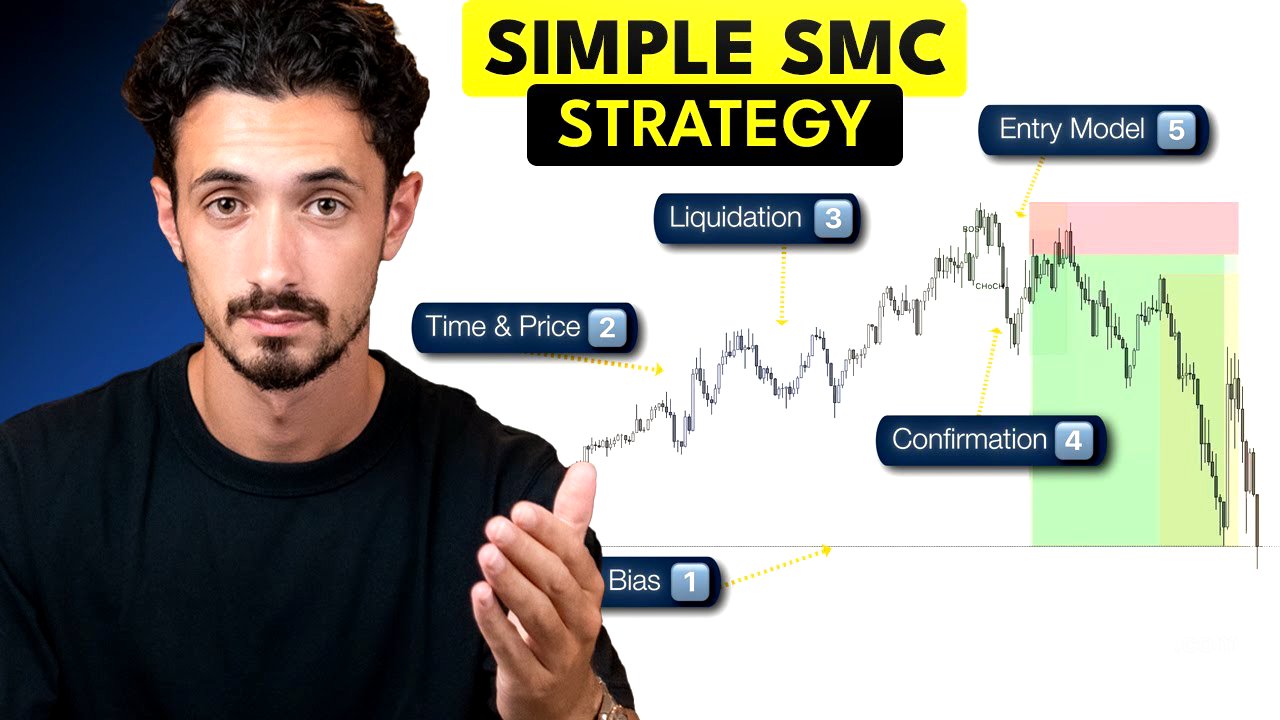
This video presents a five-rule Smart Money Concept (SMC) strategy for consistent trading profitability. It emphasizes the importance of a systematic, rule-based approach, highlighting that a trading strategy alone is insufficient without proper risk management and psychology. The strategy focuses on identifying directional bias, trading within specific time windows, waiting for liquidation events, confirming reversals on lower timeframes, and using order blocks or fair value gaps for entry.
- The strategy involves directional bias, time and price considerations, liquidation, reversal confirmation, and specific entry models.
- Backtested results from 2023 to 2025 show a 216% return with an average win-to-loss ratio of 6.23.
- The video stresses the need for simplicity and avoiding over-complication in trading.
Copy This 5-Rule SMC Strategy [0:00]
The video introduces a five-rule Smart Money Concept (SMC) strategy designed for consistent profitability in trading. The strategy is repeatable, systematic, rule-based, simple to understand, and easy to use. The presenter shares that this strategy has been used for the past 4 years and has yielded positive results for many students. The video will break down each of the five rules and demonstrate how to apply them step by step to create a working trading strategy. The presenter emphasizes that a trading strategy alone is not enough to guarantee success and offers a free training resource with other important aspects of trading.
Backtested Results [1:31]
The presenter shares backtested results of the intraday bias model from the beginning of 2023 to 2025, showing 230 trades with a 216% return, averaging over 10% per month. The data includes a healthy equity curve and a 33% win rate, which is effective due to a 6.23 average win-to-loss ratio. This means that for every dollar risked, the average win is $6.23. The presenter emphasizes that win rate alone is useless and needs to be considered with average risk-to-reward.
Rule 1: Direction Bias [2:51]
The first rule of the strategy is directional bias, which involves understanding and trading in the direction the market is heading. The market moves in bullish, consolidation, and bearish phases. Identifying external swing points of structure is crucial for determining the directional anchor. In a bullish market, swing points get progressively higher, indicating a buying opportunity on pullbacks. Conversely, in a bearish market, swing points get progressively lower, signaling selling opportunities on pullbacks. Areas of consolidation should be avoided unless swing areas can be identified.
Rule 1 Continued: Real Market Structure [7:56]
The presenter explains that the market doesn't always present clean, textbook structures, and many traders struggle to identify the correct trend. The key is to differentiate between internal and external structure. As long as the price remains within the range defined by the swing low and swing high, it is considered internal structure. Traders often make the mistake of trading internal structure, which leads to confusion. A change of character occurs when the low that created the most recent high is broken, signaling a potential bearish shift. The presenter uses real market examples to illustrate how to identify swing highs and lows and trade in alignment with the dominant trend.
Rule 2: Time & Price [15:38]
The second rule involves specific time windows for executing the strategy. The London session window is from 2 a.m. to 5 a.m. EST, and the New York session window is from 7 a.m. to 10 a.m. EST. Trades must occur within these windows. The strategy has relatively equal results across both time windows, making it suitable for traders who can only trade during one session.
Rule 3: Liquidation [16:58]
The third rule requires a liquidation event before entering a trade. A liquidation is when a key area of price is taken out before the trade is entered. For example, when trading in the London session, the Asia session high or low must be taken out before considering a trade. If the market is bearish, the Asia session high needs to be liquidated. If the market is bullish, the Asia session low needs to be liquidated.
Rule 4: Reversal Confirmation [19:07]
The fourth rule involves waiting for reversal confirmation on a lower timeframe before entering a trade. The presenter uses the 15-minute timeframe for the overall strategy and the 1-minute timeframe for confirmation. If the 15-minute timeframe is bearish but the 1-minute timeframe is bullish, traders should wait for the 1-minute timeframe to shift bearish before selling. This confirmation increases the probability of a successful trade and helps avoid multiple losses.
Rule 5: OB/FVG/IFVG Entry Model [22:36]
The fifth rule involves using order blocks (OB), fair value gaps (FVG), or inverted fair value gaps (IFVG) on a 5-minute timeframe for trade entries. After the 1-minute timeframe confirms a reversal, traders should look for these confluences on the 5-minute chart. Ideally, a combination of these elements will be present. Stop losses are placed above the high, and targets are set in the direction of the trend, typically at the swing low. This approach allows for high risk-to-reward ratios, compensating for a lower win rate.
Live Trade Showcase [26:48]
The presenter reviews a live trade example, demonstrating how the five rules align to create a high-probability trading opportunity. The presenter notes that while the strategy is effective, it is only one part of the equation for consistent profitability. Trading psychology and risk management are equally important. The presenter offers a free 45-minute training session that covers the three essential components for consistent trading success.