TLDR;
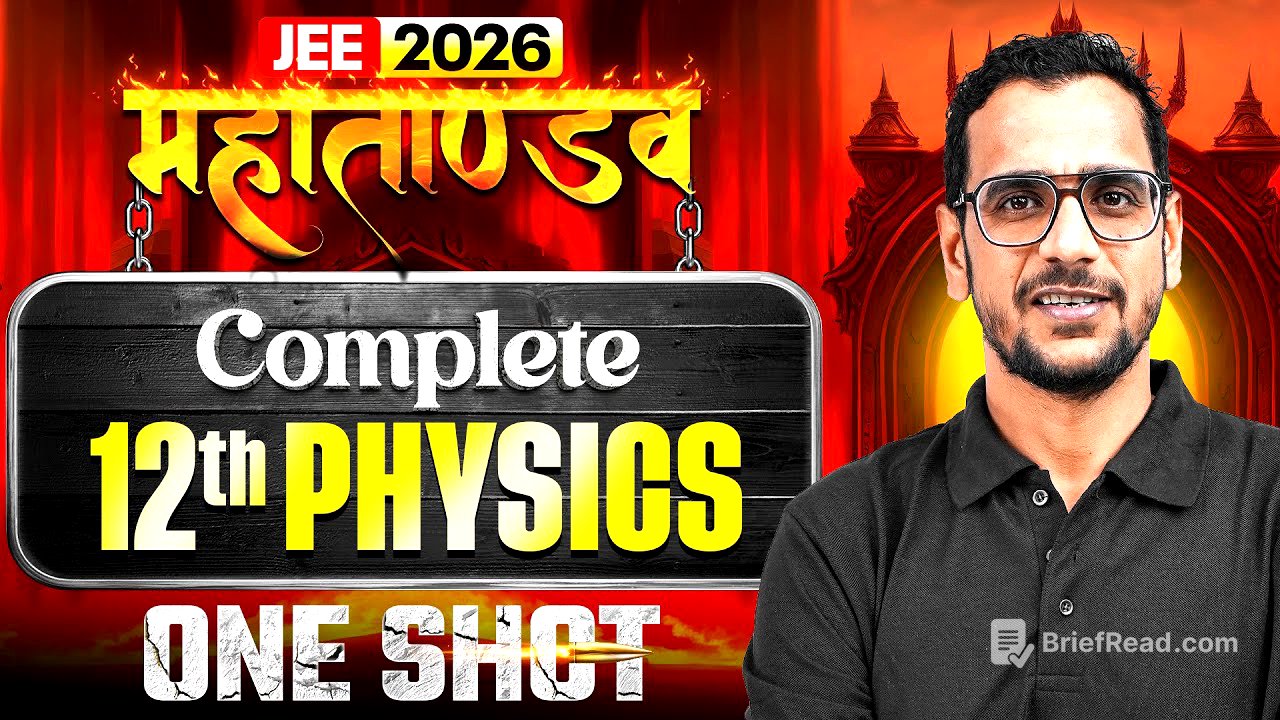
This YouTube video is a comprehensive review of key physics concepts for the JEE Main exam, focusing on 12th-grade topics. The lecture is structured to quickly recap important formulas and problem-solving techniques, rather than in-depth theoretical explanations. The content is divided into chapters, each covering a specific area of physics with an emphasis on high-yield topics and common mistakes.
- Electromagnetic Waves, Wave Optics, and Ray Optics are covered with a focus on scoring topics and formulas.
- Electrostatics, Current Electricity, and Capacitors are discussed, emphasizing connections between theory and problem-solving.
- Magnetic Effects of Current and EMI are reviewed, highlighting important formulas and common question types.
Introduction [0:00]
The lecture begins with a greeting and an overview of the session's goals, which include covering 12th-grade physics topics relevant to the JEE Main exam. The instructor outlines the topics to be covered: EM waves, wave optics, ray optics, electrostatics, current electricity, capacitors, magnetic effect of current, and EMI. The approach will be to connect questions with theory, rather than teaching theory from scratch. The instructor also shares a lighthearted prediction of the difficulty level of upcoming JEE Main papers, emphasizing that consistent study is more valuable than relying on predictions.
EM Wave [9:05]
This chapter starts with the fundamental concept of electromagnetic waves, where electric and magnetic fields oscillate perpendicular to the direction of wave propagation. Key points include:
- Remembering the diagram E, C, B (Electric field, Speed of light, Magnetic field) and the relationship E = CB. If the speed varies, use E = VB.
- Understanding the relationship between the directions using cross products (e.g., E = B x C).
- When given an equation for E, the B equation can be written immediately by copying the sin or cos part of the equation.
- The direction of wave propagation is determined by the sign in front of kx in the equation.
- Always check the velocity (omega/k) to ensure it makes sense in the context of the problem.
- The speed of light in a medium can be calculated using the relative permeability and permittivity.
The chapter includes example problems from JEE Main exams, focusing on finding the relationship between electric and magnetic fields, calculating velocity, and determining the direction of wave propagation.
Wave Optics [1:13:25]
This chapter covers wave optics, focusing on interference. Key formulas and concepts include:
- Phase difference = k * path difference, where k = 2π / lambda.
- Amplitude and Intensity equations for interfering waves.
- Conditions for constructive and destructive interference.
- In Young's Double Slit Experiment (YDSE), the fringe width (beta) = lambda * D / d.
- Angular fringe width = lambda / d.
- Position of nth maxima = n * beta, and nth minima = (2n - 1) * beta / 2.
- When YDSE is performed in a medium, the fringe width changes: beta_medium = beta_air / n.
- When using multiple wavelengths, the positions where maxima coincide are found using n1 * lambda1 = n2 * lambda2.
The chapter includes example problems from JEE Main exams, focusing on calculating fringe width, understanding the effect of changing the medium, and finding the position of maxima and minima.
Ray Optics [2:31:36]
This chapter covers ray optics, starting with reflection. Key points include:
- Angle of incidence equals the angle of reflection (i = r).
- Deviation = 180 - 2i.
- For plane mirrors, the object distance equals the image distance.
- For two plane mirrors at an angle, the number of images can be calculated using n = 360 / theta - 1 (if 360/theta is an even integer) or n = 360 / theta (if 360/theta is an odd integer).
The chapter includes example problems from JEE Main exams, focusing on finding the number of images formed by plane mirrors and understanding the geometry of reflection.
Break [4:46:20]
This section is a break in the lecture.
Electrostatics [5:24:15]
This chapter covers electrostatics, starting with Coulomb's law. Key formulas and concepts include:
- Electrostatic force between two point charges: F = k * q1 * q2 / r^2.
- Potential energy between two charges: U = k * q1 * q2 / r (remember to use signs).
- Superposition principle for multiple charges.
- When charges are placed in a medium, the force is reduced by a factor of epsilon_r (relative permittivity).
- For a system in equilibrium, the net force on every charge is zero.
- The electric field due to a uniformly charged arc is 2kλ/r sin(θ/2), where θ is the angle subtended by the arc.
- The electric field on the axis of a charged ring is kQx / (r^2 + x^2)^(3/2).
- The electric field due to a non-conducting sheet is σ / (2 * epsilon_0).
The chapter includes example problems from JEE Main exams, focusing on finding the force between charges, calculating potential energy, and determining the equilibrium position of charges.
Current Electricity [7:11:00]
This chapter covers current electricity, starting with basic definitions. Key formulas and concepts include:
- Current I = n * A * e * vd, where vd is the drift velocity.
- Current density J = I / A = n * e * vd.
- Resistance R = rho * L / A.
- Ohm's law in vector form: J = sigma * E.
- Resistivity rho = m / (n * e^2 * tau), where tau is the relaxation time.
- Mobility mu = vd / E.
- Temperature dependence of resistance: R = R0 * (1 + alpha * deltaT).
- For resistors in series, R_eq = R1 + R2 + ...
- For resistors in parallel, 1/R_eq = 1/R1 + 1/R2 + ...
- Kirchhoff's laws: KCL (current law) and KVL (voltage law).
- Wheatstone bridge condition: R1/R2 = R3/R4 (for balanced bridge).
The chapter includes example problems from JEE Main exams, focusing on calculating current, resistance, and drift velocity, as well as solving circuit problems using Kirchhoff's laws and the Wheatstone bridge condition.
Capacitor [8:14:39]
This chapter covers capacitors, starting with basic definitions. Key formulas and concepts include:
- Electric field between capacitor plates: E = Q / (A * epsilon_0).
- Capacitance C = A * epsilon_0 / d.
- Energy density in a capacitor: u = 1/2 * epsilon_0 * E^2.
- Energy stored in a capacitor: U = 1/2 * C * V^2 = Q^2 / (2C).
- When a dielectric is inserted, the capacitance increases: C' = k * C.
- When capacitors are in series, 1/C_eq = 1/C1 + 1/C2 + ...
- When capacitors are in parallel, C_eq = C1 + C2 + ...
The chapter includes example problems from JEE Main exams, focusing on calculating capacitance, energy stored, and the effect of inserting a dielectric.
Break [9:05:30]
This section is a break in the lecture.
Magnetic Effect of Current [9:40:58]
This chapter covers the magnetic effects of current, starting with the magnetic field due to a current-carrying wire. Key formulas and concepts include:
- Magnetic field due to a finite wire: B = (mu_0 * I) / (4 * pi * r) * (sin(alpha) + sin(beta)).
- Magnetic field due to an infinite wire: B = (mu_0 * I) / (2 * pi * r).
- Magnetic field due to a circular coil at the center: B = (mu_0 * N * I) / (2 * r).
- Magnetic field on the axis of a circular coil: B = (mu_0 * N * I * r^2) / (2 * (r^2 + x^2)^(3/2)).
- Force on a current-carrying wire in a magnetic field: F = I * L x B.
- Force between two parallel wires: F = (mu_0 * I1 * I2 * L) / (2 * pi * r).
- Magnetic moment of a current loop: M = I * A.
- Torque on a current loop in a magnetic field: tau = M x B.
- Potential energy of a magnetic dipole in a magnetic field: U = -M . B.
- Time period of small oscillations of a magnetic dipole: T = 2 * pi * sqrt(I / (M * B)).
The chapter includes example problems from JEE Main exams, focusing on calculating magnetic fields, forces, and torques, as well as understanding the behavior of magnetic dipoles in magnetic fields.
EMI [11:14:20]
This chapter covers electromagnetic induction (EMI). Key formulas and concepts include:
- Magnetic flux: phi = B * A * cos(theta).
- Faraday's law of induction: EMF = -d(phi) / dt.
- Motional EMF: EMF = v * B * L (where v, B, and L are mutually perpendicular).
- EMF induced in a rotating rod: EMF = 1/2 * B * omega * L^2.
The chapter includes example problems from JEE Main exams, focusing on calculating induced EMF and understanding the direction of induced current. The lecture also touches on the concept of motional EMF and provides formulas for calculating it in different scenarios.