TLDR;
In this video, physicist Marc Séguin explains the concept of color through the behavior of light and photons. He describes how light, made of tiny packets of energy called photons, interacts with our eyes to produce color perception. The video covers the roles of different types of cone cells in the retina, how specific objects absorb and reflect light frequencies, and how this leads to our perception of various colors. Key points include:
- Light consists of photons that oscillate at different frequencies.
- The human retina contains three types of cone cells that respond to specific light frequencies.
- Color perception is a result of how these cones react to different frequencies emitted or reflected by objects.
Understanding Light and Photons [0:11]
Marc introduces the topic of color by first explaining light, which is essential for the perception of color. Light is composed of photons, which are tiny packets of energy that travel at the speed of light and oscillate, producing different frequencies. These frequencies range from 450 to 750 trillion oscillations per second for most visible light emitted by sources like the sun or light bulbs.
The Retina and Cone Cells [1:06]
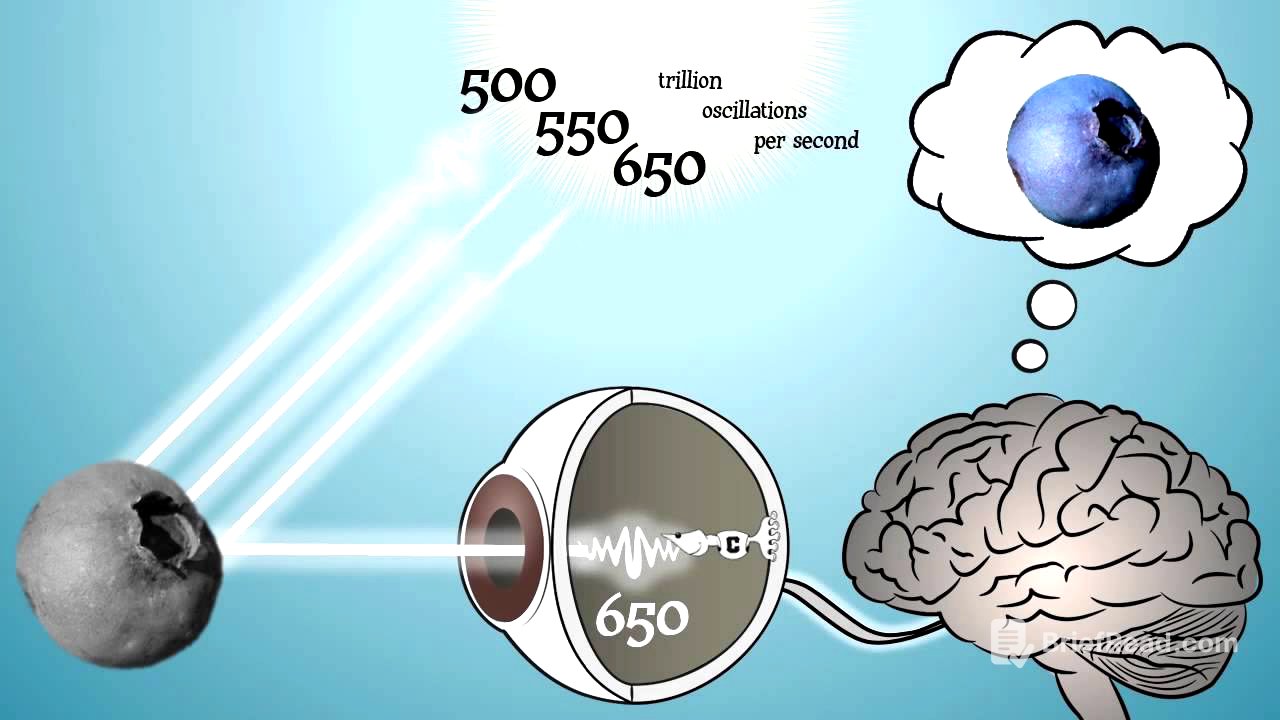
In the human retina, there are millions of tiny photon detectors known as cones, which are responsible for color perception. There are three types of cones—referred to as teams A, B, and C—each sensitive to different light frequencies. Team A is most responsive to photons oscillating at 500 trillion times per second, team B at 550 trillion, and team C at 650 trillion. The varying responses of these cones help the brain to interpret colors.
Objects and Color Perception [2:08]
An object's color is determined by the specific frequencies of photons it reflects. For example, a strawberry reflects photons oscillating around 500 trillion times per second, stimulating team A, which leads to the perception of red. A lime reflects frequencies around 550 trillion, activating team B and resulting in green. Meanwhile, blueberries reflect frequencies around 650 trillion, activating team C and leading to blue color perception.
Seeing Colors Beyond the Basics [3:32]
The video further explains that while humans have three types of cones that allow for the perception of a wide range of colors, the interplay of these teams can produce additional colors. Objects can absorb certain frequencies while reflecting others, creating a spectrum of colors. For instance, a banana reflects light in a way that activates both teams A and B, leading to the perception of yellow or orange, depending on the intensity of the responses.
The Nature of Color Perception [4:43]
Color is not inherent to objects but is a mental perception created by the brain based on signals from the cones in our eyes. Some creatures only have one type of detector and can see light and dark but not colors, reflecting a simpler visual system. Color vision serves practical purposes in nature, such as identifying ripe fruit. The closing observation points out that color televisions, despite using only red, green, and blue technologies, can reproduce a wide range of colors due to the design corresponding with human vision.