TLDR;
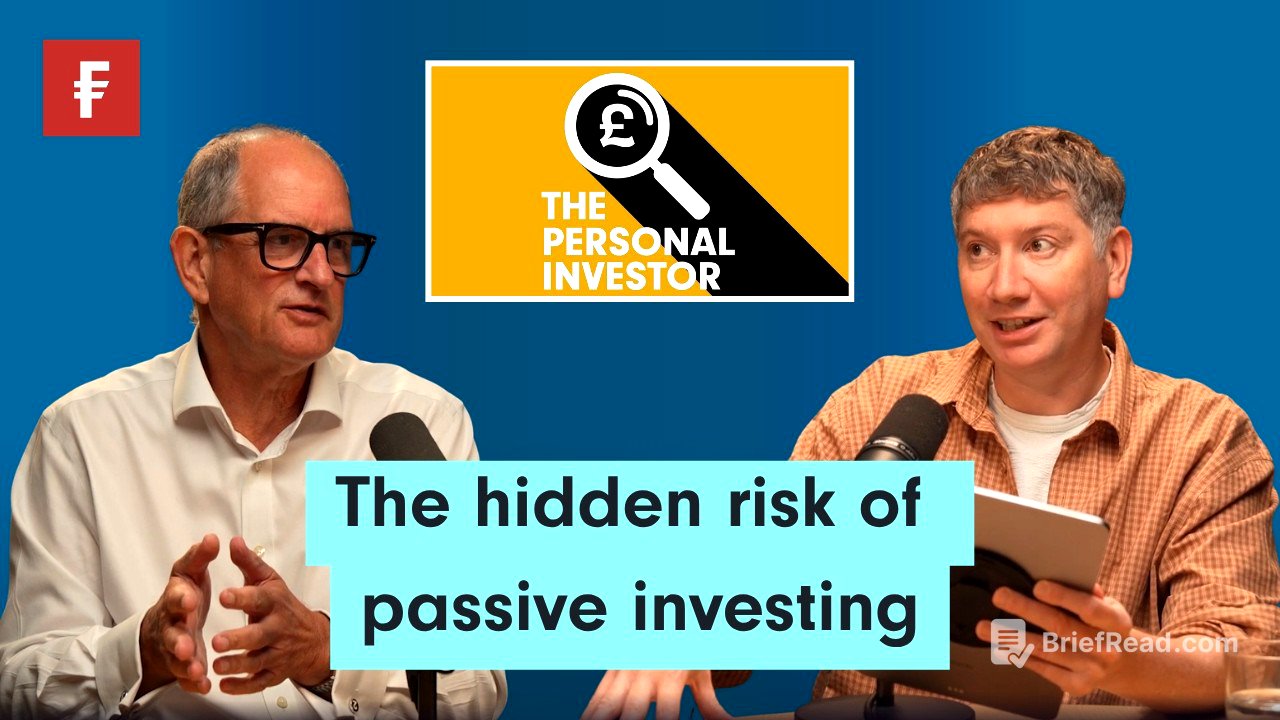
This video discusses the impact and future implications of passive investing as it has gained prominence over active management. The conversation includes insights from renowned investor Terry Smith, highlighting the performance of passive funds, challenges for active managers, and potential market scenarios if the trend continues. Key takeaways include:
- Passive funds have outperformed active funds significantly in recent years.
- Terry Smith stresses the importance of adapting to market changes and analyzing sentiment rather than just fundamentals.
- The growing dominance of passive investing raises concerns about market volatility and inefficiencies.
Intro [0:00]
The video opens with an introduction to the personal investor podcast, hosted by Ed Monk, with guest Tom Stevenson from Fidelity. They discuss the dominance of passive investing over the last five years and the sighing predictions by investors regarding market consequences, such as extreme volatility and potential market closures.
What is passive investing? How has it done recently? [1:12]
Passive investing differs from active investing in that it tracks market indices rather than selecting individual stocks based on fundamentals. More money is now allocated to passive funds than active funds, resulting in a significant transformation in the investment landscape. Passive funds have recently delivered strong performances, resulting in a self-fulfilling cycle where increasing fund inflows improve their returns, making competition difficult for active managers.
Who is Terry Smith? [3:00]
Terry Smith is a prominent UK fund manager known for his quality growth investment strategy. He gained initial recognition through his work as a banking analyst and published a controversial book on corporate accounting practices. After founding his own fund management company, he established the Fund Smith Equity Fund, focusing on high-quality companies with the potential for steady earnings growth.
His message to investors [5:23]
Terry Smith has expressed concerns to his investors regarding his fund's underperformance versus passive funds, admitting a decline of 2.9% against an 11% rise in the MSCI world index. His letter discusses the difficulties that active managers face in a market dominated by passive strategies, emphasizing that he is not simply a good investor but has also been affected by market timing.
The active vs passive debate [8:00]
The conversation delves into the implications of the active versus passive investment debate, highlighting that the market dynamics could shift when performance slows. Investors must ponder what happens when passive investing faces downward pressure, especially if market conditions turn. Smith's position asserts the need for strong active management to provide essential price-setting functions.
Why active managers are changing their approach [9:45]
Active managers like Smith must adapt strategies due to the rise of passive investing. He acknowledges that he is adjusting his focus to include momentum, which has contributed to the success of passive investing. Although he remains committed to quality investments, there is a recognition that simply investing in undervalued stocks may no longer suffice.
The passive investing “feedback loop” [11:26]
The concept of a feedback loop within passive investing is introduced, where increasing investments in passive funds lead to higher stock prices in large companies, generating more inflows. This self-reinforcing cycle creates challenges for active funds, as capital tends to flow toward popular stocks, making it difficult for them to compete, particularly as market indices tend to reflect growth.
Passive fund dominance in recent years [13:45]
The video provides statistical insight into how passive funds have significantly outperformed active funds over the past five years, creating a disparity that raises questions about the effectiveness of traditional active management strategies. The original purpose of passive funds was to offer lower fees while providing average market returns, yet their actual performance has exceeded expectations.
Why a vibrant active sector is important [15:23]
The balance between active and passive investing is critical, as a dominant passive sector may lead to pricing inefficiencies and market anomalies. The video argues the necessity for active managers to remain engaged, as they provide essential insights that guide market valuations. A lack of active involvement can result in a disconnected market.
Is volatility increasing? [18:15]
Terry Smith raises concerns about increasing market volatility, referencing recent examples where major companies experienced substantial price swings. He warns that market declines could occur rapidly, potentially impacting investors who have planned their finances for stability. The video underscores the need for awareness of changing volatility trends.
Has the market moved away from analytics and towards sentiment? [19:11]
The focus shifts to the performance of companies based on earnings, revealing that loss-making companies have outperformed those with positive earnings, indicating a market that may be driven more by sentiment rather than traditional fundamental analysis. This shift suggests a troubling trend for rational investment approaches.
What can an ordinary investor do? [20:07]
The video concludes with advice for ordinary investors, emphasizing the importance of diversification and balancing between active and passive strategies. Investors are encouraged to remain cautious while also acknowledging the potential for active management to succeed in a resurgent market phase, thus preparing for rapid changes in market dynamics.