TLDR;
This video covers key topics from Period 6 in American history, including the concept of "Laissez-faire" economics, the characteristics of the industrial workforce, the rise of labor unions and significant strikes, and the idea of the "New South." It highlights the government's non-regulation policy, the conditions faced by industrial workers, the conflicts between labor and management, and the efforts to industrialize the South.
- Laissez-faire economics and its impact on wealth justification.
- The composition and challenges of the industrial workforce.
- The formation and goals of labor unions like the National Labor Union, Knights of Labor, and American Federation of Labor.
- Key strikes such as the Great Railroad Strike, Homestead Strike, and Pullman Strike.
- The concept of the "New South" and its push for industrialization.
Laissez-faire Economics [0:23]
Laissez-faire is a French term that describes a government policy of not regulating the economy, allowing it to be governed by the "invisible hand" of supply and demand, as proposed by Adam Smith in "The Wealth of Nations" (1776). This approach was favored by industrialists like Carnegie (steel), Rockefeller (oil), and J.P. Morgan (banking) to justify their business practices and wealth accumulation, as they advocated for minimal government interference in the economy.
The Industrial Workforce [1:22]
The industrial workforce was characterized by long hours, with many workers laboring six days a week for 10 hours a day, totaling 60 hours per week. Child labor was common as families needed additional income. The workforce saw significant internal migration, with farmers moving to cities for factory jobs, and international migration, particularly "new immigration" from Southern and Eastern Europe (e.g., Italy, Poland), contrasting with the earlier "old immigration" from Northern and Western Europe. Chinese immigration also occurred on the West Coast until the Chinese Exclusion Act of 1888 banned it.
Labor vs. Management and the Rise of Unions [2:36]
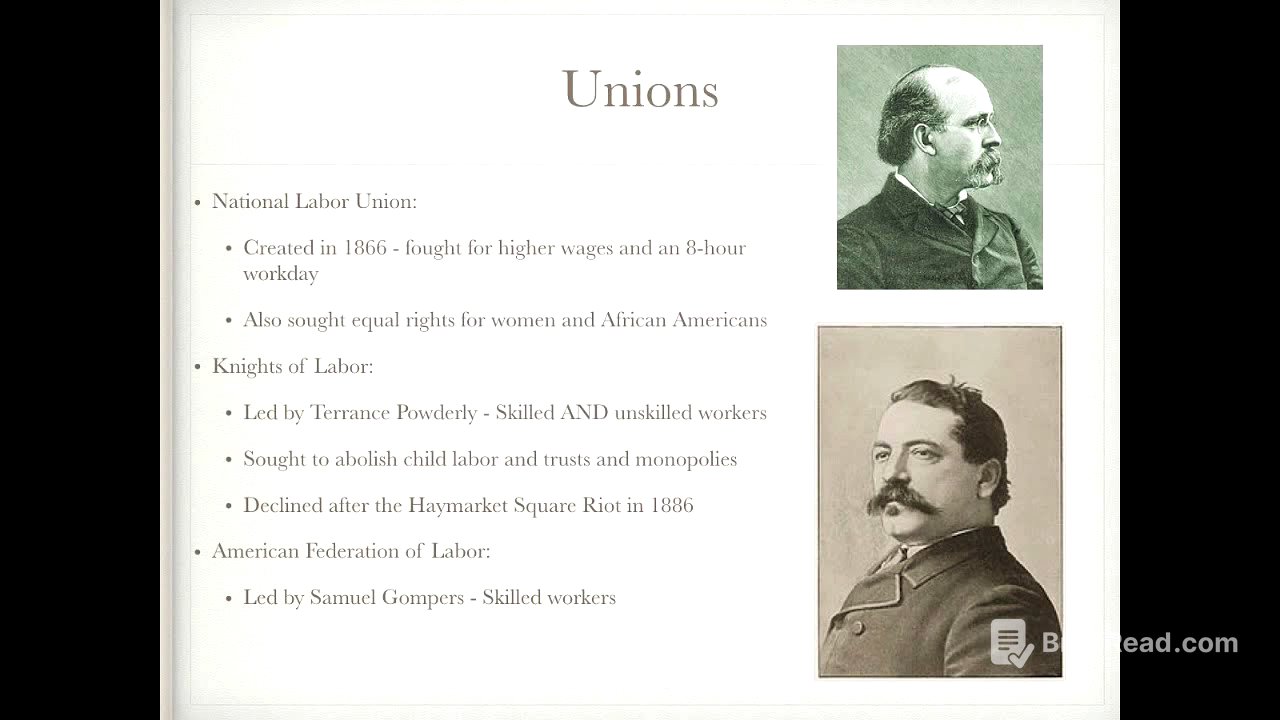
Conflicts between labor and management arose over wages and working conditions, leading workers to form labor unions at local and national levels to improve their positions. Key unions included the National Labor Union (founded in 1866), which fought for higher wages, an eight-hour workday, and equal rights for women and African Americans. The Knights of Labor, led by Terrence Powderly, included both skilled and unskilled workers and sought to abolish child labor and trusts/monopolies but declined after the Haymarket Square Riot in 1886. The American Federation of Labor (AFL), led by Samuel Gompers, comprised only skilled workers and focused on "bread and butter" issues like an eight-hour workday and higher wages.
Key Strikes [4:27]
Several significant strikes occurred during this period. The Great Railroad Strike of 1877 was a reaction to wage cuts, prompting President Hayes to intervene on the side of the railroads. The Homestead Strike in 1892 at the Carnegie Steel plant was triggered by a 20% wage cut, leading to the use of strike breakers and the eventual return of workers. The Pullman Strike involved workers refusing to work on trains with Pullman Palace cars, resulting in President Cleveland deploying troops to end the strike, illustrating the government's tendency to side with businesses over labor.
The New South [5:36]
The "New South" was an idea promoted by Southern leaders like Henry Grady, who called for increased industrialization and the establishment of more textile factories to emulate the North's success in the Civil War. Despite these calls for industrialization, sharecropping and tenant farming remained prevalent in the South.





![[WARNING!] After This Rampage, They’ll Chase You Like Never Before!](https://wm-img.halpindev.com/p-briefread_c-10_b-10/urlb/aHR0cDovL2ltZy55b3V0dWJlLmNvbS92aS9NWlhWS0VDdEpGSS9ocWRlZmF1bHQuanBn.jpg)