TLDR;
This video discusses four ammonium nitrate-based explosives: ANNM (ammonium nitrate nitromethane), Taten (tetramine copper nitrate), AMT (amatol hexamine), and AMGC (ammonium nitrate glycine). It covers their preparation, properties such as sensitivity and detonation velocity, and potential uses, highlighting their versatility and accessibility, especially in situations where conventional explosives are unavailable.
- ANNM is the simplest to prepare but most expensive due to the cost of nitromethane.
- Taten is a metal complex explosive that can be produced from readily available materials.
- AMT is a melt-cast explosive with high performance and ease of preparation.
- AMGC is a co-crystal explosive that is non-hygroscopic and versatile.
Intro [0:00]
The video addresses a comment about the audio quality of the headset microphone and transitions into a discussion about ammonium nitrate explosives, referred to as "energetic America." The presenter emphasizes that explosives are not difficult to make.
Ammonium Nitrate Explosives Overview [0:45]
Ammonium nitrate explosives typically combine ammonium nitrate with a fuel, such as metal or fuel oil (referred to as ANFO when using fuel oil). These mixtures are generally good for heaving but have a lower velocity, ranging from 2500 to 3000 meters per second. They are often considered insensitive and require boosters like high-velocity det cord or TNT to detonate effectively. The key differences between traditional ANFO and the explosives discussed in the video are their sensitivity to a number eight cap or stronger detonators and the intimate mixing of fuel and oxidizer, achieved through metal complexes or co-crystallization, allowing for melt-cast properties.
Ammonium Nitrate Nitromethane (ANNM) [3:35]
Ammonium nitrate nitromethane (ANNM) is the simplest and most readily available explosive in the United States, as its individual components are not regulated until combined. The ideal ratio is 66% ammonium nitrate to 34% nitromethane, though some prefer a 60/40 mix. While simple to prepare, ANNM is the most expensive due to the cost of nitromethane, which ranges from $80 to $100 per gallon. The presenter uses finely ground ammonium nitrate mixed in a Ziploc bag for preparation. ANNM is cap-sensitive and more powerful than traditional ammonium nitrate explosives, with a detonation velocity exceeding 6,000 m/s. The presenter prefers adding auxiliary fuels like aluminum to ANNM to increase heat energy and extend the explosive charge. When using caps, PETN or RDX are recommended over ETN due to the latter's higher failure rate.
Tetramine Copper Nitrate (Taten) [8:16]
Tetramine copper nitrate (Taten) is a metal complex secondary explosive. It consists of a copper atom nucleating two nitrate molecules and four amine molecules. Taten can be made by heating ammonium nitrate with copper. The presenter initially faced issues with a low-yielding method due to contaminants from using old copper wiring. The presenter then used basic copper nitrate with 10% ammonia solution and additional ammonium nitrate to produce Taten. Taten forms lustrous purple crystals and has average sensitivity for a secondary explosive. Detonation velocities vary with density, reaching 5,630 m/s at maximum density (1.6 g/cm³). Gurney constants range from 1.63 to 1.8 km/s, comparable to TNT. A 60g charge of Taten, loosely placed in a bag and primed with a single cap, results in a simple explosion. Taten is non-hygroscopic but should be kept away from water to preserve the complex. It is a popular choice in amateur pyrotechnics and can potentially replace TNT in certain applications.
Amatol Hexamite (AMT) [15:51]
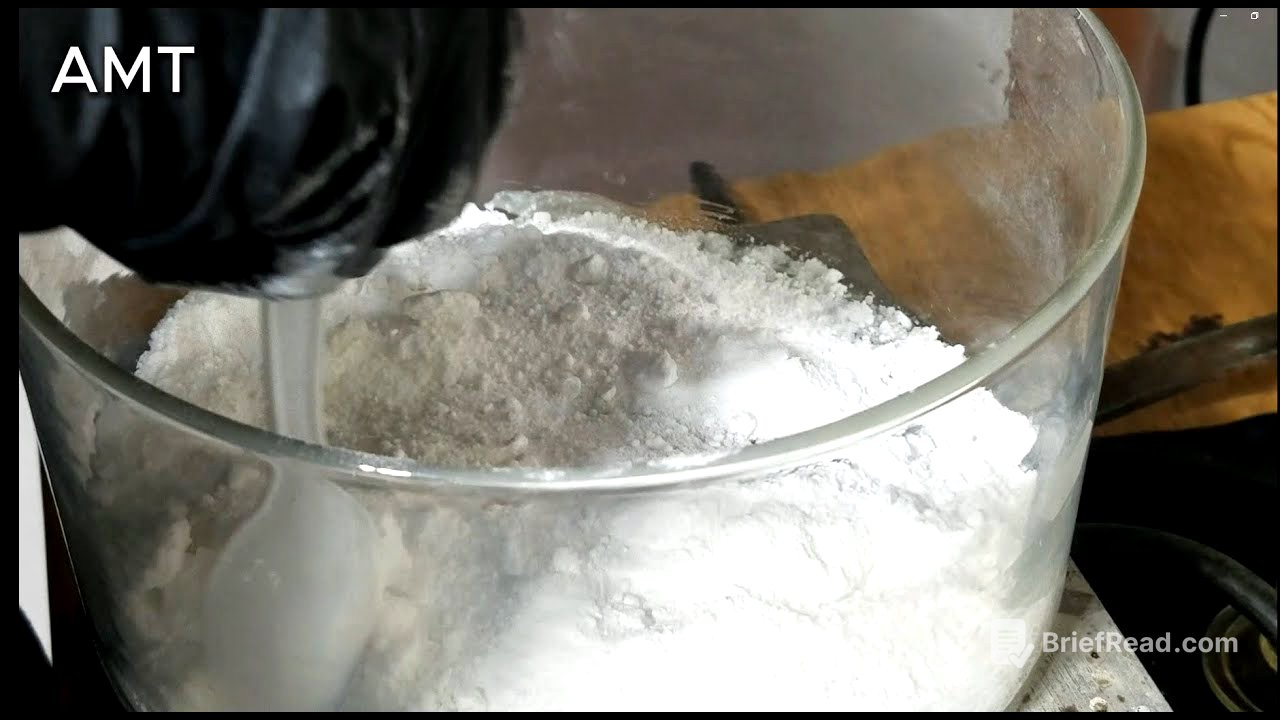
Amatol hexamine (AMT) is a co-crystal explosive derived from a patent, with measured detonation velocities of 4 to 5 km/s. It is notable for its melting point depression, making it a melt-cast explosive with a melting temperature of 145°C. AMT is prepared with approximately 90% ammonium nitrate and 10% hexamethylene tetramine (hexamine). The presenter used a 91/9 ratio, verifying the melting temperature. The process involves melting the mixture, which emits some ammonia, and then pouring it onto a cold surface to flake off. The presenter also experimented with adding aluminum to AMT in a one-to-one ratio, noting the mixture was very reactive. AMT's performance relative to its simplicity is considered excellent for an ammonium nitrate-based explosive. AMT is purportedly hygroscopic and should be kept contained from air to prevent moisture absorption.
Ammonium Nitrate Glycine Co-Crystal (AMGC) [19:09]
Ammonium nitrate glycine co-crystal (AMGC) is a co-crystallization of ammonium nitrate and glycine, an amino acid. The presenter expresses a fondness for amino acid explosives due to their versatility. AMGC is considered the best overall ammonium nitrate melt-cast explosive. Developed from a patent, AMGC has varying grades depending on glycine content, with the lowest melting temperature at 118°C with 15% glycine. The preferred embodiment uses 94 parts ammonium nitrate and six parts glycine, mixed with water, heated to 60°C, and then cooled. The co-crystal product is separated and dried. AMGC is cap-sensitive and can be used as a melt-cast carrier for other explosives. A significant advantage of AMGC is that it is non-hygroscopic, making the ammonium nitrate stable. The presenter considers AMGC the most capable general-purpose ammonium nitrate explosive tested. While a 600 milligram PETN detonator works effectively, a test charge of powdered AMGC primed with a 1g PETN cap also performed well. The presenter attempted a melt cast with AMGC and nitr guanidine, but it resulted in partial detonation due to the insensitivity of nitr guanidine without a booster charge.
Conclusion [23:17]
The video concludes by summarizing the four ammonium nitrate-based explosives, highlighting their high performance and versatility. AMGC is noted as the best filler for devices or charges, while Taten is recommended as a potential replacement for TNT in emergency situations. The presenter encourages viewers to learn more about these explosives, emphasizing their relevance in apocalyptic scenarios due to the widespread availability of ammonium nitrate. The presenter underscores the flexibility and utility of these compositions.