TLDR;
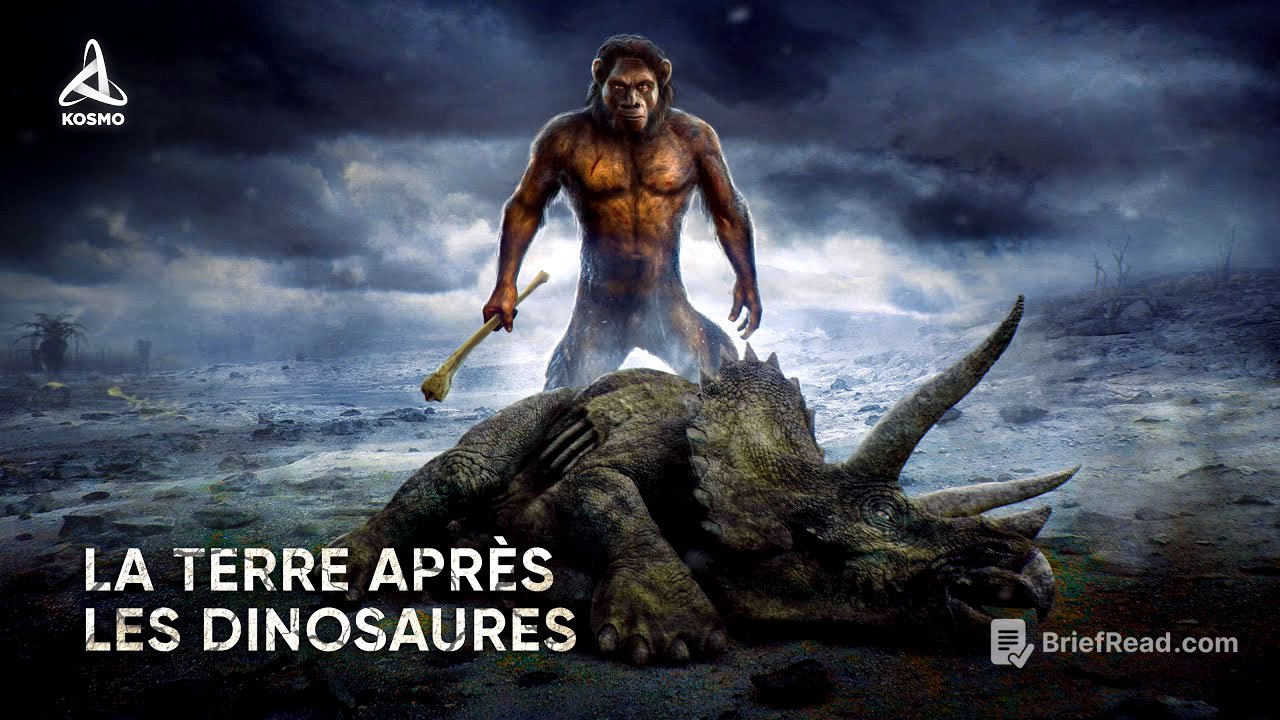
This video explores the evolutionary journey of life on Earth, focusing on the Cenozoic Era and the emergence of humans. It covers major geological and climatic events, the evolution of mammals, and the key adaptations that led to the rise of hominids. The video also touches on the impact of environmental changes on early human ancestors and the development of human civilization.
- The Cenozoic Era marked a new beginning after the extinction of the dinosaurs, leading to the rise of mammals.
- The Pliocene Epoch saw significant climate changes that influenced the evolution of early hominids.
- The savanna hypothesis explains how environmental pressures led to bipedalism and tool use in early humans.
- The Quaternary Period brought cyclical climate changes that spurred further human evolution and migration.
- The development of agriculture during the Holocene Epoch marked a major turning point in human history.
Introduction [0:00]
The video introduces the concept of Earth's history being shaped by various life forms, highlighting the dinosaurs as dominant creatures for 145 million years. A global catastrophe 66 million years ago led to the extinction of most large animals, paving the way for mammals to diversify and evolve. Among these mammals, a unique creature emerged that adapted by changing its environment, eventually becoming the dominant species on Earth.
Cénozoïque [1:24]
The Cenozoic Era began 66 million years ago, following the Cretaceous-Paleogene extinction event. During this era, significant geological transformations occurred, such as India colliding with Asia to form the Himalayas and Antarctica becoming covered in ice. Mammals rapidly filled ecological niches, evolving into diverse forms like the giant Indricotherium and the aquatic Archaeocetes. The Paleogene period transitioned into the Neogene about 23 million years ago, marked by a gradual cooling and drying of the planet. Mountain ranges like the Alps and Andes rose, and the Mediterranean Sea nearly dried out, becoming a vast salt desert.
Èpoque du pliocène [4:52]
The Pliocene Epoch, starting 5.3 million years ago with the Zanclean flood, saw continents settling into familiar positions. North and South America were still separated by a strait, and the Rocky Mountains were still forming. The Earth's climate was warmer, with average temperatures 2-3 degrees Celsius higher than today. The Arctic ice cap was intermittent, and dense coniferous forests extended far north. Sea levels were about 25 meters higher. Early human ancestors like Ardipithecus, Sahelanthropus, and Orrorin lived in Africa, showing early signs of bipedalism and increased cranial capacity.
Hypothèse de la savane [7:57]
Around 3 million years ago, the collision of North and South America led to the formation of the Isthmus of Panama, disrupting ocean currents and causing global cooling. The Rocky Mountains further blocked air currents, leading to increased glaciation and reduced African forests, giving rise to savannas. The savanna hypothesis suggests that these environmental changes forced early primates into the savanna, where bipedalism and tool use became crucial for survival. Walking upright allowed for increased speed and the ability to spot prey and dangers from a distance. Cooperative hunting and defense led to the development of the brain and primitive language.
Australopithèques [9:14]
Over millions of years, Ardipithecus and Sahelanthropus evolved into Australopithecus, agile and intelligent creatures that lived in Africa between 4.2 and 1.8 million years ago. They were 120-140 cm tall and weighed around 40 kg. Australopithecus moved primarily on two legs, had larger brains than great apes, and lived in groups, cooperating for hunting and defense. Early species used improvised tools, while later species learned to make more primitive tools.
Faune du Pliocène [11:09]
During the Pliocene Epoch, many animals resembled modern species, but there were also unique creatures. In North and South America, flightless predatory birds like the phorusrhacids grew up to 3 meters tall. In Asia, Deinotherium, an elephant-like beast, weighed up to 14 tons and fed on tree foliage.
Inversion magnétique de Gauss-Matuyama [12:23]
About 2.58 million years ago, the Gauss-Matuyama magnetic reversal occurred, causing the Earth's magnetic poles to switch. This event reduced the planet's protective field, allowing destructive cosmic rays to reach the surface and causing a mass extinction of several species.
Quaternaire [12:58]
The Gauss-Matuyama magnetic reversal marked the beginning of the Quaternary Period, which is divided into the Pleistocene and Holocene epochs. The Pleistocene was characterized by cyclical cooling and glaciation, forcing living beings to adapt rapidly. Australopithecus evolved into Paranthropus and Homo, with multiple species coexisting and competing for survival.
Aube de l'humanité [16:24]
During the Quaternary Period, Homo habilis, or "handy man," emerged in Africa 2.3 to 1.5 million years ago. They had more developed brains and were capable of making primitive tools. Homo ergaster and Homo erectus appeared about 2 million years ago, migrating throughout Africa, Asia, and Europe. These early humans lived in tribes, leading nomadic lives of gathering and hunting, gradually settling across all continents except Antarctica.
Final [18:18]
The end of the last glacial period about 12,000 years ago led to a warmer, wetter climate, allowing for the development of agriculture in fertile regions like Mesopotamia and the Nile Delta. This marked the Neolithic Revolution and the beginning of the Holocene Epoch, a period of rapid growth in human civilization, technological progress, and environmental impact.