TLDR;
This lecture provides a comprehensive overview of the American War of Independence, highlighting the roles of marginalized groups such as women and African Americans. It discusses the conditions leading up to the war, the advantages and disadvantages faced by both the Americans and the British, and the significance of popular mobilization in the revolution.
- The British had superior military strength and loyalist support, while Americans had the advantage of the geography and a passionate cause.
- African Americans and women played critical roles in the war, yet they did not gain substantial recognition or rights post-revolution.
Introduction to the American War of Independence [0:00]
The lecture begins with an introduction to the American War of Independence, focusing on the mobilization of minority groups, including women and African Americans. It poses the question of how and why this war was revolutionary and outlines the advantages and disadvantages faced by both the American colonies and the British Empire as tensions escalated into conflict.
British Advantages and Loyalist Support [0:40]
The British Empire had significant advantages, including a well-trained military, the strongest navy, and support from loyalists within the American colonies. Approximately 20-30% of the colonial population were loyalists, predominantly wealthy individuals associated with British interests. Loyalists were concentrated in port and capital cities, providing crucial support to the British forces as they aimed to maintain control over the colonies.
Native American Alliances [3:10]
The British also enjoyed more Native American allies compared to the American colonists, who encroached on Indigenous lands. The Iroquois Confederacy in the north and tribes like the Cherokee in the south sided with the British, hoping to protect their territories from American expansion.
British Disadvantages and Complexity of the War [4:54]
Despite their military might, the British faced significant challenges such as lack of familiarity with American territory and the difficulties of operating 3,000 miles from home. They relied heavily on mercenaries, some of whom were disloyal, and their supply lines were stretched thin, hindering their operational effectiveness as the war progressed.
American Strengths and Citizen Militias [8:13]
Conversely, the American colonies lacked a formal military structure but compensated through citizen militias and the establishment of the Continental Army in 1776. Early efforts in military engagement demonstrated that Americans could rapidly mobilize to defend their homes, gaining advantages despite a fragmented and inexperienced military force. John Paul Jones emerged as a notable naval leader, capturing hundreds of British ships during the conflict.
International Alliances and Support [10:29]
International support played a crucial role in the American Revolution, as Spain, France, and the Netherlands allied with the colonies. Britain underestimated France's desire for revenge due to previous conflicts, paving the way for foreign aid that bolstered the American cause.
The Role of African Americans in the Revolutionary War [11:05]
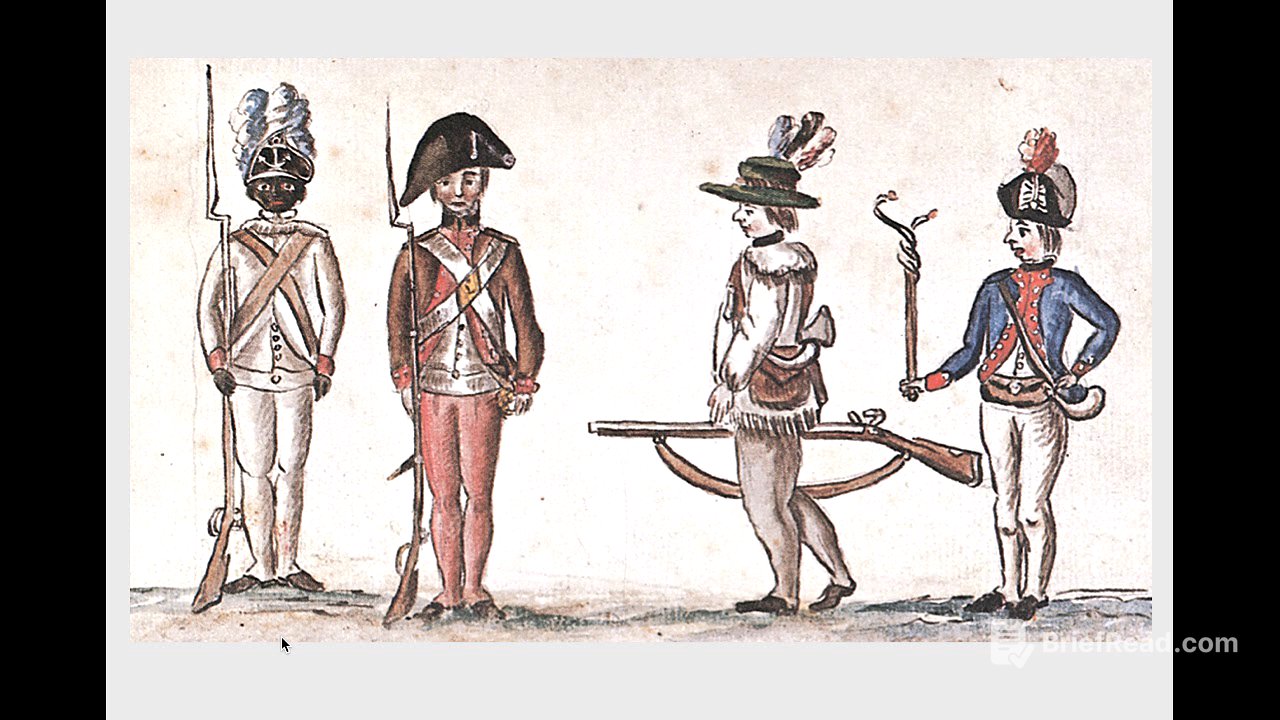
The lecture discusses the vital contributions of African Americans, who participated in significant battles like Lexington and Concord. Initially barred from service due to fears of rebellion, policies shifted in 1777, allowing African Americans to join the Continental Army as a response to labor shortages exacerbated by British recruitment of enslaved individuals.
The Dunmore Proclamation [13:57]
The British used the Dunmore Proclamation to recruit enslaved individuals by promising them freedom in exchange for military service. This proclamation spurred significant defections from enslaved people supporting the British side, impacting the Southern economy and bolstering the loyalist army.
Post-War Experiences of African Americans [31:03]
After the war, experiences for African American soldiers varied significantly. While some gained freedom and resettled in places like Sierra Leone, many who served in the Continental Army found that promises of liberation were largely unmet. The systemic exclusion of African Americans from military service became formalized in the 1790s.
Women’s Contributions to the Revolutionary War [34:13]
Women played essential roles during the Revolution, serving in various capacities, including as camp followers. However, they faced increasing inequality post-war, as their contributions were largely unrecognized. Figures like Abigail Adams advocated for women's rights, but most leaders dismissed these claims, leading to further entrenchment of gender roles.
Military Actions by Women [35:25]
Women like Molly Pitcher and Deborah Sampson broke gender norms by directly participating in military actions. Molly Pitcher emerged as a heroine for her bravery during the Battle of Monmouth, while Deborah Sampson disguised herself as a man to serve in the Continental Army, showcasing the varied ways women contributed to the war effort.
Conclusion: Overall Impact and Legacy [1:02:04]
The lecture concludes by reflecting on the overall impact and legacy of the American War of Independence, emphasizing that while African Americans and women mobilized robustly during the conflict, the post-war society failed to address their rights and needs adequately.