TLDR;
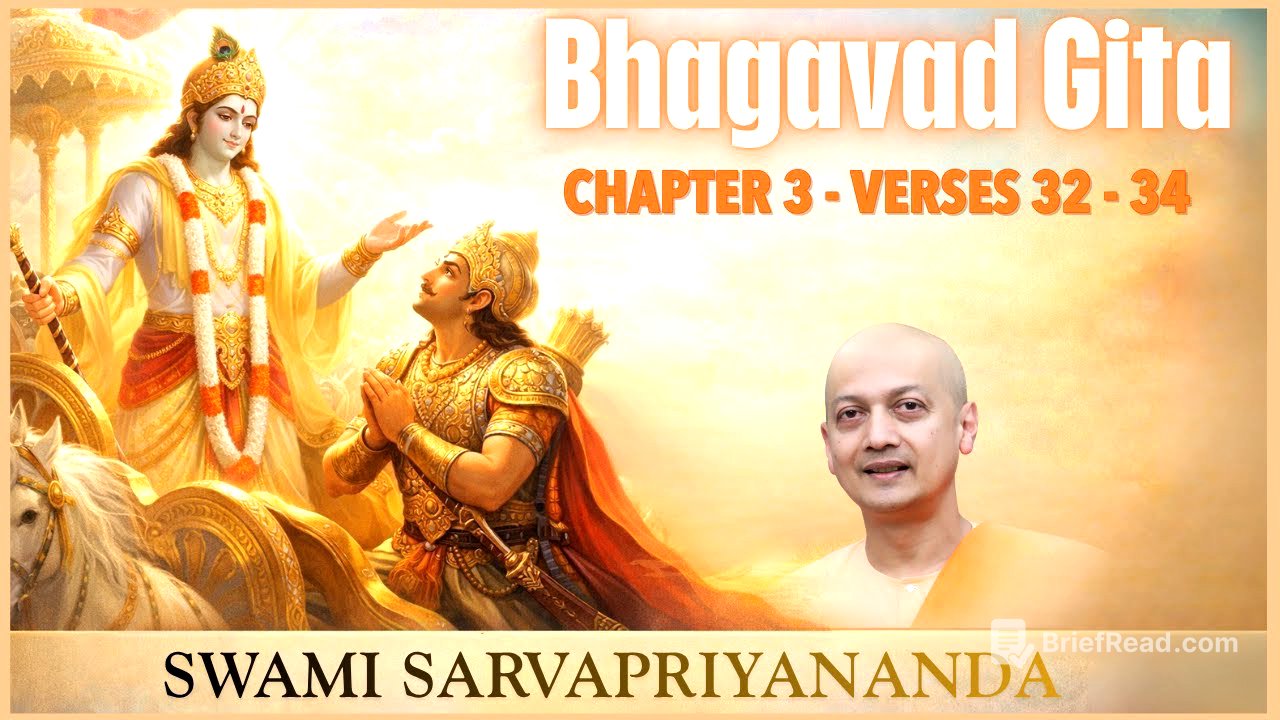
This Bhagavad Gita class focuses on key teachings from chapters 3, verses 31 to 34 and discusses the significance of Karma Yoga, the nature of prakriti, and the obstacles to spiritual progress. The teachings emphasize the difference between following and not following the spiritual path, the influence of individual nature on behavior, and the importance of self-awareness in spiritual practice.
- Following the teaching leads to liberation from karma.
- Individual nature (prakriti) greatly influences behavior and spiritual practices.
Introduction to Bhagavad Gita [0:00]
The class begins with a traditional chant followed by an introduction by the host. The discussion centers around the Bhagavad Gita, engaging participants and encouraging interactions through virtual means such as raised hands and chat messages.
Verse 31: Following Krishna's Teachings [1:05]
In this verse, Sri Krishna states that those who adhere to his teachings will attain liberation (moksha). He shows humility by presenting his view as one of many perspectives in spiritual life. This teaching emphasizes the importance of offering all actions to God and performing duties without attachment or anxiety.
Verse 32: Criticism and Its Consequences [3:29]
Krishna warns that those who do not follow his teachings will live a life of ignorance and bondage to karma, emphasizing the importance of spiritual knowledge and the consequences of rejecting it. Such critics are identified as lacking a spiritual attitude and are warned of the delusions that arise from following desires and aversions.
Verses 33-34: Nature and the Difficulty of Change [9:21]
These verses inquire into the challenges faced in spiritual life and personal transformation. They assert that individuals act according to their nature (prakriti), and even a person of knowledge follows their inherent tendencies. The verses highlight that repression of one's nature is ineffective; instead, practices must align with spiritual growth without undue force.
The Role of Prakriti in Spiritual Growth [10:40]
The discussion delves into prakriti as the body-mind complex shaped by past actions and experiences. It underscores how spiritual practices can modify personal tendencies and refine one’s nature, leading to a more sattvic (pure) approach to life.
Polishing the Mirror of Prakriti [16:20]
The analogy of polishing a mirror is used to illustrate how spiritual practices enhance one’s qualities and tendencies. The speaker explains that changing one’s nature requires consistent effort, revealing that while prakriti shapes one's actions, transformation is achieved through repeated spiritual practice.
Decision-Making and Self-Control [20:50]
The speaker addresses how every individual possesses the power of decision at any moment, and emphasizes the need for self-awareness in controlling impulses. It is essential to intercept negative thoughts before they manifest into actions. The discussion also explains that a calm mind facilitates better control over one’s decisions.
Expression of Likes and Dislikes [23:53]
This section explores how personal tendencies steer actions and highlights the importance of discerning which actions align with spiritual progression. The speaker stresses the necessity of monitoring one's thoughts and acting according to higher principles rather than impulsive desires.
The Influence of Nature on Practices [30:30]
A conversation touches upon thechallenge of maintaining spiritual practices in daily life and the impact of individual nature on adherence to discipline. The speaker explains that transformation can seem difficult, as personal tendencies resist change, but consistent practice yields positive results over time.
Final Thoughts on Sadhana [1:05:00]
The concluding remarks focus on perseverance in spiritual efforts and the importance of routine. The discourse emphasizes that while prakriti may dictate tendencies, self-effort can lead to significant transformation in personal nature, moving toward spiritual realization. The session ends with a prompt for audience questions, reinforcing the interactive format of the class.