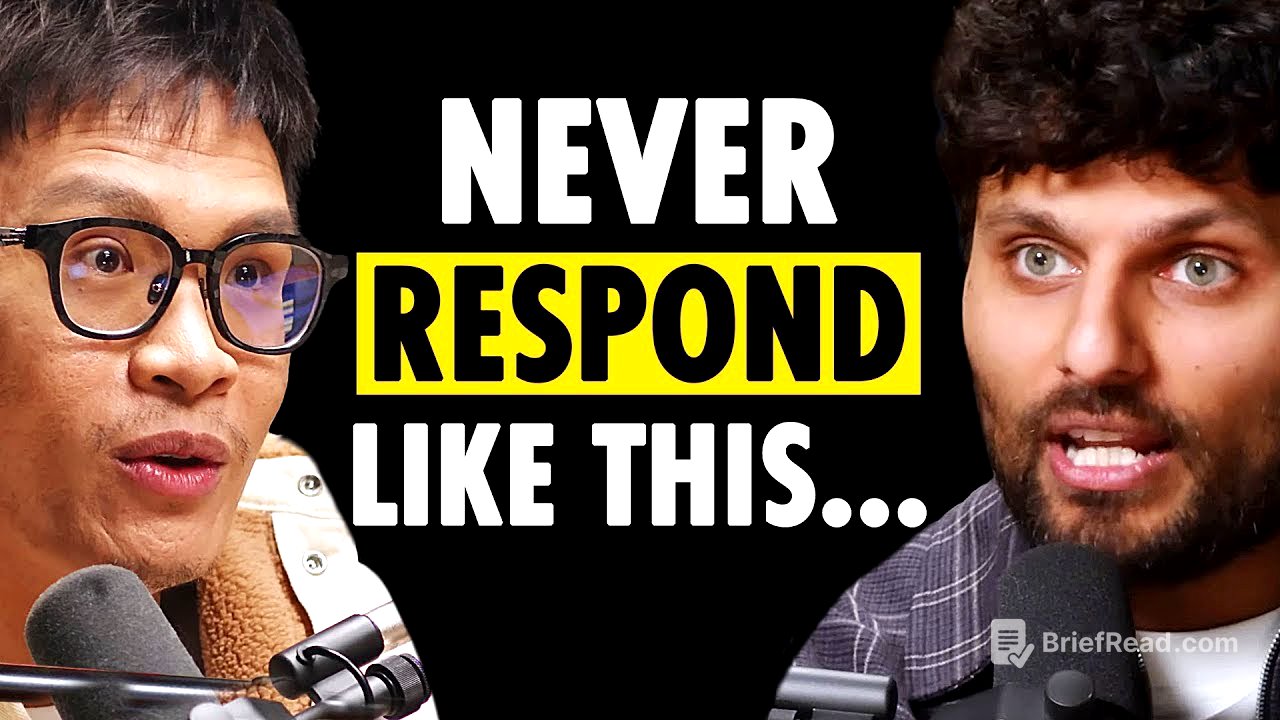
TLDR;
This Jay Shetty Podcast episode features Vinh Giang, a communication expert, discussing how to find your voice and communicate with confidence. They discuss practical techniques to improve communication skills, overcome shyness, and protect your energy as an introvert or extrovert. The conversation emphasizes the importance of self-awareness, practice, and understanding the impact of your communication on others.
- Overcoming shyness and developing confidence in communication through practice and behavioral changes.
- The importance of self-awareness in identifying and correcting communication weaknesses.
- Tailoring communication style to match the audience and context for better connection and influence.
Intro [0:00]
The episode starts with a brief overview of the topics that will be discussed, including communication skills, confidence, and finding your voice. It highlights the importance of pauses in communication to allow listeners to process information and emphasizes that effective communication involves understanding and practicing specific behaviors.
Are You Struggling to Communicate Clearly? [0:29]
Vinh Giang shares his personal journey of overcoming communication challenges, noting that English is his third language. He discusses how his early struggles with communication led him to a career in teaching public speaking and communication skills, driven by a desire to help others find their voice and confidence. He contrasts this with his previous career as a magician, where the applause felt empty compared to the fulfillment of teaching.
The Path to Becoming a Confident Speaker [2:13]
Vinh asserts that anyone can transform from a shy, insecure speaker into a confident and prolific communicator. He explains that communication is a series of behaviors that can be learned and practiced. He encourages listeners to recognize that shyness is a set of practiced behaviors and that confident communication can be developed through consistent effort.
Do you have “Unconscious Incompetence?” [4:27]
Vinh and Jay discuss the four stages of competence: unconscious incompetence, conscious incompetence, conscious competence, and unconscious competence. They highlight that many people are unaware of their communication flaws (unconscious incompetence) and emphasize the importance of becoming aware of these flaws to improve. Vinh points out that people often mistake their habitual voice for their natural voice, not realizing it's a set of learned behaviors.
Change Your Habits, Change Your Confidence [6:07]
Vinh explains that moving from conscious competence to unconscious competence requires pushing through the uncomfortable stage of feeling fake or phony. He uses the analogy of home to illustrate that people become comfortable with familiar communication patterns, but growth requires exploring new ways of communicating. He encourages listeners to view unfamiliar communication techniques as opportunities for growth rather than labeling them as fake.
A Simple Way to Build Self-Awareness [8:40]
Vinh shares a practical technique for building self-awareness: record and review. He advises recording a video of yourself speaking for five minutes and then reviewing it in three steps: first, watch on mute to observe body language; second, listen to the audio to assess vocal qualities; and third, transcribe the video to analyze communication patterns. He notes that many people resist this process due to discomfort, but those who do it gain valuable insights into their communication habits.
Why You Keep Getting Interrupted (and How to Stop It) [12:30]
Vinh addresses the common problem of being interrupted in meetings, explaining that it often results from low vocal and physical presence. He advises listeners to increase their vocal volume, use larger body language, and stand up during presentations to assert authority and make it more difficult for others to interrupt. He emphasizes that how you use your voice and presence influences how others treat you.
Why Communication Skills Are More Important Than Ever [15:57]
Jay and Vinh discuss the broader impact of communication skills on various aspects of life, including career advancement and personal relationships. Vinh shares an anecdote from his vocal teacher, highlighting that introverts and extroverts can both be great musicians, but introverts need to be more strategic about when they "play their instrument" to conserve energy. They stress that technical skills alone are insufficient and that effective communication is essential for shining brightly in the world.
Protecting Your Energy as an Introvert or Extrovert [19:01]
Vinh shares strategies for introverts to manage their energy while improving communication skills. He emphasizes the importance of conserving energy, having "menu items" (quick energy boosters), and being strategic about when to engage in energy-intensive activities. He suggests techniques like Wim Hof breathing, healthy snacks, and enjoyable routines to rejuvenate energy.
How to Create a Routine That Helps You Perform at Your Best [23:21]
Jay shares his experience from a world tour, highlighting the importance of routines for maintaining performance. He describes how he had to adjust his eating and rest schedule to accommodate the demands of performing every night. Vinh emphasizes that showing up with energy, intention, and purpose requires work and dedication, and people should not assume it comes naturally.
Why You Cringe at the Sound of Your Own Voice [26:25]
Vinh explains why people dislike the sound of their own voice on recordings, noting that it sounds different due to the way vibrations travel through bones and air. He advises desensitizing yourself by listening to your voice repeatedly to calibrate your perception. He also explains that seeing yourself on video can be jarring because it shows how others see you, which is often different from your mirror image.
What Failure Teaches Us About Growth [31:00]
Jay shares his experience in public speaking school, emphasizing the years of discomfort and practice required to build confidence. Vinh highlights that it's harder to change communication behaviors later in life due to ingrained habits. He stresses that struggle and failure are essential for learning and improvement, and people should not be resistant to failing.
How to Become a Natural Communicator [35:31]
Vinh advises older individuals to focus on changing one communication behavior at a time, emphasizing patience and persistence. He uses the analogy of driving to illustrate how bad habits can develop over time without review. Jay highlights that unconscious competence in communication, like driving, requires dedication to mastery.
Why Mastering Communication Gives You True Freedom [39:43]
Vinh and Jay discuss the freedom that comes with mastering communication skills, allowing for spontaneity and adaptability in various situations. Vinh shares his experience of giving keynotes without extensive planning, feeding off the energy of the room and discovering new insights in the moment. He emphasizes that this level of freedom is achievable through dedication and practice.
Vinh’s Most Embarrassing Public Speaking Moment [44:49]
Jay shares his most embarrassing public speaking experience from childhood, where he forgot the words to a prayer and was led off stage by his teacher. Vinh recounts a traumatic experience in university where he had a blood nose during a presentation. They emphasize that these experiences are common and highlight the importance of building communication skills to overcome such challenges.
Do Accents Hold You Back from Being Understood? [47:53]
Jay and Vinh discuss the fear people have around their accents and how it affects their confidence. Vinh believes accents are beautiful and tell a story, but articulation and pronunciation are key to being understood. He shares his experience of learning English and realizing that his Vietnamese mouth movements affected his articulation.
The Pen-in-Mouth Trick to Sharpen Your Speech [52:57]
Vinh shares a technique to improve articulation: read a book aloud with a pen in your mouth, overdoing lip and tongue movements. This forces you to articulate more clearly and identify sounds you struggle with. He emphasizes that accents are not the problem; poor articulation is.
Don’t Just Learn the Tools, Own Them [56:20]
Vinh and Jay discuss the importance of continuous improvement and practice, even after achieving a certain level of expertise. They demonstrate the pen-in-mouth technique, highlighting how it forces you to stretch your mouth and speak more clearly. Vinh emphasizes that each language has a different set of mouth movements, and English requires more jaw movement.
How to Slow Down Your Speech Without Sounding Boring [59:36]
Vinh provides advice on how to slow down speech, emphasizing the importance of mindset and addressing the root cause of speaking too fast, such as nervousness or anxiety. He recommends breathing exercises, physical activity to release adrenaline, and shifting focus from self-consciousness to serving the audience. He also highlights the power of pauses in communication, allowing listeners to process information and creating clarity.
It’s Not Just What You Say, It’s How People Hear It [1:04:45]
Vinh emphasizes that communication is not just about what you say but how it is received. He highlights the importance of clarity and processing time for the audience. He uses the analogy of music to illustrate the power of silence after a crescendo, emphasizing that pausing gives people time to process and breathe.
Matching Energy: How to Meet People Where They Are [1:07:40]
Vinh discusses the importance of audience consciousness and meeting people where they are. He explains that matching and mirroring vocal foundations, such as rate of speech, volume, pitch, and tonality, can build rapport and connection. He advises against bringing a stage persona into everyday interactions and emphasizes the importance of sensitivity and adapting to the other person's energy.
How to Show Up as the Bigger, Bolder Version of Yourself [1:13:25]
Vinh shares his personal experiences of not being sensitive to others' emotions and how it affected his relationships. He emphasizes the importance of having different "gears" and being dynamic in communication. He encourages listeners to think about how they use their voice and body language differently in various situations and to be more conscious of their communication style.
Why Public Speaking Is Still the #1 Fear [1:16:02]
Vinh and Jay discuss why public speaking is the number one fear in the world and highlight the competitive edge that comes with mastering this skill. They emphasize that public speaking is not just about being on stage but about any form of public communication. They note that creators often become great communicators through the practice of filming themselves and observing their behaviors.
How Filming Yourself Can Instantly Improve Your Speaking [1:18:00]
Jay and Vinh reiterate the importance of filming yourself speaking as a way to improve communication skills. Jay shares his personal experience of filming himself and discovering a distracting hand gesture he was unaware of. Vinh emphasizes that listeners already have internal references for what makes a great communicator and can apply those same standards to themselves.
What Makes Steve Jobs’ Speech So Powerful [1:25:07]
Vinh discusses how to find your own style by copying and experimenting with different communication behaviors. He uses the analogy of becoming a great chef, starting by copying recipes and then adding your own twist. He encourages listeners to identify their top five communicators and try on their behaviors, even if they don't feel natural at first.
Why We Sense When Someone Feels Inauthentic [1:28:35]
Vinh explains that people sense inauthenticity when someone is trying something new that they haven't ironed out yet. He uses the analogy of a beginner playing the saxophone to illustrate that it's okay to sound awkward while learning. He advises priming conversations by telling others that you're working on improving your communication skills and asking for encouragement.
Vinh on Final Five [1:34:06]
In the final segment, Vinh answers five rapid-fire questions:
- Best communication advice: "Your voice is an instrument; play all the songs trapped within you."
- Worst communication advice: "If you're nervous, just look over their heads."
- Why do hands shake when nervous?: "Excess adrenaline."
- Something once believed about communication: "That I was stuck with the sound of my voice."
- One law for the world: "Use your instrument to spread more love, kindness, and compassion."