TLDR;
This video, "What is Light?", explains the classical understanding of light as an electromagnetic wave, setting the stage for future discussions on quantum mechanics. It covers Maxwell's equations, electromagnetic oscillations, wave properties like wavelength and frequency, and phenomena like diffraction, interference, and polarization. The video also discusses energy, momentum, and continuous absorption/emission of radiation, highlighting key differences that will be challenged by quantum mechanics.
- Light is an electromagnetic wave.
- Maxwell's equations explain light's behavior.
- Classical physics describes continuous energy absorption/emission.
Introduction [0:00]
The lecture series on quantum mechanics starts with a simple question: what is light? In classical physics, light is understood as something that helps us see, emanating from sources like bulbs, lamps, fire, or the sun. However, light occupies a special place in the birth of quantum mechanics. Before exploring the wave-particle duality of radiation, it's important to understand the singular nature of radiation from a purely classical physics perspective. This video discusses light from this classical viewpoint, setting the stage for future lectures that will explore more mind-blowing characteristics of light.
Maxwell's Equations [2:40]
James Maxwell combined the laws of electric and magnetic fields into four equations, forming the foundation of classical electromagnetic theory. These equations provide insight into what light actually is. The first equation, Gauss's law for electrostatics, relates the Divergence of the electric field to the charge density, rho, divided by the permittivity of free space, Epsilon naught. This equation describes the relationship between static electric fields and electric charges, indicating that electric fields point outward from positive charges and inward toward negative charges. The second equation, Gauss's law for magnetostatics, states that the Divergence of the magnetic field is zero, implying that magnetic monopoles do not exist. Magnetic field lines are always associated with dipoles, meaning the net outflow of a magnetic field from a closed surface is always zero.
Faraday's law of electromagnetic induction, the third equation, states that the curl of the electric field is equal to the time derivative of the magnetic field. This law explains how a time-varying magnetic field corresponds to the curl of an electric field and is fundamental to electromagnetic generators. The fourth equation, Ampere's law with Maxwell's modification, relates the curl of the magnetic field to both electric current and the time variation of the electric field. These equations show that electric fields can be generated by changing magnetic fields, and magnetic fields can be generated by changing electric fields, which is central to understanding light as electromagnetic oscillations.
Electromagnetic Oscillations [14:58]
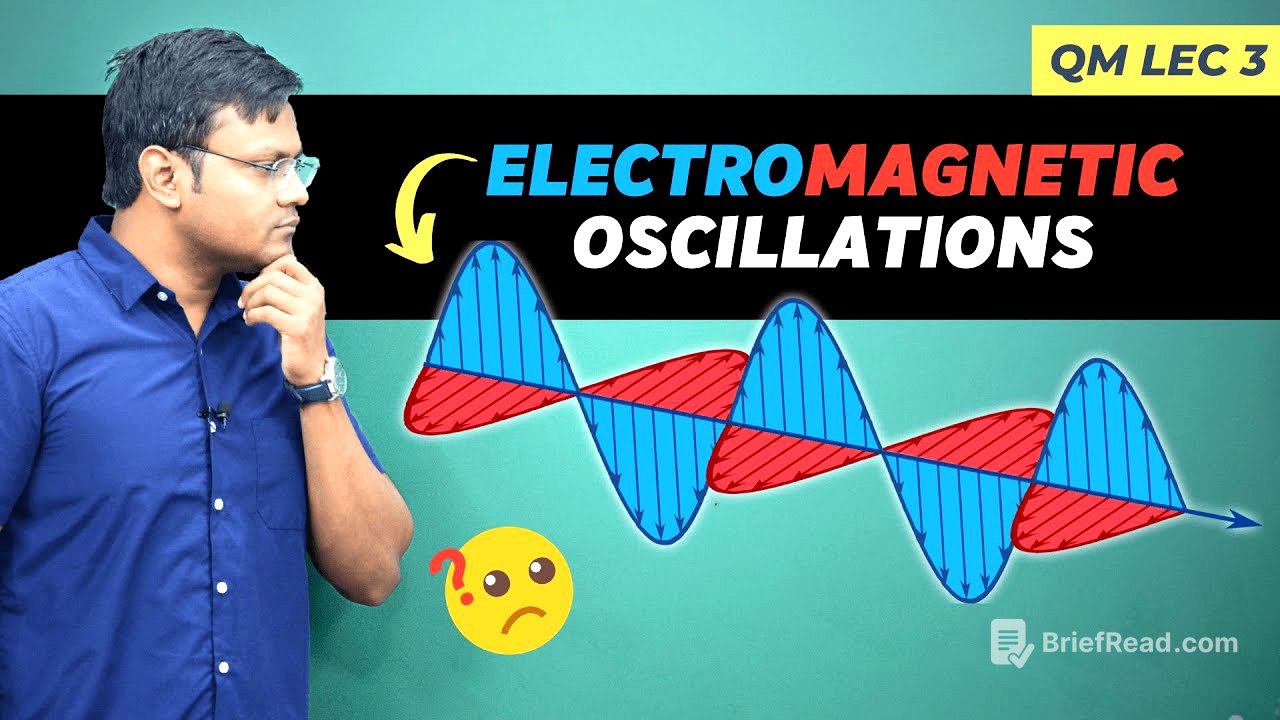
Electric fields can be generated by changing magnetic fields, and magnetic fields can be generated by changing electric fields. This concept is central to understanding light as electromagnetic oscillations. By taking the curl of Faraday's law and applying a vector identity, and considering Maxwell's equations in a vacuum (where charge and current densities are zero), we can derive a wave equation for the electric field. Similarly, by taking the curl of Ampere's law, we can derive a wave equation for the magnetic field. These equations demonstrate that both electric and magnetic fields propagate as waves.
Wave Properties [17:05]
Light, being an electromagnetic wave, exhibits several wave characteristics. It has a wavelength, which is the distance between two successive crests or troughs. Wavelength can be calculated using the speed of light and the frequency of the wave, or in terms of wave number (Lambda = 2 pi / k). Frequency is the number of oscillations of the electromagnetic field per unit time, and it is the inverse of the time period of one complete oscillation. Amplitude refers to the maximum value of the electric field from its mean. Light exists in a spectrum of electromagnetic radiation, with visible light being a small portion of this spectrum, ranging from radio waves to gamma radiation.
Diffraction [19:52]
Light demonstrates diffraction, which is the bending of a wavefront around sharp corners, obstacles, or through apertures. When a wavefront encounters an aperture with a size comparable to its wavelength, the secondary wavefront that emerges tends to spread out. This behavior is distinct from that of classical particles, which follow specific trajectories.
Interference [20:44]
Interference occurs when two or more waves interact, causing their amplitudes to add up and create a resultant wave. This phenomenon is based on the principle of superposition. When two monochromatic waves from a single source are in phase, they undergo constructive interference, resulting in a wave with greater amplitude and intensity. Conversely, if they are out of phase, they undergo destructive interference, potentially canceling each other out. Young's double-slit experiment demonstrates this, where monochromatic radiation passing through two slits creates an interference pattern of alternating dark and light fringes due to varying path lengths.
Polarization [23:00]
Polarization is a property of transverse waves, including light, that describes the geometrical orientation of the oscillations. In plane-polarized light, the electric field oscillates in a fixed direction. In circularly or elliptically polarized light, the direction of the electric field's oscillations changes with time, rotating as it propagates.
Energy & Momentum [23:36]
Light carries both energy and momentum. The energy per unit time per unit area carried by an electromagnetic wave is known as intensity, which is equal to the time average of the Poynting vector. Intensity is proportional to the square of the amplitude of the electric field (E naught Square). When light is incident on a surface, it can transfer momentum, resulting in radiation pressure, which is the force exerted per unit area. The momentum transferred is equal to the intensity divided by the speed of light (c).
Continuous Absorption/ Emission [26:17]
Matter can interact with electromagnetic radiation by absorbing and emitting it. According to classical physics, this absorption and emission occur in a continuous fashion. For example, an object placed in sunlight will continuously absorb light energy and convert it into thermal energy, causing it to heat up over time. There are no restrictions on the type of electromagnetic wave that can be absorbed by a particular material. An oscillating charge particle can release energy in the form of electromagnetic oscillations.
Future [28:35]
The classical understanding of light, with its wave properties, energy proportional to amplitude squared, and continuous interaction with matter, will be challenged in the coming years. Future experiments will reveal that the energy of a light photon is related to its frequency, and that energy absorption and emission can occur in discrete, quantized amounts. Light will be shown to behave as both an electromagnetic oscillation and as concentrated packets of energy called photons, which can collide with other particles.