TLDR;
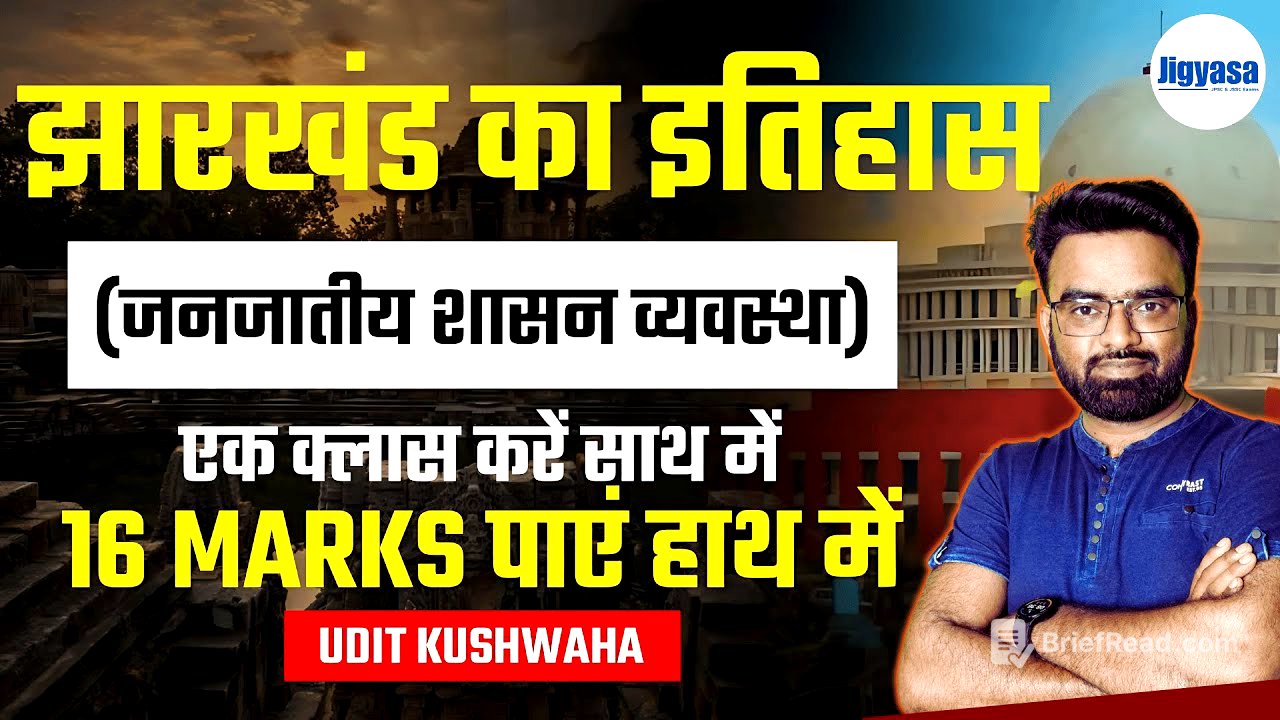
Alright, so this class is super important 'cause it's all about the tribal governance systems of Jharkhand, which is a key topic in the JPSC prelims, GS Paper 2. You'll get a complete overview, plus previous years questions from the 6th to 11-13th JPSC exams. If you're prepping for the 14th JPSC, this is your go-to guide.
- Covers syllabus topics like Munda, Nagvanshi, Paha Panchayat, Manjhi Pargana, Munda Manki, Dhoklo Sohar, and Jatiya Panchayat systems.
- Aims to solve any problems you might have with tribal governance systems.
- Includes previous years questions from JPSC exams.
Intro [0:27]
The class is about Jharkhand's tribal governance systems, a key topic in JPSC prelims GS Paper 2. The aim is to provide a complete overview and solve any problems you might have with these systems, especially if you're prepping for the 14th JPSC. Plus, they'll be covering previous years questions from the 6th to 11-13th JPSC exams.
Munda Governance System [3:59]
The Munda governance system is the traditional system of the Munda tribe, the third-largest in Jharkhand, mainly found in Ranchi, Gumla, and Simdega. Mundas call themselves "Horo" and their language "Horo Jaggar". They're mostly into agriculture, using "Khutkatti" land, with families known as "Koont". They migrated from the Rohtasgarh area, clearing forests to create agricultural land. Villages are called "Hatu", with "Parha" above that, and "Raj" at the top. Hatu's head is the Munda, assisted by the Pahan, who has a helper called Mahato. The Pahan's religious duties are aided by Baiga or Panbhara. The Parha head is the Parha Raja, and the Raj head is Raja or Sardar. The village is the smallest unit, while the Raj is the highest.
Functions of Munda, Pahan, and Mahto [9:59]
The Mahato acts as a messenger for the village. The Munda settles disputes, manages land issues, and maintains law and order with the help of village elders. They also collect revenue for the Raja. The Pahan is the village's religious head, assisting the Munda in administrative tasks and handling religious disputes. Pahans get tax-free land called "Dali Katari". The Mahato helps with administrative tasks, while Baiga or Panbhara assists with religious duties. The Mahato conveys decisions and orders from the Munda to the villagers. The Munda is the village head, and the Pahan is the religious head, assisted by Pujar or Panbhara and Mahato. The Pahan gets Dali Katari land, which is tax-free.
Parha Level and Exam Questions [15:46]
The Parha is the supreme judiciary, executive, and legislature, headed by the Parha Raja or Manki. These positions are hereditary. Key officers include the Diwan (minister), Thakur (acts when Diwan is absent), Pande (document maintenance), Karta (maintains discipline in meetings), and Lal (lawyer). Women don't have any role in these positions. The Diwan is of two types: Garh Diwan and Raj Diwan. The Lal is of three types: Balal, Manjhlal, and Kotlal. The Panchayat site is called Akhra, which is also a cultural site.
In previous JPSC exams, questions have covered topics like officials of the Bhuihari Parha, the religious head of the village (Pahan), the meeting place of the Panchayat (Akhra), and officers who are not part of the Munda Parha Panchayat system (Negi).
Nagvanshi Governance System [24:45]
The Nagvanshi governance system came after the Munda Raj, founded by Phani Mukut Rai in 64 AD. It was a mix of monarchy and republic. The village head was the Mahto, also called Mahatam. Above the village was the Parha, headed by the Manki, later changed to Bhuihar, who collected taxes. The Raja or Sardar was the head of the state. The village level had 22 officials, but only the Mahto and Bhandari are important. The Mahto was the village head with administrative powers, while the Bhandari managed the king's land and stored grains. At the Parha level, key officials were Bhuihar, Jagirdar, and Pahan. Bhuihars had political and judicial powers, and initially economic powers, but these were later taken away when the Nagvanshi kings became Jagirdars under the British. The Pahan performed religious activities.
Key Nagvanshi Rulers and Exam Questions [32:56]
Key Nagvanshi rulers include Phani Mukut Rai, the founder with his first capital at Sutiambe. Pratap Rai shifted the capital to Chutia. Bhimkarna made Khukhragarh the capital. Durjan Sal, a contemporary of Jahangir, was imprisoned in Gwalior for 12 years. In 1627, he made Dosagarh his capital and agreed to pay ₹6,000 annual tax to Jahangir. Yadunath Shah made Palkot his capital, and Udaynath Shah made Ratu Garh the capital. Jagannath Shahdev made Palkot Bharon his capital. Drapnath Shahi was the first king to become a Jagirdar of the British.
Previous JPSC exam questions have covered the annual tribute paid to Jahangir by Durjan Sal (₹6,000), the ruler who shifted the capital from Sutiambe to Chutia (Pratap Rai), and the head of the Nagvanshi administrative system (Raja).
Parha Panchayat Governance System [42:38]
The Parha Panchayat governance system belongs to the Uraon tribe, the second-largest in Jharkhand. They mainly live in central Jharkhand, like Ranchi and Gumla. Their system has three levels: Gram Panchayat, Parha Panchayat, and Antar Parha Panchayat. The Gram Panchayat is the lowest unit, with the Mahto as its head. Several Bhuihari villages form a Parha Panchayat, with the Parha Deewan as its head. The Antar Parha Panchayat is headed by the Parha Raja. The Mahto's position is hereditary, and they are the independent head of the village. They protect the social and cultural life of the village and get land called "Mahtwai Land" instead of a salary. They are assisted by the Manjhi, who acts as a messenger.
Functions of Key Officials in Uraon System [46:39]
The Pahan is the religious head, handling all religious activities, assisted by the Baiga, who also acts as a traditional healer. The Pahan's term is three years, with re-election during the Khaddi festival. They get land called "Pahan Land". The Bhandari acts as a messenger and gets "Bhandargiri Khet" land. The Mahto is the head of the village, and a saying goes, "Pahan makes the village, and Mahto runs it." The Baiga was the secular head before the Mahto.
Exam Questions on Parha Panchayat System [50:40]
Previous JPSC exam questions have covered topics like the secular head before the Mahto (Baiga), what the families who cleared the jungle were known as (Bhuihars), the function of the village Baiga (to appease village deities), the head of the Parha Panchayat (Parha Raja), and the two most important officers in an Uraon village (Mahto and Pahan).
Manaki Munda Governance System [56:59]
The Munda Manaki governance system is the traditional system of the Ho tribe. It was approved by Captain Thomas Wilkinson in 1837 through the Wilkinson Rule in the Kolhan region. This system is considered India's first democratic governance system. The structure has three levels: the village (lowest unit), Pir or Parha, and Teen Manaki. The village head is the Munda, assisted by the Dakua, who is both an assistant and a messenger. The Pir or Parha head is the Manki, with a judicial head called Pir Panch. The Teen Manaki is a bench of three Mankis.
Functions of Officials and Exam Questions [1:02:51]
The Dakua is the Munda's assistant and messenger. The Deuri is the religious head, assisted by the Yatra Deuri. The Munda has judicial and administrative powers, collects revenue, and manages land settlement. The Tahsildar is the revenue officer at the Pir or Parha level.
Previous JPSC exam questions have covered the British officer who recognized the Munda Manki system (Thomas Wilkinson), who the Munda applies to under the Manki Munda system (Head of a Village), and the statement that is not correct regarding the Munda Manki system (Manki's position is hereditary).
Manjhi Pargana Governance System [1:08:38]
The Manjhi Pargana governance system is related to the Santhal tribe, the largest in Jharkhand and India. They migrated from Bengal to the Chai Champa area and then to the Santhal Pargana region. Their traditional system is called Manjhi Pargana. It got legal approval through the Yule Rule in 1856, after the Santhal rebellion. The system was adopted from the Souriya Pahariya tribe. The village is the smallest unit, headed by the Manjhi, assisted by the Pranik (or Pramanik), who is also the Up-Manjhi. The secretary is the Gudait, and the chief advisor is the Jog Manjhi. Five to eight villages form a Desh, headed by the Desh Manjhi or Mode Manjhi. The Pargana, made up of 15-20 villages, is headed by the Parganait.
Village Level Officials and Their Functions [1:15:49]
Village-level officials include the Pranik, Gudait, Jog Manjhi, Jog Pranik, Bhagdo Praja, Lasher Tangai, and Naike. The Pranik is the Manjhi's assistant, also called Up-Manjhi. The Gudait is the messenger, collecting revenue and keeping accounts. The Jog Manjhi assists the Pranik and is the chief advisor to the Manjhi. They are also the head of the Ghotul, a youth dormitory. The Jog Pranik is the assistant to the Jog Manjhi. The Bhagdo Praja is an advisory committee of elders, who don't receive a salary. The Lasher Tangai is the head of the village defense force. The Naike is the religious head, assisted by the Udam Naike.
Higher Level Institutions and Punishments [1:22:49]
Disputes that can't be resolved at the village level go to the Desh level, and then to the Pargana level, headed by the Parganait, who is elected by all the Manjhis. Besides these, there are two other institutions: the Indra Basi Uchcha Karya Parishad (high court) and the Lobir Sendra (supreme court). The high court is headed by the Deuri and meets at least once a year. Appeals can be made to the high court against decisions by the Manjhi, Desh Manjhi, and Parganait. The supreme court's decision is final. Punishments include "Karela" (smallest punishment, economic penalty) and "Bitlaha" (most severe, social boycott for offenses like sexual crimes or marrying within the same clan).
Exam Questions and Other Tribal Systems [1:30:34]
Previous JPSC exam questions have covered the sub-head of the Manjhi (Pranik), the assistant to the village headman (Pramanik), what Bitlaha is (a type of punishment), what Sadra Basi is (a hunting council), and the religious head in a Santhal village (Naike).
Other tribal governance systems include those of the Lohra, Bhumij, Mahli, Mal Pahariya, Chero, Badaik, Bediya, Kora, Gond, Kanwar, and Pole tribes.
Dhoklo Sohar Governance System [1:32:47]
The Dhoklo Sohar governance system is related to the Khadia tribe. It's influenced by the Munda system. "Dhoklo" means meeting or assembly, and "Sohar" means chairman or president. The Khadia tribe established the All India Khadia Mahasabha in 1934-35, which supports the caste system but opposes the Panchayati Raj system. The system has a Gram Panchayat or Dhoklo Panchayat at the village level, headed by the Mahto. At the Sohar level, there's the Sohar Panchayat, headed by the Sohar. The Mahto, also called Dhoklo, is the main person in the village and can be replaced with the villagers' consent.
Key Officials and Exam Questions [1:36:34]
There are three types of Khadia: Doodh Khadia, Dhelki Khadia, and Pahari Khadia. In Pahari Khadia, the head is called Dandia, and the religious head is Dehri. In Doodh and Dhelki Khadia, the head is the Mahto. A key figure is the Karta, elected by 20-25 villages. The Karta is responsible for organizing the annual meetings. Every three years, the Dhoklo Sohar, the head of the entire Khadia society, is elected. The Pahan or Kalo is the religious head, getting Pahan land. The Dhoklo Sohar has assistants like Likhakad (secretary), Injokad (treasurer), and Dewan (advisor).
Previous JPSC exam questions have covered statements regarding the Dhoklo Sohar Mahasamiti (opposes the Panchayati Raj system), the tribe associated with the Dhoklo Sohar system (Khadia), and the relationship of Karta to the system (Dhoklo Sohar).
Other Tribal Systems and Conclusion [1:43:48]
Other tribal systems include those of the Lohra, Bhumij, Mahli, Mal Pahariya, Chero, Badaik, Bediya, Kora, Gond, Kanwar, and Pole tribes. The head of the Birhor tribe is called Naya. In the Souriya Pahariya tribe, the village head is called Manjhi.