TLDR;
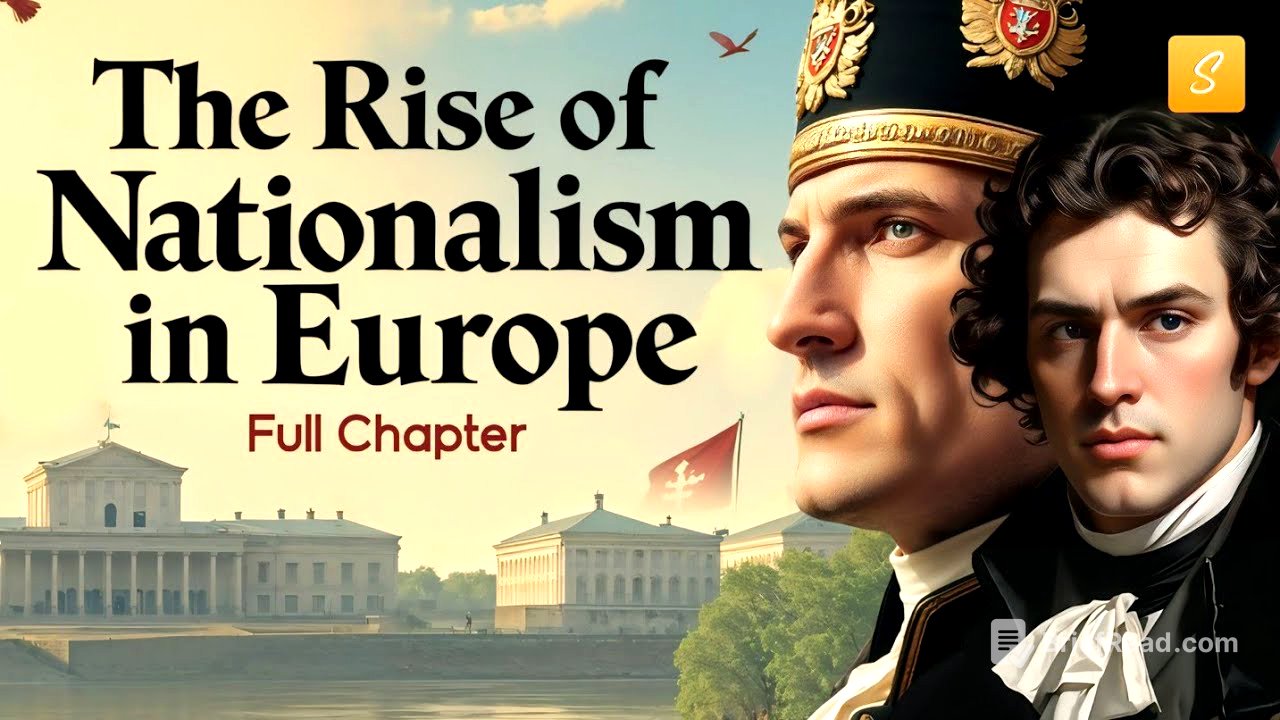
Alright, so this video is all about the first chapter of Class 10th History, "The Rise of Nationalism in Europe." It starts with a peek into Frédéric Sorrieu's utopian vision and then walks us through the French Revolution, the Napoleonic Code, and how nationalism brewed in Europe. It touches upon the aristocracy, the middle class, liberal nationalism, conservatism, and the Treaty of Vienna. The video also covers the age of revolutions, romantic imagination, economic hardships, and the revolutions of the liberals, before diving into the making of Germany and Italy, the strange case of Britain, visualizing the nation, and the link between nationalism and imperialism.
- Frédéric Sorrieu's utopian vision of a democratic and republic world.
- The spread of nationalism in Europe and the struggle for liberty.
- The unification processes of Germany and Italy.
Introduction [0:00]
The video kicks off with an intro to a new series aimed at covering each chapter quickly for board exam prep. The focus is on the first chapter of Class 10th History, "The Rise of Nationalism in Europe." The chapter starts in 1848 with French artist Frédéric Sorrieu's four imagined pictures called "The Pact Between Nations." One picture shows Sorrieu's dream of a democratic and republic world, featuring the Statue of Liberty, symbolizing freedom, with a torch in one hand and the charter of human rights in the other. Broken monarchical symbols are scattered on the ground. Sorrieu envisions people from different nations marching towards liberty, blessed by God. The chapter will explore the real struggles for liberty and the spread of nationalism in Europe, including the changes, struggles, the fall of dynastic rule, and the rise of nation-states.
Frédéric Sorrieu utopian vision [0:24]
Frédéric Sorrieu, a French artist, created four pictures envisioning a democratic and republic world. In his depiction, people from various nations march towards the Statue of Liberty, which holds a torch and the charter of human rights. The remnants of monarchical systems are shown scattered on the ground, symbolizing their destruction. God is depicted blessing the nations as they move towards freedom. This image represents Sorrieu's utopian idea of nations moving away from monarchy towards liberty.
The French Revolution and the idea of the Nation [2:13]
The French Revolution of 1789 had a widespread impact beyond France, influencing the rest of Europe. Before 1789, France was under a monarchy, but the revolution brought significant changes. Power shifted from the monarchy to the common citizens of France. Ideas promoting unity, like "le patrie" (the fatherland) and "le citoyen" (the citizen), were introduced to foster equality. The old French flag was replaced with a new tricolor flag, and French was declared the national language. A new national anthem was composed, and patriotic songs were created. The Estates-General was replaced by the National Assembly, and internal customs duties were removed. These changes marked the arrival of democracy in France, initially celebrated by the people.
Civil Code of 1804 (Napoleonic Code) [4:02]
In 1799, Napoleon Bonaparte seized power in France, ending democracy and declaring himself Emperor in 1804. He introduced the Civil Code of 1804, also known as the Napoleonic Code, which brought several changes. It established equality before the law, protected the right to property, abolished the feudal system, improved transport and communication, standardized weights and measures, introduced a common currency, and removed guild restrictions. Initially, people were happy with Napoleon, especially as he abolished monarchies in other regions. However, their perception changed as they realized Napoleon was expanding his own domination rather than bringing liberty.
The making of nationalism in Europe [5:54]
In the mid-18th century, Europe lacked nation-states with common languages, cultures, histories, and identities. Instead, large empires existed with diverse populations. The video explores how nationalism spread and how the idea of a nation-state emerged among these diverse groups.
The Aristocracy and the new Middle class [6:29]
At that time, European society was mainly divided into two classes: the aristocracy and the peasantry. The aristocrats were wealthy landowners, socially and politically powerful, often intermarrying and speaking French, which they considered a high-status language. They shared a similar lifestyle, wearing expensive clothes and enjoying fine dining. The peasants, on the other hand, were poor and lacked land. Although they formed the majority, they were not powerful due to their lack of wealth. The Industrial Revolution in the second half of the 18th century led to the rise of a new working class, the middle class. This class consisted of businessmen, industrialists, and professionals who were educated due to their improved financial status.
What did liberal nationalism stand for? [7:53]
The middle class embraced the idea of liberal nationalism, with "liberalism" derived from the Latin word "liber," meaning free. They demanded the end of autocratic rule and the privileges of the clergy. They advocated for a constitution and a representative form of government, where the government is elected by the people. However, the problem was that they only demanded voting rights for men with property, excluding women and men without property. Women and propertyless men protested for voting rights across Europe. Additionally, traders faced issues like high taxes and different currencies in different regions, hindering trade.
A new conservatism after 1815 [10:40]
Napoleon's rule, which began in 1799, ended in 1815 with his defeat at the Battle of Waterloo. The victorious nations were conservative, opposing societal changes and favoring the restoration of monarchy. They implemented conservatism, reversing Napoleon's changes by restoring monarchies, the power of the Church, and social hierarchies. They also re-established autocratic rule and imposed censorship, preventing any opposition.
Treaty of Vienna (1815) [12:18]
The four victorious nations signed the Treaty of Vienna in 1815, led by Austrian Chancellor Duke Metternich. The treaty aimed to undo the changes brought by Napoleon. It restored the Bourbon dynasty in France and created states around France to prevent its expansion. Prussia gained important territories on its western border, Austria gained control over Northern Italy, and Russia gained control over Poland. The conservatives were now in power, reversing most of Napoleon's changes except for the Confederation of 39 states, which they left untouched.
The Revolutionaries [13:26]
Liberal nationalists were unhappy with the new conservatism and went underground to oppose it secretly. They formed secret groups to oppose monarchy and autocratic rule, aiming for liberty and freedom. Giuseppe Mazzini, an Italian revolutionary born in 1807, formed two underground societies: Young Italy in Marseilles and Young Europe in Berne. Mazzini was considered a dangerous enemy to the social order by conservatives like Duke Metternich.
The age of Revolution (1830-1848) [14:54]
The period from 1830 to 1848 is known as the Age of Revolutions due to numerous uprisings. Three major revolutions occurred in France, Belgium, and Greece. The July Revolution in France in 1830 led to the removal of the Bourbon dynasty, which had been restored by conservatives in 1815. A constitutional monarchy was established with Louis Philippe as the constitutional monarch. Duke Metternich remarked that "When France sneezes, the rest of Europe catches cold," highlighting the influence of French revolutions on the rest of Europe. Inspired by France, Belgium revolted and separated from the United Kingdom of the Netherlands.
The Romantic Imagination and the National feeling [18:47]
Nationalism wasn't just about wars and expansion; culture played a big role too. People started using art, poetry, stories, and music to stir up national feelings. This was called Romanticism, a movement to build national sentiment. Artists tried to connect people emotionally to their culture, sparking love for their nation. Johann Gottfried, a German philosopher, said that to know a nation's culture, you need to look among the common people, not in royal palaces. He believed folk songs, poetry, and dances were the true spirit of a nation. Language also played a key role. For example, when Russia tried to force Russian language on Poland, the Polish people resisted fiercely to protect their cultural identity.
Hunger, Hardship and The popular Revolt [22:01]
The 1830s were a tough time in Europe due to economic hardship. Population growth led to unemployment, forcing people to move from rural areas to overcrowded cities, creating slums. Crop failures caused food prices to rise, leading to widespread hunger. In 1848, the situation in Paris, France, became so dire that people took to the streets in protest. The ruler, Louis Philippe, fled, and a National Assembly was formed, declaring France a republic. Voting rights were granted to all men over 21, and the right to work was established.
Silesia Revolt of 1845 [23:25]
Amidst the economic hardship, the Silesia Revolt occurred in Poland in 1845. Weavers revolted against contractors who had reduced the prices of their goods. The weavers, already struggling due to the economic situation, attacked the contractors' homes, destroying property and looting supplies. The contractors called in the army, and 11 weavers were killed in the revolt. A journalist named William Wolfe described the events of the Silesia Revolt.
The Revolution of the Liberals [24:18]
In 1848, the middle class also revolted, seeking to establish nation-states and demanding parliamentary principles such as a constitution, freedom of the press, and freedom of association. In the German region, middle-class individuals formed an All-German National Assembly, electing 831 members. These members gathered in Frankfurt in May 1848 to draft a constitution for a unified German nation. However, the constitution failed to address the concerns of peasants, workers, and artisans, leading to a loss of support. The middle class then approached the King of Prussia, Frederick William IV, with the constitution, requesting him to accept it.
The making of Germany and Italy [27:14]
The video transitions to the making of Germany and Italy, exploring their unification processes, along with the unification of Britain.
Germany – Can the Army be the Architect of a Nation? (Unification of Germany) [27:31]
After the failed attempt by liberals to unify Germany in 1848, Prussia took the lead in unifying the German states to increase its political dominance. King William I of Prussia appointed Otto von Bismarck as Chief Minister, tasking him with unifying the German states under Prussian rule. Bismarck, along with the Prussian army and bureaucracy, engaged in wars against Austria, Denmark, and France, who controlled various German regions. After seven years of wars, Prussia emerged victorious, uniting the German states and creating a large German nation. In January 1871, William I was declared the Emperor of a unified Germany.
Italy unified [29:54]
Italy was divided into seven states, with only Sardinia-Piedmont under Italian control. The rest of Italy was ruled by Austria, the Pope, and the Bourbon kings of Spain. Giuseppe Mazzini had attempted to unify Italy but failed. Victor Emmanuel II, the King of Sardinia-Piedmont, took on the responsibility of unifying Italy. He appointed Count Cavour as his Chief Minister, who formed an alliance with France. With the help of Giuseppe Garibaldi and his army, they conquered the southern part of Italy in 1860. The central region, under the Pope's control, surrendered, and in 1861, Victor Emmanuel II was declared the King of a unified Italy.
The Strange case of Britain [31:47]
The unification of Britain is described as a "strange case" because it was a long, gradual process rather than a sudden revolution or war. Britain was divided into Scotland, England, Wales, and Ireland, each with distinct ethnic identities. Wales had been part of England since 1565. In 1688, the English Parliament seized power from the monarchy. England then aimed to capture surrounding territories to create a larger English nation. In 1707, the Act of Union was signed with Scotland, uniting them to form the United Kingdom of Great Britain.
Visualising the Nation [34:07]
In the 18th and 19th centuries, artists began to visualize nations by personifying them, similar to how India is represented by Bharat Mata. This was done to evoke national sentiments and create a sense of unity. Artists in Europe used female figures, known as allegories, to represent their nations. For example, France was represented by Marianne, and Germany by Germania.
Nationalism and Imperialism [35:07]
By the end of the 19th century, nationalism transformed into imperialism, where large nations began capturing smaller ones to expand their territories and power. The Balkans region serves as a case study of imperialism. The Balkans, part of the Ottoman Empire, consisted of states like Romania, Bulgaria, Albania, and Greece. As the Ottoman Empire weakened, these states sought independence, leading to conflicts among themselves as each aimed to dominate the others. This attracted larger nations like Russia, France, Germany, and Britain, resulting in the First World War.
Thank you! [37:06]
The video concludes by noting that after the war, anti-imperial movements arose as people realized that nationalism turning into imperialism is detrimental. The feeling of nationalism re-emerged as countries sought independence from those who had occupied them.