TLDR;
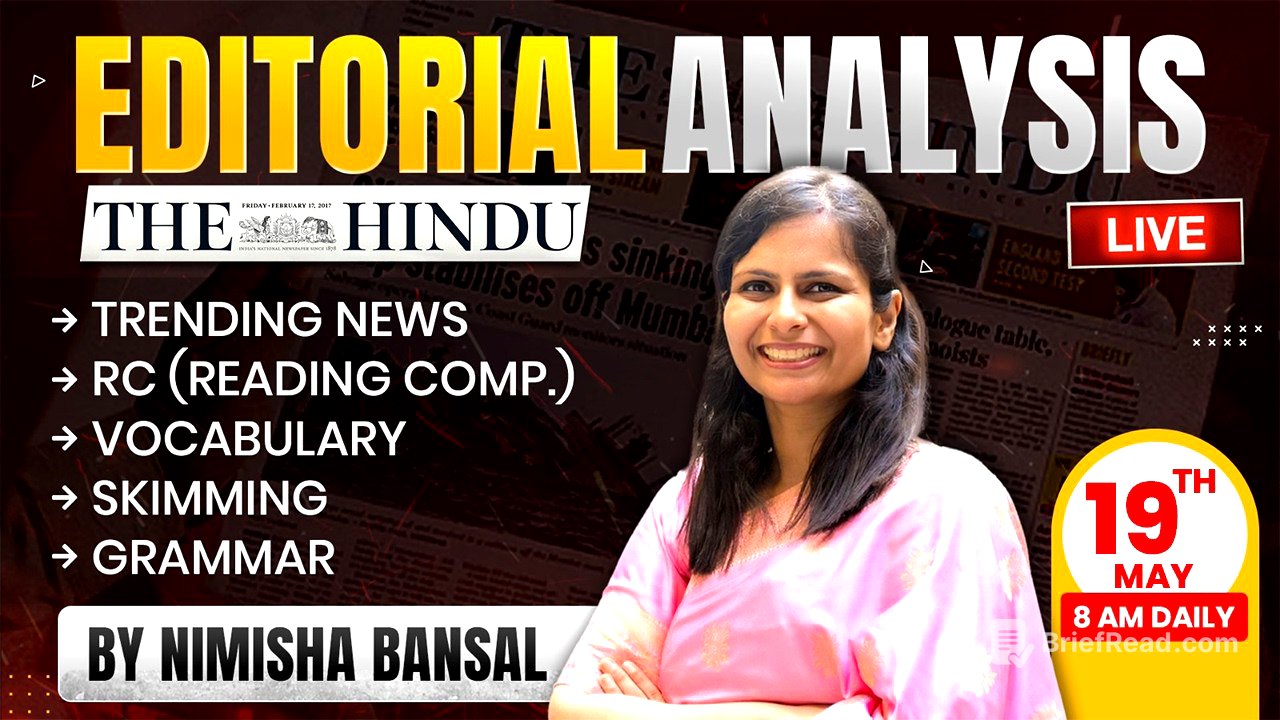
Alright, folks! This session by Nimisha Bansal covers vocabulary from "The Hindu" newspaper, one-word substitutes, phrasal verbs, idioms, and a detailed editorial analysis. Key takeaways include learning new words and their usage, understanding the nuances of the English language, and applying this knowledge to improve reading comprehension and overall communication skills.
- Vocabulary building with synonyms and antonyms
- Understanding one-word substitutes, phrasal verbs, and idioms
- Editorial analysis for reading comprehension
Introduction [0:00]
Nimisha Bansal welcomes everyone to the session, emphasizing the importance of subscribing, liking, and sharing the video. She sets an enthusiastic tone, asking "How's the josh?" and expressing excitement to begin with vocabulary.
What are the vocabulary words of today's Hindu article? [0:36]
The session starts with the word "erroneous," an adjective meaning incorrect or faulty. Nimisha explains its connection to "error" and introduces "erratic," describing something unpredictable or irregular. She provides synonyms like "fickle," "capricious," and "impulsive," and antonyms like "accurate" and "right." Then she discusses the word "huge" and its many synonyms such as "gargantuan," "gigantic," "massive," "immense," "colossal," "prodigious," "astronomic," "mountainous," "elephantine," "titanic," "leviathan," "behemoth," "vast," "towering," "tremendous," "whopping," "humongous," and "enormous." Near synonyms like "mighty," "monumental," "cosmic," "herculean," "ponderous," "cumbersome," "burdensome," "onerous," and "bulky" are also discussed. Antonyms like "tiny," "small," and "little" are mentioned, leading to synonyms for "tiny" such as "petite," "diminutive," "microscopic," "iota," "morsel," "spec," "pumy," and "lilliputian." The word "dainty," meaning small and beautiful, is highlighted. Words indicating scarcity like "paucity," "dearth," "scarcity," "modicum," "lack," and "shortfall" are covered, along with words for insignificance like "trivial" and "trifling."
AM - Editorial Analysis - YouTube [8:00]
Moving on, Nimisha introduces "seismometer," the equipment used to detect and measure earthquakes, emphasizing its spelling. She then discusses "obliterate," meaning to destroy completely, providing synonyms like "extirpate," "expunge," "eradicate," "extinguish," "erase," "raze," "ravage," "sabotage," "wipe out," "demolish," "smash," "crush," "pulverize," "incinerate," "ruin," "erode," "corrode," "shatter," "disappear," "vanish," "spoil," "blemish," "tarnish," "smear," "delete," and "abolish." Antonyms include "create," "preserve," "protect," "conserve," and "support." Next is "reproach," a verb meaning to criticize or blame, with synonyms like "criticize," "blame," "scold," "lambast," "excoriate," and "berate." Antonyms include "extol," "exalt," "approve," "compliment," and "commend." "Poignant," an adjective describing something emotionally touching or painful, is discussed, with synonyms like "touching," "emotional," "moving," "distressful," and "sorrowful," and antonyms like "indifferent." The idiom "a lump in one's throat" is also mentioned.
AM - Perfection Batch [11:00]
Nimisha encourages viewers to join the Perfection Batch, reminding them that today is the last day for a 60% discount using the code NB60 for English only or Safalta for all subjects.
Obliterate [12:23]
Nimisha explains the word "obliterate" which means to destroy something completely. She provides a list of synonyms like destroy, erase, demolish, extirpate, expunge, eradicate, extinguish, raze, ravage, sabotage, wipe out, smash, crush, pulverize, incinerate, ruin, erode, corrode, shatter, vanish, spoil, blemish, tarnish, smear, delete and abolish. She also gives antonyms like create, preserve, protect, conserve and support.
Glint [18:53]
The word "glint," a noun meaning a small flash or sparkle of light, is introduced, with synonyms like "gleam," "shimmer," "sparkle," "twinkle," and "glimmer." The idioms "light at the end of the tunnel" and "a glimmer of hope" are also explained.
Seize [20:32]
Nimisha discusses the word "seize" which means to give up or surrender. She provides synonyms like relinquish, surrender, abdicate, give up, give in, throw in the towel and raise the white flag. Antonyms include harmony, defend and hold on.
Tenability [21:38]
"Tenability," a noun referring to the justifiability or defensibility of something, is explained, with related terms like "sustainable," "defensible," "viable," "practical," "feasible," "logical," and "plausible." The idiom "pass muster," meaning to meet a required standard, is also discussed.
Splintering [24:07]
The word "splintering," a verb describing something breaking into small pieces, is covered, with synonyms like "disintegrate," "fragment," and "shatter," and antonyms like "consolidate," "integrate," and "unify." Related words for collecting excessively, such as "accumulate," "gather," "hoard," "rack up," and "pile up," and words for wasting, such as "squander," "dissipate," and "fritter away," are also mentioned.
Confide [26:41]
"Confide," a verb meaning to share personal or secret information, is discussed, with synonyms like "disclose" and "reveal," and antonyms like "suppress" and "withhold."
Story Part [28:04]
Nimisha shares a story about Jaden, an athlete who faces a career-threatening accident. Despite facing numerous challenges, including self-doubt and societal criticism, Jaden perseveres with determination. He confides in his closest supporters and gradually returns to training. Overcoming erroneous assumptions and emotional setbacks, Jaden eventually triumphs, proving that resilience and courage can overcome adversity. The story emphasizes the importance of never giving up and not allowing negative emotions or circumstances to define one's future.
One word substitute [32:00]
Nimisha explains one-word substitutes, starting with "wreath," a circular arrangement of flowers. She also defines "maestro" or "doyen" as someone highly skilled in their field, "volunteer" as someone who works without pay, and "zealot" as someone with extreme beliefs.
What are today's phrasal verbs and idioms? [33:13]
Phrasal verbs are discussed, including "live down" (to be able to forget something embarrassing), "look after" (to take care of), "take after" (to resemble), "live up to" (to meet a standard), and "live on" (to survive). Idioms and phrases covered include "still waters run deep" (quiet people have deep thoughts), "blood is thicker than water" (family relationships are stronger), "water under the bridge" (problems that are no longer important), "like water off a duck's back" (criticism that doesn't affect someone), and "make waves" (to cause problems).
Article Reading [36:10]
Nimisha begins reading and explaining an article about the impact of pre-monsoon storms in Uttar Pradesh. The article discusses the high number of deaths and injuries caused by these storms, the intensity of the winds, and the role of convective systems and western disturbances. It also raises questions about the effectiveness of warnings issued by the India Meteorological Department and the Uttar Pradesh government. The article further explains the convergence of hot, dry winds from the Thar Desert and moist winds from the Bay of Bengal, which contributes to the formation of storms. It highlights the vulnerability of people living in structurally weak houses and the risks posed by faulty wiring and public signage.
Questions from the Passage [52:50]
Nimisha leads a reading comprehension exercise based on the article. The first question addresses what the Uttar Pradesh storms reveal, with the correct answer being that disaster vulnerability is not entirely unpredictable and that warnings alone are insufficient without proper communication and infrastructure. The second question asks which statements are true, with the correct answer being that the IMD and the Uttar Pradesh government issued advance warnings and that converging climatic systems caused atmospheric disturbances. The third question asks which statement best summarizes the passage, with the correct answer being that Uttar Pradesh's vulnerability to recurring storms is exacerbated by existing weaknesses. The fourth question asks what conclusion can be drawn from the passage, with the correct answer being that weak housing and public installations increase the impact of storms on people. The fifth question asks about the tone of the passage, with the correct answer being cautionary.
Article for Skimming [1:01:05]
Nimisha instructs viewers to read another article about petroleum and gas reserves in India.
Questions from the Passage [1:04:05]
Nimisha discusses questions related to the second article. The main point is India's vulnerability due to limited reserve capacity compared to countries like the US and China.
Match the Columns [1:07:21]
Nimisha concludes with a "match the columns" exercise, pairing words with their meanings: mandate (compulsory), concede (admit), juxtapose (place side by side), anomaly (deviation from the norm). She also reviews previous year's idioms: go down in flames, take something with a grain of salt, make ends meet, hold one's ground, and tough nut to crack. She assigns viewers the task of writing the meanings of at least three words from the session in the comments. Finally, she reminds everyone about the Perfection Batch and offers contact information for any queries.