TLDR;
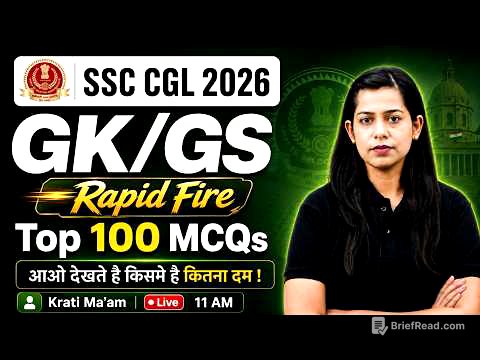
Namaste everyone! This session focuses on solving GK/GS MCQs and Ancient India MCQs, acting as a daily mock test for CGL and CHSL aspirants. Key points covered include:
- Emergency provisions borrowed from the Government of India Act 1935 and Germany.
- Discussions on state lists, simple majority for new states, and the meaning of "Keralam."
- Examination of writs, reservation for SC/ST in services, and pardoning powers of the President.
- Analysis of Indian Parliament structure, schedules of the Constitution, and common High Courts.
- Exploration of Indus Valley Civilization, Mauryan Empire, Buddhism, and historical figures like Bal Gangadhar Tilak.
Introduction and Class Overview [0:04]
The class is designed for students preparing for CGL and CHSL exams. Every day at 8 PM, they solve GK/GS questions and cover specific topics. Today's session includes 25 GK/GS MCQs and 30 MCQs on Ancient India. This acts as a daily mock test to help students practice and cover important topics for the upcoming exams.
Emergency Provisions and Constitutional Borrowings [1:29]
The emergency provisions in the Indian Constitution are borrowed from the Government of India Act 1935. A key point to remember is that during an emergency, fundamental rights can be suspended, a concept taken from the German Constitution.
State List and New State Formation [2:47]
Public health, sanitation, hospitals, and dispensaries fall under the State List in the Indian Constitution. Article 2 and 3 deal with the creation of new states and alteration of existing state names and boundaries. For example, changing Kerala to Keralam falls under Article 3 and requires a simple majority, not a special majority under Article 368. Keralam means "land of coconut," where "Kera" means coconut and "ilam" means land of origin.
Writs and Reservation in Services [5:32]
When a lower court is exceeding its jurisdiction, a higher court can issue a writ of prohibition to stop the proceedings. Regarding reservation for Scheduled Castes and Scheduled Tribes in services, Article 335 is relevant. Article 330 deals with reservation in the Lok Sabha (84 seats for SC and 47 for ST).
Pardoning Powers of the President [8:45]
Under Article 72, the President has pardoning powers, while the Governor has similar powers under Article 161. Commutation means substituting a punishment with a lighter form. Pardon means complete forgiveness. Remission means reducing the time period of the punishment without changing its nature. Respite involves reducing the sentence due to special conditions, like pregnancy. Reprieve means temporarily suspending a sentence to allow time for seeking pardon.
Indian Parliament and Constitutional Schedules [11:54]
The Indian Parliament follows a bicameral legislature, with two houses: Lok Sabha and Rajya Sabha. This concept was introduced in the Government of India Act 1919. Only six states in India have bicameral legislatures. The Ninth Schedule, which deals with land reforms, was introduced in 1951 during Jawaharlal Nehru's tenure as Prime Minister.
High Courts and Capacity Building Program [14:25]
Lakshadweep falls under the Kerala High Court's jurisdiction, while Andaman and Nicobar Islands fall under the Calcutta High Court. Punjab, Haryana, and Chandigarh share a common High Court. Maharashtra, Goa, Dadar, and Nagar Haveli, Daman and Diu share the Bombay High Court. A capacity-building program for elected women representatives of Panchayats was launched in Ranchi, Jharkhand, by the Ministry of Women and Child Development in collaboration with the Ministry of Panchayati Raj.
Financial Emergency and UPSC Chairman Appointment [17:46]
If the President declares a financial emergency under Article 360, it must be approved by the Parliament within two months. Once approved, there is no fixed period, and the President can lift it anytime. The Chairman of the UPSC is appointed by the President of India, as per Article 316. The current UPSC chairman is Dr. Ajay Kumar.
Martial Law and Historical Figures [20:05]
Martial law, mentioned in Article 34 of the Indian Constitution, implies military control over administration. In such situations, fundamental rights can be restricted. Bal Gangadhar Tilak started the Ganpati Mahotsav in 1893 to unite people. He also launched newspapers like Kesari and Maratha and wrote the book Gita Rahasya while in jail. He established the Home Rule League in April 1916.
Indus Valley Civilization and CSR [24:12]
The people of the Indus Valley Civilization worshipped Pashupati. CSR (Corporate Social Responsibility) pertains to social responsibility. Companies with a turnover of more than 1000 crore or a net profit of more than 5 crore are required to spend 2% of their income on CSR activities.
Nalanda University and Chandragupta Maurya [27:38]
Nalanda Mahavira or Nalanda University was located in Bihar. Chandragupta Maurya was a follower of Jainism.
Mauryan Dynasty and Gautam Buddha [30:48]
Ghatotkacha was the father of Chandragupta I in the Gupta dynasty. Kanishka's personal physician was Charaka, known for the Charaka Samhita. The community of Koch Rajbongshi is found in the North-Eastern areas, including Assam and Meghalaya. Gopala was the founder of the Pala dynasty.
International Relations and Ancient History [35:14]
Sri Lanka honored Prime Minister Modi with its highest civilian award, Mitra Bhushan. The SLINEX military exercise is conducted between the Indian Navy and the Sri Lankan Navy. The Battle of Tarain was fought between Prithviraj Chauhan and Muhammad Ghori.
Ancient India: Indus Valley Civilization [38:37]
The session transitions to Ancient India, starting with the Indus Valley Civilization. Lothal is associated with the Indus Valley Civilization due to its dockyard. The people of the Indus Valley traded with Mesopotamia. Most Indus Valley sites are now in Pakistan and Northwest India. Mohenjo-daro is also known as the "Mound of the Dead" because of the skeletons found during excavation. The town planning of the Indus Valley Civilization was a key feature.
Indus Valley Artifacts and Discoveries [41:56]
The dancing girl figurine found in Mohenjo-daro is made of bronze. The Indus Valley people were not familiar with horses, according to NCERT. Seals found in Indus Valley sites indicate trade and business activities. R.D. Banerji discovered Mohenjo-daro.
Harappan Sites and Mauryan Empire [44:08]
Lothal provides evidence of a dockyard. Alamgirpur in Ghaziabad district is an Indus Valley site. Patliputra (Patna) is not associated with the Indus Valley Civilization. Dholavira is related to the Harappan culture. Sitadhyaksha was the head of the agriculture department.
Mauryan Rulers and Buddhism [46:15]
Dharma Mahatras was a post created by Ashoka. Chandragupta Maurya founded the Mauryan Empire by defeating Dhanananda. Bindusara was the son of Chandragupta Maurya. Pushyamitra Shunga killed the last Mauryan ruler, Brihadratha, and established the Shunga dynasty.
Historical Figures and Buddhist Literature [47:38]
Greek scholars referred to Chandragupta Maurya as "Sandrocottus" and "Androcottus." Ashoka was referred to as "Devanampriya Priyadarshi." Sarnath inscription refers to Ashoka as "Dhamma Ashoka." The largest Buddhist temple is in Indonesia. Jataka tales contain stories of the various births of Buddha. Jivaka was Gautam Buddha's personal physician.
Buddhist Concepts and Class Conclusion [51:15]
Pattimokha in Buddhism refers to the rules for those living in the monasteries. The class concludes with a request for feedback and suggestions for future topics. The instructor encourages viewers to like the video and subscribe to the channel. Information about the Safalta 2.0 batch for CGL and CHSL exams is provided, along with a coupon code (AVS) for discounts.