TLDR;
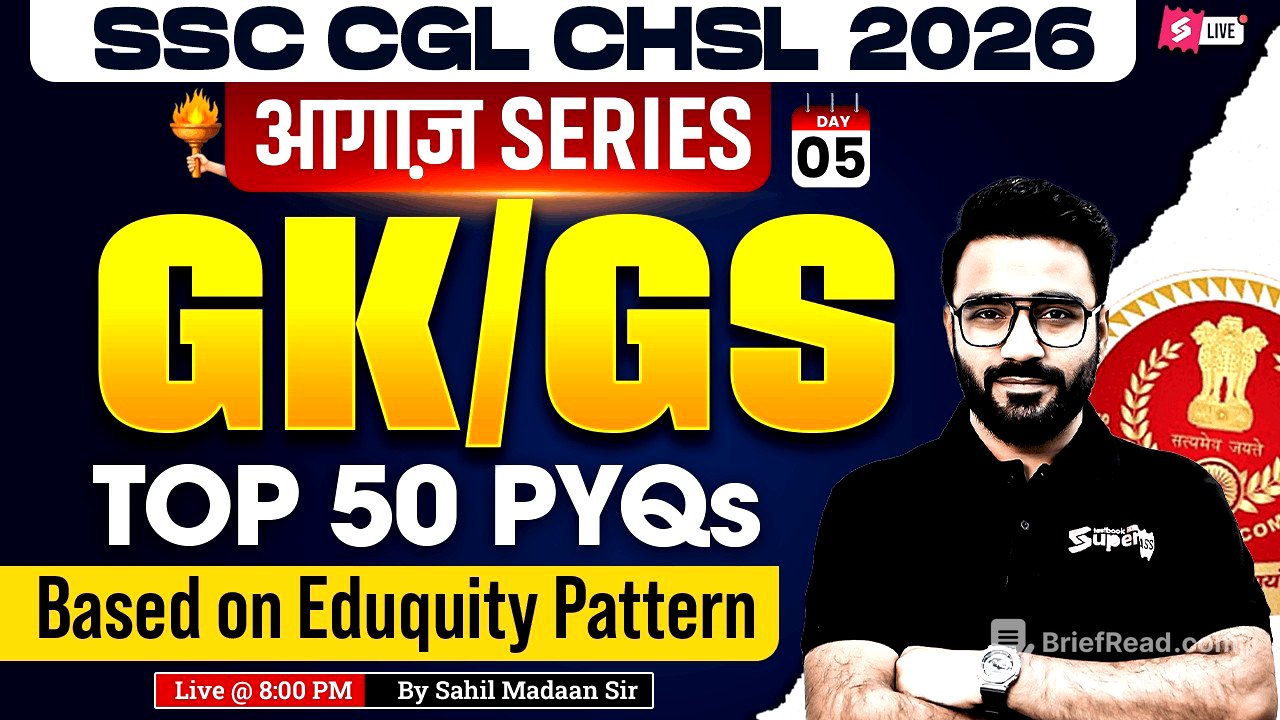
Namaste doston! This video is a power-packed session for all SSC CGL and CHSL aspirants. Sir covers important GK/GS MCQs, current affairs, and key topics. Plus, there's info on a Safalta Batch for Tier 1 & 2 prep. Key topics include the Mahanadi River, historical acts, Indian National Movement, and a detailed look at the Census of India.
- Daily GK/GS and current affairs updates
- Exam-oriented MCQs and topic discussions
- Census 2011 data and analysis
Introduction and Class Overview [0:04]
Sir welcomes everyone and outlines the daily class schedule for SSC CGL and CHSL aspirants. He conducts a GK/GS class at 8 PM, where he solves MCQs based on the exam pattern and covers one important topic daily. Additionally, he takes a current affairs class at 1 PM. Attending these classes regularly will help students ace the upcoming exams.
Safalta Batch Announcement [1:16]
Sir introduces the Safalta Batch, designed for comprehensive Tier 1 and Tier 2 exam preparation. The entire team is dedicated to teaching in this batch. Students with Superpass access can automatically access the batch, while others can enroll using the AVS coupon code for maximum discount.
Mahanadi River and Key Facts [2:03]
The first question is about the total length of the Mahanadi River, which is 851 km. The Mahanadi River originates near Raipur, Chhattisgarh, and flows through Chhattisgarh and Odisha, eventually draining into the Bay of Bengal. Its longest tributary is the Seonath. Other tributaries include Hasdeo, Mand, Ib, Jonk, Ong, and Tel. The famous Hirakud Dam is built on this river. Major cities like Raipur, Sambalpur, and Cuttack are located on the banks of the Mahanadi.
Historical Acts and Governance [4:03]
The discussion moves to historical acts, specifically which act authorized the Governor-General to override his council on matters affecting the British Empire in India. The answer is the Charter Act of 1793. Sir mentions four important Charter Acts: 1793, 1813, 1833, and 1853. He advises students to study all acts before India's independence, as questions from this area are common in exams.
Historical Figures and Dynasties [5:17]
The next question asks which ruler, after his death in 1530, left behind a newly established empire in North India. The answer is Babur.
River Systems and Geography [5:44]
The discussion shifts to river systems, asking which river is not a tributary of the Ganga but still drains into the Bay of Bengal. The answer is the Mahanadi. The Mahanadi is also known as the "Sorrow of Odisha."
Sports and Athletics Achievements [6:32]
The focus moves to sports, specifically the World Para Athletics Grand Prix 2025, where India won 134 medals, including 45 gold, 40 silver, and 49 bronze.
Holozic Nutrition [7:09]
The discussion shifts to biology, focusing on the first step in holozoic nutrition, which is ingestion. Holozoic nutrition refers to how our body gets nutrition from food. The process involves ingestion, digestion, absorption, assimilation, and egestion. This type of nutrition is commonly seen in amoeba.
International Meetings and Chairmanship [8:51]
The discussion moves to international events, specifically the 13th Governing Council Meeting of the Bay of Bengal Inter-Governmental Organization. The meeting was held in Male, Maldives, and India holds the chairmanship.
Indian Art Forms and Paintings [9:39]
The topic shifts to Indian art forms, specifically the Sora painting, which is associated with Odisha. Sir also lists other famous paintings and their states, such as Madhubani painting from Bihar, Warli painting from Maharashtra, Thangka painting from Ladakh, Sikkim, and Arunachal Pradesh, Pattachitra from Odisha, Kalamkari from Andhra Pradesh, Tanjore painting from Tamil Nadu, Pichwai painting from Rajasthan, Kangra painting from Himachal Pradesh, and mural paintings found in Ajanta (Maharashtra), Bagh Caves (Madhya Pradesh), and Tamil Nadu.
Indian People's Theatre Association [11:35]
The discussion shifts to the Indian People's Theatre Association and its role in the Indian National Movement. The association used art to express dissent.
Healthcare Initiatives and Disease Prevention [13:00]
The discussion moves to healthcare initiatives, specifically a state initiative launched in 2025 to prevent mother-to-child transmission of HIV, syphilis, and hepatitis B. West Bengal has been doing commendable work in this area.
Bhagat Singh and Batukeshwar Dutt [13:59]
The discussion shifts to the 1929 Delhi Assembly bombing case, where Bhagat Singh and Batukeshwar Dutt were involved. They threw harmless bombs in the Central Legislative Assembly in Delhi to protest the Public Safety Bill and Trade Dispute Bill. Their motive was "to make the deaf hear."
Geography - Matching [15:45]
Sir explains how to solve match-the-following questions, using the example of rock types. Granite is an igneous rock, and limestone is a sedimentary rock.
Pardoning Power of President [17:21]
The discussion shifts to the pardoning power of the President of India, as per Article 72, which allows the President to pardon even death sentences. While Article 161 grants similar powers to the Governor, only the President can fully pardon a death sentence.
Official Language and Important Articles [18:35]
The discussion moves to articles related to the official language. Article 343 declares Hindi as the official language of the Union. Sir also mentions Article 123, which gives the President the power to issue ordinances, and Article 213, which grants similar power to the Governor.
Sports Personalities and Games [19:43]
The discussion shifts to sports personalities, asking which athlete is associated with the javelin throw. The answer is Neeraj Chopra. Sir also mentions other sports personalities like Pankaj Advani (billiards/snooker), Saurabh Chaudhary (shooter), Manika Batra (table tennis), Saina Nehwal (badminton), Sania Mirza (tennis), and Virat Kohli (cricket).
Indian Dance Forms [20:46]
The topic shifts to Indian dance forms, specifically Chhau dance, which is considered a semi-classical dance form in India. It is found in the eastern part of India and has three types: Seraikela Chhau (Jharkhand), Purulia Chhau (West Bengal), and Mayurbhanj Chhau (Odisha).
Harvest Festivals [21:34]
The discussion moves to harvest festivals, specifically the Nabanna festival, which is celebrated in West Bengal, Tripura, and Assam. It is a harvest festival where people thank God for the new rice crop.
Books and Authors [22:15]
The discussion shifts to books and authors, specifically "The Yoga Sutra for Children," written by Roopa Pai.
Computer Generations [23:18]
The discussion moves to computer generations, asking which generation the transistor-based computer system belongs to. The answer is the second generation. The first generation used vacuum tubes, followed by transistors, integrated chips, microprocessors, and now artificial intelligence.
Fundamental Rights and Laws [24:31]
The discussion shifts to fundamental rights, asking which article gives Parliament the power to make laws related to fundamental rights. The answer is Article 35.
Oath of Governor [25:17]
The discussion moves to the oath of the Governor, which is covered under Article 159. Article 60 covers the oath of the President, administered by the Chief Justice of India, while the Governor's oath is administered by the Chief Justice of the High Court.
Tenure of Vice President [26:07]
The discussion shifts to the tenure of the Vice President, which is covered under Article 67. Article 63 states that there will be a Vice President, and Article 64 states that the Vice President will be the Chairman of the Rajya Sabha.
Presidential Functions [27:55]
The discussion moves to the discharge of presidential functions in unforeseen circumstances, which is addressed in Article 70.
Census of India - Introduction [29:16]
Sir introduces the next topic: the Census of India. He requests everyone to like the class and subscribe to the channel.
Census 2011 - Sex Ratio [30:22]
The first question from the Census topic is about the state with a higher number of women than men, according to the 2011 census. The answer is Kerala. India's sex ratio is 943 females per 1000 males, while Kerala has 1084 females per 1000 males. Among Union Territories, Puducherry has the highest sex ratio with 1037 females per 1000 males.
Decennial Census in India [31:12]
The discussion moves to the year when the 10-year census started in India. The answer is 1881. Although the census started in 1872, it failed. The successful decennial census started in 1881 under Viceroy Ripon.
Population Density and Distribution [32:07]
The discussion shifts to population distribution, asking about the district with the lowest population density in India. The answer is Dibang Valley in Arunachal Pradesh. The district with the highest population is Thane in Maharashtra.
Literacy Rate Disparity [32:42]
The discussion moves to literacy rates, asking about the state with the highest difference between male and female literacy rates. The answer is Rajasthan.
Literacy Rate in Kerala [33:16]
The discussion shifts to the literacy rate in Kerala during the 2011 census, which was 94%. Some states, like Himachal Pradesh, Tripura, Goa, and Mizoram, have achieved 100% literacy. Mizoram was the first to achieve this.
Overall Literacy Rate in India [34:18]
The discussion moves to the overall literacy rate in India, which is 74.04%. The male literacy rate is 82.14%, and the female literacy rate is 65.46%. Kerala has the highest literacy rate, while Bihar has the lowest at 63.82%.
Second Highest Literacy Rate [34:51]
The discussion shifts to the state with the second-highest literacy rate in the 2011 census, which is Mizoram.
First Census in India [35:12]
The discussion revisits the year of the first census in India, which was 1872.
Lowest Population State [35:28]
The discussion moves to the state with the lowest population in India, which is Sikkim.
Population and Area Table [35:43]
Sir presents a table summarizing population and area data for states and union territories:
- Population:
- Highest (State): Uttar Pradesh (UP)
- Lowest (State): Sikkim
- Highest (UT): Delhi
- Lowest (UT): Lakshadweep
- Area:
- Largest (State): Rajasthan
- Smallest (State): Goa
- Largest (UT): Ladakh
- Smallest (UT): Lakshadweep
Highest Population State [37:29]
The discussion revisits the state with the highest population, which is Uttar Pradesh (UP).
Second Largest State by Area [37:41]
The discussion shifts to the second-largest state by area, which is Madhya Pradesh (MP). The order is Rajasthan, Madhya Pradesh, Maharashtra, Uttar Pradesh, and Gujarat.
Highest Literacy Rate UT [38:11]
The discussion moves to the Union Territory with the highest literacy rate, which is Lakshadweep.
Scheduled Castes Population [38:33]
The discussion shifts to the state with the highest Scheduled Caste (SC) population, which is Uttar Pradesh (UP). Conversely, Madhya Pradesh (MP) has the highest Scheduled Tribe (ST) population.
Total Population of India (2011 Census) [39:04]
The discussion revisits the total population of India according to the 2011 census, which was 121.05 crore.
Correct Statements about Census [39:22]
Both statements are correct: the first census was conducted in 1872, and the first decennial census was conducted in 1881.
Highest Sex Ratio District [39:51]
The discussion shifts to the district with the highest sex ratio, which is Mahe district in Puducherry, with 1184 females per 1000 males.
Most Literate District [40:42]
The discussion moves to the most literate district according to the 2011 census, which is Serchhip in Mizoram.
Decade with Population Decrease [40:57]
The discussion shifts to the decade in which India's population decreased, which was from 1911 to 1921. From 1921 to 1951, the population gradually increased, and from 1951 to 1981, it skyrocketed.
Lowest Sex Ratio District [41:49]
The discussion moves to the district with the lowest sex ratio, which is Daman district in Daman and Diu, with only 533 females per 1000 males.
Budget Article [42:12]
The discussion shifts to the budget, which is mentioned in Article 112. The Finance Minister presents the budget in the Lok Sabha during the budget session.
Most Budget Presentations [42:35]
The discussion moves to the person who has presented the budget the most times in India, which is Morarji Desai. Nirmala Sitharaman has presented it nine times and could surpass him in the future.
Highest Population Growth Rate [43:00]
The discussion shifts to the state with the highest population growth rate according to the 2011 census, which is Meghalaya. Nagaland is the only state with negative population growth.
Most Densely Populated State [43:32]
The discussion moves to the most densely populated state in India, which is Bihar, with 1100 people per square kilometer. India's overall density is 382 per square kilometer. Delhi has the highest density, with 11,000 people per square kilometer.
Conclusion and Upcoming Session [44:17]
Sir concludes the Census topic and encourages viewers to like the session, subscribe to the channel, and suggest topics for future sessions. He mentions that the class is useful for SSC and railway exams. He also announces an upcoming session to discuss the SSC CGL 2026 notification and potential exam postponement.