TLDR;
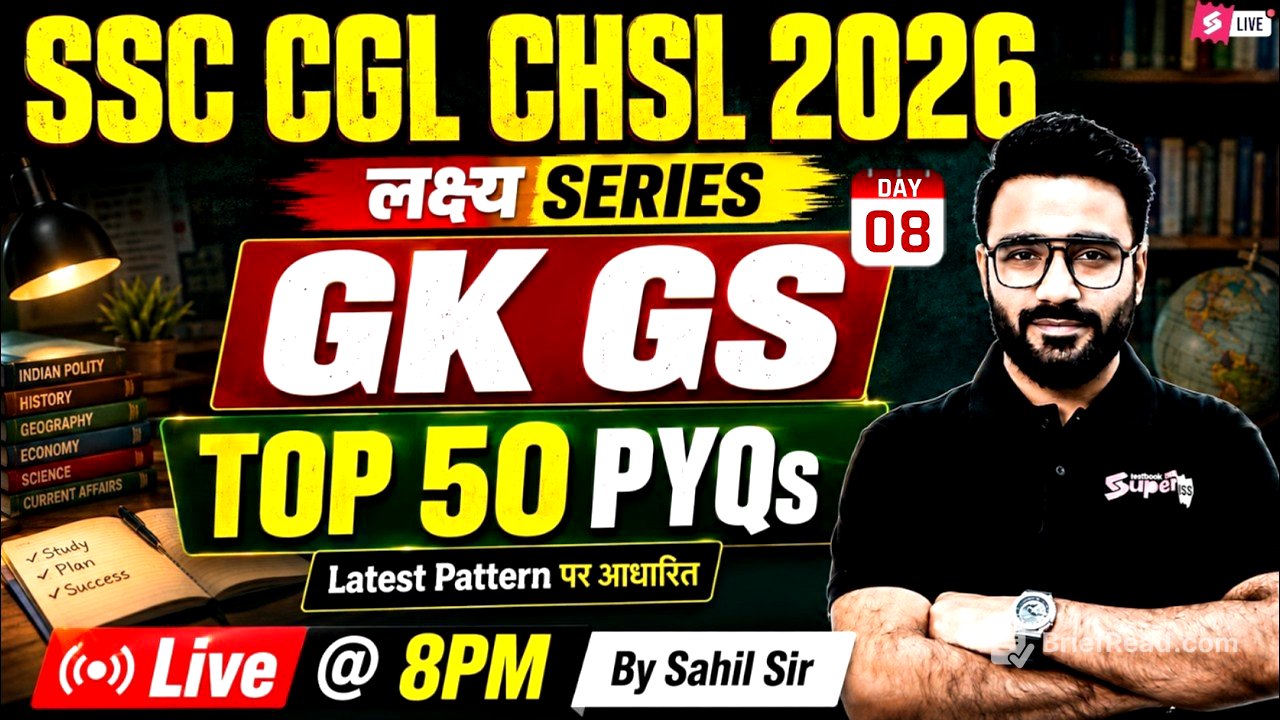
Alright, so the video is basically about cracking the SSC CGL exam with a solid strategy. Key takeaways include:
- Focus on sectional timing in prelims and tier 2.
- Utilize the 90 days effectively with hard work.
- Revise topics with MCQs and make notes.
- Join Shikhar 2.0 batch for comprehensive preparation.
CGL Notification and Exam Strategy [0:18]
The SSC CGL notification is out with over 12,000 posts. This time around, you'll have to deal with sectional timing in both tier 1 and tier 2 exams. It's crucial to prepare well, keeping in mind that there are about 90 days left for the exam. The good news is that sectional timing applies to everyone, and there's no sectional cut-off. So, buckle up and work harder than ever before to crack the CGL and CHSL exams.
Polity MCQs: Fundamental Rights and Duties [2:10]
During an emergency under Article 352, Article 20 (right to life) and Article 21 cannot be suspended. Fundamental duties are given in Part 4A of the Constitution, under Article 51A, with a total of 11 duties. 10 were added in 1976 by the 42nd amendment, and one in 2002 by the 86th amendment, based on the recommendations of the Sooran Singh and Justice Verma committees.
Polity MCQs: Religious Freedom and Equality [5:06]
Articles 25-28 deal with religious freedom, while Articles 23 and 24 cover rights against exploitation. Article 14 ensures equality before the law, borrowed from the UK, and equal protection of the law, borrowed from the USA. Article 15 prohibits discrimination, Article 17 abolishes untouchability, and Article 18 abolishes titles. Fundamental rights are in Part 3 of the Constitution, from Articles 12 to 35, and are justiciable, meaning you can approach the court for their enforcement.
Polity MCQs: Untouchability and Fundamental Rights [7:31]
Article 17 abolishes untouchability, making any discrimination based on caste or religion illegal. Part 3 of the Indian Constitution contains fundamental rights. The 42nd amendment added 10 fundamental duties, and the 86th amendment in 2002 added the 11th duty, which relates to providing education for children aged 6 to 14, a duty of their parents. The Suran Singh committee recommended adding fundamental duties to the Constitution.
Polity MCQs: Right to Freedom and Equality [11:43]
Articles 19 to 22 talk about the right to freedom, while Articles 25 to 28 cover religion. Articles 23 and 24 deal with the right against exploitation. Article 14 provides the right to equality. The President has been mentioned from 1952 to 1962.
Polity MCQs: Tahseeldar's Role and Finance Commission [14:12]
A Tahseeldar in district administration is responsible for land revenue. Article 280 discusses the Finance Commission, which is currently the 16th Finance Commission, headed by Mr. Arvind Pangariya. The Finance Commission, appointed by the President every 5 years, decides how tax is distributed between the state and the center. Article 352 talks about national emergency, Article 356 about president's rule, and Article 324 about the Election Commission. Gyanesh Kumar is the present Chief Election Commissioner of India.
Polity MCQs: Emergency Provisions and Right to Marry [17:33]
Emergency provisions were borrowed from the Government of India Act 1935, while the suspension of fundamental rights during an emergency was taken from Germany. Article 21, which talks about the right to life, includes the right to marry the person of your choice, the right to sleep, the right to privacy, and the right to digital access.
Polity MCQs: Consolidated Fund and Village Panchayat [19:27]
Article 266 discusses the Consolidated Fund of India, Article 267 covers the Contingen-cy Fund of India, and Public Account of India is mentioned in Article 266 (2). Article 40, a DPSP based on Gandhian principles, talks about the formation of village panchayats. Article 19 is about freedom, Article 21 about the right to life, Article 12 defines the state, Article 13 talks about judicial review, and Article 35 states that only the Parliament can amend fundamental rights.
Polity MCQs: National Commissions and Writ Jurisdiction [22:26]
Article 338 is for the National Commission for Scheduled Castes, Article 338A for the National Commission for Scheduled Tribes, and Article 338B for the National Commission for Backward Classes. Article 330 discusses reservation in the Lok Sabha, with 84 seats reserved for Scheduled Castes and 47 for Scheduled Tribes. The 106th amendment mentions 33% women's reservation. The High Court has the power to issue a writ under Article 226, while the Supreme Court does so under Article 32. The High Court's writ jurisdiction is wider, covering fundamental rights and other cases.
History MCQs: Swadeshi Movement and Ancient Universities [25:03]
The Swadeshi movement started in 1905, during the partition of Bengal. 1906 saw the formation of the Muslim League in Dhaka. The Surat Split, with the separation of Naram Dal and Garam Dal, happened in 1907. The Morley-Minto Reforms in 1909 introduced separate electorates for Muslims. In 1911, the Delhi court was discussed, and the partition of Bengal was cancelled, shifting the capital from Calcutta to Delhi. Nalanda University was established in Bihar by Kumar Gupta.
History MCQs: Governor Generals and Key Events [30:26]
The first Governor of Bengal was Robert Clive, the first Governor-General of Bengal was Warren Hastings, the first Governor-General of India was William Bentick, and the first Viceroy of India was Kenning. The Jallianwala Bagh massacre happened on April 13, 1919. Amar Sonar Bangla, the national anthem of Bangladesh, was written by Rabindranath Tagore, who also wrote the national anthem of India and was the first Asian to win the Nobel Prize in literature for Gitanjali.
History MCQs: Gandhi-Irwin Pact and Important Figures [33:55]
The Gandhi-Irwin pact in 1931 led to the end of the Civil Disobedience Movement and the removal of tax from salt. The book "India of My Dreams" is a collection of Mahatma Gandhi's speeches and notes. Dada Bhai Naroji, known as the Grand Old Man of India, was the President of Congress three times and wrote "Poverty and Un-British Rule in India." He was also the first Indian to become a member of the House of Commons and calculated national and per capita income for the first time.
History MCQs: Kesari Hind and Harappan Civilization [37:47]
Mahatma Gandhi was awarded the Kesari Hind title for his work in South Africa. The Harappan civilization was discovered in 1921 by Mr. Dayaram Sahni. Dr. Rajendra Prasad was called Ajat Shatru by Gandhi and became the first President of India on January 24, 1950. Gopal Krishan Gokhale was the mentor of both Mahatma Gandhi and Muhammad Ali Jinnah. Gautam Buddha was born in Lumbini, Nepal. The Victoria Memorial was built by Karzan in Calcutta.
Current Affairs MCQs: Personhood Status and Bharat Parv [41:56]
Mount Taranaki has been given the status of a personhood by New Zealand. Bharat Parv, organized on Lal Kilai around 2025, was from the Ministry of Tourism.
Current Affairs MCQs: River Blindness and Naxal Free State [43:32]
Niger became the first country in Africa to completely eliminate river blindness or Onchocerciasis. After capturing Lakshmi, a Maoist, Karnataka became a Naxal Free State.
Current Affairs MCQs: Prime Minister of Lebanon and Asian Fisheries Forum [44:48]
Nawaf Salaam was made the new Prime Minister of Lebanon, with Joseph Aung as President and Nabi Berri as Speaker of Parliament. The Asian Fisheries Forum's basic theme is greening the blue growth in the Asia Pacific, focusing on increasing fish production, employment, development, and sustainable development.
Current Affairs MCQs: BAFTA Awards and Satellite Township Scheme [46:36]
In the BAFTA awards in 2025, the movies Conclave and The Brutalist each won four awards. Karnataka launched a satellite township scheme to develop its cities and increase employment.
Current Affairs MCQs: Zonal Council Meeting and Bay of Bengal Organization [47:55]
The 27th Western Zonal Council meeting was held in Maharashtra, headed by Mr. Amit Shah, India's Home Minister. India assumed the chairmanship of the Bay of Bengal Interim Government Organization, with the meeting held in Maldives.
Shikhar 2.0 Batch and Exam Preparation [49:04]
The Shikhar 2.0 batch of CGL 2026 is starting from 28th May, covering the entire syllabus before the exam. It includes live classes, recordings, PDFs, over 2500 mock tests, previous year papers, and over 14000 practice questions. By using the discount code AVS, you can get the batch for Rs. 529, along with a free boon batch and test pass. The batch covers GK, GS, Current Affairs, Math, Reasoning, English, and Computer.