TLDR;
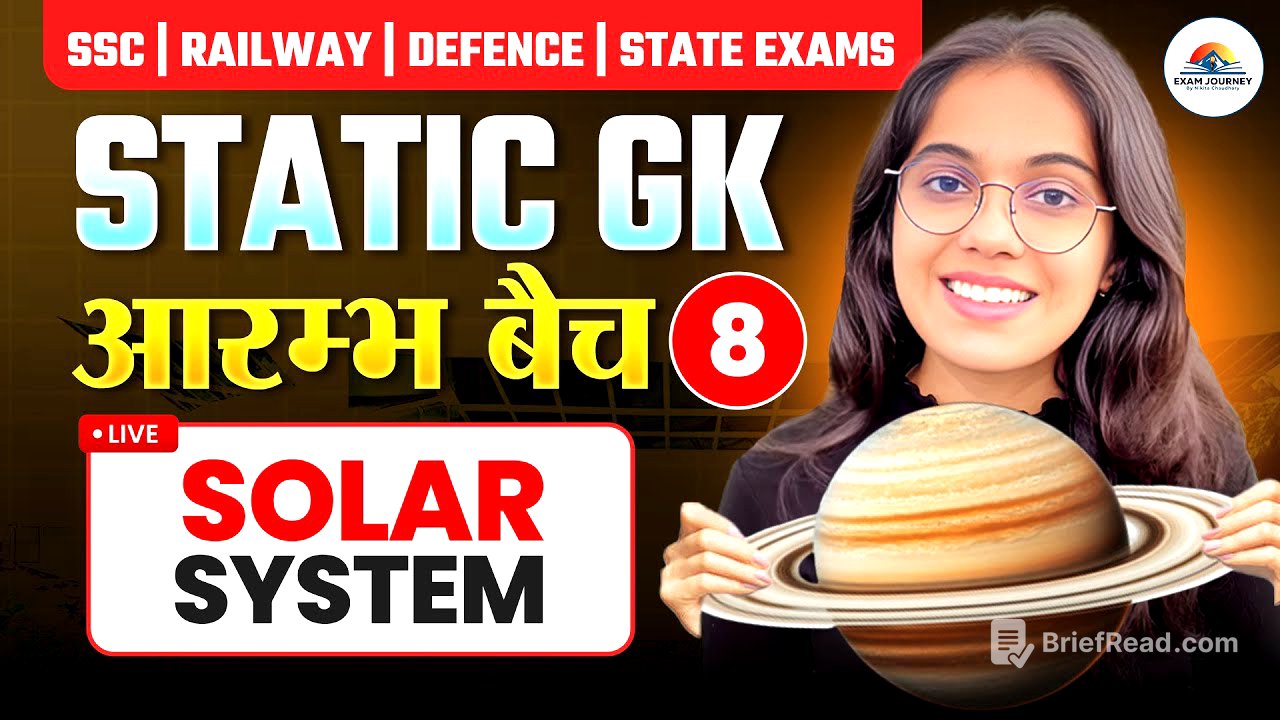
In this session, the instructor discusses the Solar System and other related astronomical concepts. Key highlights include the origins of the universe and the solar system, various planets, their characteristics, and the significant theories explaining these cosmic phenomena. The instructor also emphasizes the importance of these topics for various competitive exams.
- Overview of the Solar System
- Key theories regarding the origin of the universe
- Characteristics of each planet in our Solar System
Introduction to the Solar System [0:30]
The instructor begins the session by welcoming the audience and hoping everyone is doing well with their studies. They focus on covering Static GK relevant for various competitive exams, including UPSC and police services. The class discusses the Solar System, starting from its basic concepts, and lays the groundwork for understanding planets and cosmic structures.
Understanding the Size of the Solar System [1:30]
The instructor illustrates the scale of the Solar System, explaining that the Sun makes up 99% of the system's mass and is surrounded by eight planets. They also describe the Milky Way galaxy's structure and how our Solar System fits into the vast universe filled with billions of galaxies.
Theories of the Universe's Origin [6:15]
The discussion on the origin of the universe includes the Big Bang Theory, which suggests an initial cosmic explosion that created the universe approximately 13.6 billion years ago. The instructor also mentions the Steady State Theory, which discusses consistent density during the universe’s expansion.
Solar System Formation Theories [9:46]
The instructor introduces the Nebular Theory, proposed by Eminal Kent in 1775, later refined by Laplace. It explains how the Solar System formed from a rotating nebula, which created rings that eventually became planets. Key terminologies like "light-year" and "parsec," measuring astronomical distances, are explained.
Characteristics of Planets [14:03]
Details about the planets in the Solar System are covered. The eight planets are listed in sequence as Mercury, Venus, Earth, Mars, Jupiter, Saturn, Uranus, and Neptune. The instructor explains distinctive features such as the asteroid belt located between Mars and Jupiter and the Kuiper belt beyond Neptune.
Inner vs. Outer Planets [17:12]
The class differentiates between terrestrial (inner) planets and gaseous (outer) planets. Inner planets like Mercury and Venus are smaller and have no moons, while outer planets such as Jupiter and Saturn are larger with several moons. The distinction helps clarify their physical characteristics.
Exploring Individual Planets [23:21]
Each planet's features are discussed. Mercury is noted for its proximity to the Sun and fast revolution. Venus is considered Earth's twin due to its similar mass but is the hottest planet. Earth is highlighted as the only planet with known life and Mars is noted for its red color due to iron-rich soil.
gas giants and their attributes [30:01]
The gas giants, Jupiter and Saturn, are discussed, emphasizing their massive size, numerous moons, and unique characteristics, such as Saturn's rings. Jupiter has the most moons of any planet, while Saturn is noted for its low density. Uranus is recognized as the rolling planet due to its tilted axis.
Pluto and the Kuiper Belt [36:15]
At the end of the lesson, the instructor talks about Pluto, explaining its reclassification from a planet to a dwarf planet in 2006 based on set criteria. Pluto's position in the Kuiper belt and its physical characteristics are also covered.
Conclusion and Key Takeaways [40:00]
The session wraps up by encouraging students to prepare thoroughly for their exams. The importance of understanding these concepts for competitive exams is reiterated, along with a reminder to utilize study time effectively.